
In manufacturing, quality issues rarely come from a single failure. They build up quietly, an unchecked supplier delivery, a missed inspection during production, or a rushed validation at dispatch. Over time, these gaps lead to rework, delayed shipments, and customer complaints. This is where Odoo quality management fits naturally. Instead of treating quality as a separate activity, it embeds quality inspections directly into purchasing, production, and inventory workflows, helping manufacturers enforce consistency in how work is actually executed.
For manufacturing teams evaluating whether Odoo’s built-in quality tools are sufficient or whether a separate quality management system is required, this guide explains what Odoo realistically supports today, where it works best, and where its limits lie.
Odoo Quality Management at a glance
- Enforces quality checks at key transaction points (receipt, production, delivery)
- Blocks operational steps when inspections fail
- Links quality results directly to products, stock moves, and work orders
- Supports consistent quality control without a standalone QMS
- Best suited for small to mid-sized manufacturing operations
Why quality consistency is difficult to maintain in manufacturing
Most manufacturers understand the importance of quality. The real challenge is sustaining it consistently as operations scale.
As volumes increase, quality control processes often become fragmented. Incoming materials may be inspected inconsistently, production checks vary by operator, and approvals are handled through emails or spreadsheets. When defects surface, tracing the root cause is slow and usually reactive.
Common reasons quality consistency breaks down include:
- Inspections that rely on individual judgment rather than system enforcement
- Disconnected tools for purchasing, production, and quality control
- Inconsistent inspection practices across shifts or locations
- Limited visibility into recurring defects or supplier-related issues
The result is higher scrap rates, more rework, delayed deliveries, and stressful audits. Over time, quality issues stop being exceptions and become part of daily operations creating long-term risk.
What is Odoo Quality Management?
Odoo Quality Management is not a standalone quality management system. It operates entirely within Odoo’s manufacturing ERP and depends on real operational events.
Quality checks are triggered only when specific transactions occur, such as:
- Validating a goods receipt
- Completing a production work order
- Validating a delivery or internal transfer
Because quality inspections are tied directly to these actions, they become part of daily execution rather than an extra process layer. Inspection results, failures, and follow-up actions are linked to products, stock moves, work orders, lot or serial numbers, and suppliers creating a single operational source of truth.
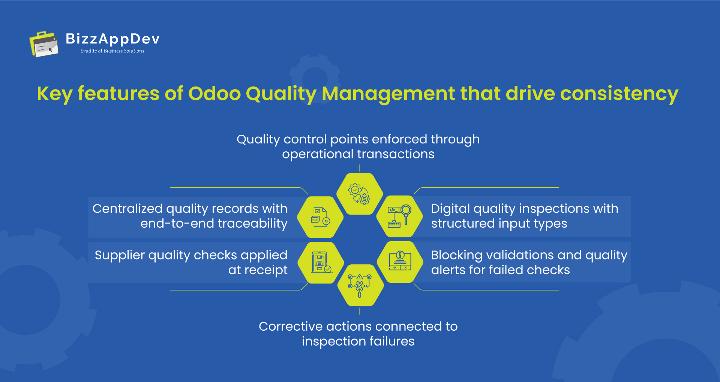
Key features of Odoo Quality Management that drive consistency
Odoo’s approach to quality focuses on transaction-level enforcement, not complex approval hierarchies or heavy statistical analysis.
Quality control points enforced through operational transactions
Quality control points define where inspections must occur during goods receipt, at specific production steps, or before delivery validation. Each control point is tied to an operational trigger such as a receipt, work order, or picking.
Inspections only appear when the related transaction is performed. This ensures checks happen at the right moment and cannot be bypassed unintentionally.
Digital quality inspections with structured input types
Odoo supports several inspection methods, including pass/fail checks, numeric measurements, text observations, and selection lists. These inspection types cover most manufacturing quality control processes.
Operators receive clear instructions and structured input fields, reducing ambiguity and ensuring inspections are performed consistently. While Odoo does not include native statistical process control tools, it provides reliable, standardized inspection execution.
Blocking validations and quality alerts for failed checks
When a quality inspection fails, Odoo can block the related transaction preventing receipt validation, work order completion, or delivery confirmation until the issue is addressed.
Quality alerts can also be created and assigned to responsible users. Odoo does not include native multi-level approval workflows; instead, it emphasizes blocking incorrect actions and making exceptions visible and traceable.
Corrective actions connected to inspection failures
Failed inspections can result in operational follow-up actions such as scrap orders, repair orders, or quality alerts. These actions remain linked to the original inspection, helping teams understand what went wrong and how it was resolved.
While Odoo does not provide a formal CAPA lifecycle module, this linkage supports continuous improvement by highlighting recurring quality issues.
Supplier quality checks areare applied at receipt
Supplier quality control in Odoo is enforced at the goods receipt stage. Quality rules can be configured so that specific products or vendors require inspection when materials arrive.
This prevents defective materials from entering production and builds historical insight into supplier quality performance without complicating purchase order workflows.
Centralized quality records with end-to-end traceability
All quality inspections, results, and corrective actions are stored centrally and linked to operational documents such as stock moves, work orders, and lot or serial numbers.
This structure supports production traceability and simplifies audits, even though reporting remains primarily operational rather than analytical.
How Odoo enforces quality through inventory and production transactions
Odoo Quality Management is enforced through inventory and manufacturing transactions, not separate review processes.
A failed inspection can:
- Prevent stock from becoming available for use
- Block completion of a production step
- Stop delivery validation until the issue is resolved
Because quality checks are embedded in these workflows, teams maintain stronger control across the Odoo inventory process and reduce the risk of using or shipping unapproved materials.
How Odoo Quality Management improves daily manufacturing operations
Earlier defect detection
Inspections at receipt and during production catch issues before value is added, reducing rework and limiting defect propagation.
Clear accountability and audit readiness
Each inspection records who performed it, when it occurred, and the outcome. This creates a reliable audit trail without relying on external documentation.
Better coordination across teams
Purchasing, production, and warehouse teams share the same quality data, making it easier to identify whether issues originate from suppliers, processes, or handling.
Real-world manufacturing use cases
Discrete manufacturing
Quality checks tied to routing steps help prevent defective components from moving into final assembly, where corrections are more costly.
Batch and process manufacturing
For batch-based production, lot-linked inspections help maintain consistency and reduce risk in safety- or compliance-sensitive environments.
Multi-vendor sourcing environments
Receipt-based inspections reveal supplier quality patterns over time, supporting better sourcing and vendor management decisions.
When Odoo Quality Management is the right fit
Odoo Quality Management is best suited for manufacturers that want quality embedded into their ERP rather than managed through a separate system.
It works well for organizations that:
- Need consistent quality inspections across teams and locations
- Want enforcement at the transaction level
- Prefer operational simplicity over complex quality administration
For businesses requiring advanced SPC, formal CAPA workflows, or highly specialized regulatory reporting, additional tools or extensions may be required.
Implementation considerations that matter
Defining meaningful quality control points
Quality checks should be mapped carefully to products, operations, work centers, and locations. Too many inspections slow operations; too few reduce effectiveness.
Supporting shop-floor adoption
Clear instructions and simple inspection steps are essential. Many organizations rely on structured Odoo implementation services to align quality workflows with real operational practices.
Adapting quality processes as operations evolve
As products, suppliers, and volumes change, quality rules often need refinement. Targeted Odoo customization services can help adapt workflows without disrupting core operations.
Making quality part of everyday execution
Odoo Quality Management is not designed to replace specialized quality management systems. Its strength lies in embedding quality control into everyday manufacturing transactions.
By enforcing inspections at the right operational moments and keeping quality data connected to real workflows, Odoo helps manufacturers move from reactive quality control toward consistent, predictable execution without adding unnecessary complexity.
Want to see how Odoo quality management can bring consistency to your manufacturing workflows?
Start by evaluating where quality breakdowns really occur.
FAQs
It is used to enforce quality inspections during inventory and manufacturing transactions to maintain consistent operational standards.
Yes. It supports inspections during goods receipt, production steps, and delivery validation.
Supplier quality checks are enforced during goods receipt to identify issues before materials enter production.
Yes. All inspections and outcomes are recorded and linked to operational documents for traceability.
No. It operates entirely within Odoo’s ERP workflows and depends on transactional events.