
Odoo helps transport companies track delivery performance by capturing real operational timestamps and comparing planned versus actual delivery outcomes. While it does not include a native SLA engine, configurable workflows, delivery analysis reports, and dashboards provide practical SLA visibility when set up correctly.
For transport and logistics companies, delivery performance is not just an operational metric, it’s a promise made to customers. Missed delivery windows, unclear handovers, or delayed responses to exceptions quickly turn into customer complaints, penalties, and strained vendor relationships. As operations grow, many teams realise that spreadsheets and disconnected systems can no longer keep up.
This is where Odoo for Transport Companies becomes part of the conversation. Not as a silver bullet, but as a practical ERP platform that helps teams capture delivery reality, monitor performance trends, and bring more structure to SLA management. The real value lies in visibility knowing what’s happening, when it’s happening, and why, using operational data rather than assumptions.
This article explains how transport companies can realistically use Odoo to track delivery performance, manage SLA expectations, and improve accountability, along with the limitations to be aware of before adopting it.
Why Delivery Performance and SLA Compliance Matter in Transport
In transport operations, SLAs are often tied to customer trust and long-term contracts. Whether it’s same-day delivery, fixed delivery windows, or penalty-backed commitments, performance expectations are usually clear on paper, but harder to enforce consistently.
Common challenges include:
- Delivery status updates arriving late or inconsistently
- No single view of planned versus actual delivery times
- Manual follow-ups when delays occur
- Limited data to justify whether an SLA breach was avoidable
When these gaps exist, teams end up reacting instead of managing proactively. Operations managers chase updates, finance teams struggle to validate penalties, and leadership lacks reliable data to improve routes or renegotiate terms.
A system that captures delivery events as part of daily operations and compares them against planned timelines changes that dynamic. It moves performance tracking from hindsight to informed decision-making.
How Odoo Supports Transport and Logistics Operations
Odoo works well for transport companies because it is modular and process driven. Instead of forcing rigid workflows, it allows teams to model how deliveries actually happen, from order creation to dispatch and final confirmation.
At a practical level, Odoo connects:
- Customer orders and delivery commitments
- Dispatch and inventory movements
- Transporters, routes, and vehicles
- Delivery confirmations and exceptions
- Reporting and analysis
All of this lives in a single database. This matters because delivery performance is measured using operational timestamps, not manual reports created after the fact.
Section summary: Odoo provides a unified operational data model that makes delivery performance measurable using real execution data.
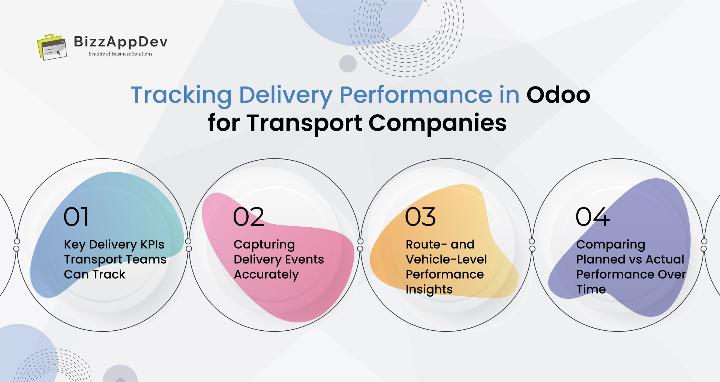
Tracking Delivery Performance in Odoo for Transport Companies
Delivery performance tracking in Odoo starts with capturing the right operational events. Odoo does not assume how a delivery should work; instead, it records what happens during execution.
Key Delivery KPIs Transport Teams Can Track
Once delivery data is structured, transport teams can track KPIs such as:
- On-time delivery rate (scheduled vs completed)
- Average delivery delay
- Delivery variance (planned vs actual date/time)
- Exception frequency by route, vehicle, or carrier
- Cost impact of delayed deliveries
These metrics help teams identify patterns instead of treating delays as isolated incidents.
Capturing Delivery Events Accurately
The quality of delivery performance data depends on consistent event capture. In Odoo, timestamps are recorded through operational actions such as:
- Delivery validation in Inventory
- Transport start and completion via transport entries
- Exception logging during execution
Clear milestone definitions such as “dispatched,” “in transit,” and “delivered” are essential. Without process discipline, even accurate systems produce unreliable insights.
Route- and Vehicle-Level Performance Insights
By grouping deliveries by route, transporter, or vehicle, Odoo enables teams to identify recurring bottlenecks. These insights often highlight unrealistic schedules, traffic-heavy routes, or vehicle capacity constraints, supporting better planning decisions.
Comparing Planned vs Actual Performance Over Time
Using Delivery Analysis reports, teams can compare scheduled delivery dates with actual completion dates across weeks or months. This historical view helps distinguish one-off delays from systemic issues and supports more realistic delivery commitments.
Section summary: Odoo tracks delivery performance by comparing planned and actual execution data across orders, routes, vehicles, and carriers.
How Transport Companies Actually Track SLAs in Odoo
It’s important to be clear: Odoo does not include a dedicated, out-of-the-box SLA engine for transport operations. SLA management is achieved through delivery analysis, configurable workflows, and structured reporting.
Managing Delivery Performance in Odoo (SLA Reality Explained)
Defining SLA Expectations Within Operations
SLA expectations are typically reflected through planned delivery dates, cut-off times, or agreed delivery windows stored on orders or deliveries. These values act as reference points for performance measurement.
Monitoring Delays Using Configurable Alerts
Odoo allows teams to configure automated actions that trigger alerts when deliveries are completed after their scheduled dates. These alerts help surface SLA risks early but require setup—they are not automatic by default.
Approval Flows for Delivery Exceptions
Not all delays are equal. Weather conditions, vehicle breakdowns, or customer-side issues require different handling. Odoo workflows allow exceptions to be reviewed, approved, and categorised, creating an audit trail for internal and external discussions.
SLA Performance Reviews and Continuous Improvement
Rather than real-time SLA enforcement, many transport companies use Odoo for periodic SLA reviews. Delivery Analysis reports and spreadsheet dashboards consolidate breach frequency, delay reasons, and resolution timelines.
Section summary: Odoo supports SLA tracking through delivery analysis and configurable workflows not native SLA automation.
Odoo Transport Management System (TMS) Capabilities
Odoo’s Transport Management System (TMS) module adds transport-specific functionality that strengthens delivery tracking.
Key capabilities include:
- Automatic transport entry creation from validated deliveries
- Transporter and route configuration
- Shipment status tracking with timestamps
- LR numbers, parcel details, and tracking numbers
- Vehicle assignment per transporter
These features allow shipments to be tracked as structured operational records rather than informal updates.
Section summary: The TMS module provides transport-specific execution and tracking data essential for delivery performance analysis.
Vendor and Carrier Performance Visibility
Odoo links carriers directly to delivery outcomes, enabling objective performance tracking. Teams can analyse:
- On-time delivery performance by transporter
- Delivery delays by route or contract
- Long-term performance trends
This data supports clearer vendor accountability and more fact-based negotiations.
Reporting and Dashboards for Transport Decision-Makers
Odoo includes native delivery analysis reports that show:
- Scheduled vs actual delivery completion
- Carrier and route performance
- Delay trends over time
These reports can be extended using spreadsheet dashboards for SLA visualisation. While there is no out-of-the-box SLA breach dashboard, structured reporting provides actionable visibility.
Practical Implementation Considerations
Success with Odoo depends on clear processes and disciplined data capture.
Key considerations include:
- Standardising delivery milestones
- Training teams to record events consistently
- Deciding where automation adds value versus manual review
Many organisations work with experienced partners during their Odoo implementation to align system configuration with real operational needs.
In some cases, additional workflows or reports are required. Carefully scoped Odoo customization services can address these gaps without overengineering the system.
Is Odoo the Right Fit for Your Transport Business?
Odoo suits transport companies seeking delivery visibility and structured performance tracking without excessive system complexity. It works best for organisations that:
- Are outgrowing spreadsheets
- Want clearer delivery accountability
- Need data-backed carrier insights
However, it requires realistic expectations. Odoo captures delivery reality exceptionally well, but SLA enforcement depends on configuration and process maturity.
Final Thoughts
Tracking delivery performance and managing SLA expectations does not require overly complex systems, but it does require accurate data and clear processes. Odoo provides a solid foundation by capturing delivery reality and making performance visible.
For transport companies willing to invest in disciplined execution, Odoo becomes less about automation promises and more about operational clarity. Starting with delivery performance is often the most practical step toward stronger service reliability and informed decision-making.
Ready to evaluate if Odoo fits your transport operations?
Explore how delivery tracking and SLA visibility can work in your real workflows before committing to an ERP change.
FAQs
Yes. Odoo compares scheduled and actual delivery dates using operational timestamps.
No. SLA tracking is achieved through delivery analysis, alerts, and reporting.
Yes. Transporters can be linked directly to deliveries for performance tracking.
Not always. Basic monitoring works through configuration; complex logic may require extensions.