
Managing multiple companies, subsidiaries, branches, or warehouses inside one ERP system sounds efficient, until operational complexity begins to slow decisions, distort reporting, and increase compliance risk. Many growing organizations outgrow basic ERP setups when coordinating data, processes, and finances across entities. This is where Odoo Customization becomes critical. With the right configuration and targeted enhancements, Odoo can manage operations for multiple legal entities and locations within a single system while keeping legal, financial, and tax responsibilities separate.
In short: Odoo supports multi-company and multi-location operations natively, but complex structures, such as holding companies, distributed supply chains, or shared service models, often require customization to handle intercompany transactions, governance, and consolidated reporting effectively.
In real implementations, most multi-company challenges stem from process differences between entities rather than software limitations. A critical concept in Odoo is that some master data, such as contacts and products, can be shared across companies if configured that way, although certain fields, including accounting properties and taxes, remain company-dependent. Proper configuration of company contexts, intercompany rules, pricing, taxes, and access rights is essential before considering customization.
Why Is Multi-Company and Multi-Location ERP Management So Complex?
Operating multiple entities is not simply scaling one business model. Each company or branch may follow different regulations, workflows, currencies, and performance targets.
Common challenges include:
- Fragmented data across legal entities
- Manual intercompany transactions and reconciliations
- Limited inventory visibility across warehouses
- Different tax and compliance requirements
- Inconsistent reporting structures
- Complex approval hierarchies
Without a unified system, teams often rely on spreadsheets or disconnected tools, which slows decision-making and increases the likelihood of costly errors.
How Odoo Handles Multi-Company Management
Odoo is designed to support multiple companies within a single database while maintaining clear separation between them.
Key capabilities include:
- Multiple legal entities in one system
- Shared or company-specific master data
- Independent accounting per company
- Automated intercompany workflows (when configured)
- Multi-currency support
- Consolidated reporting options (depending on configuration and consolidation features)
- Role-based access control
This architecture allows organizations to centralize operations without merging financial identities.
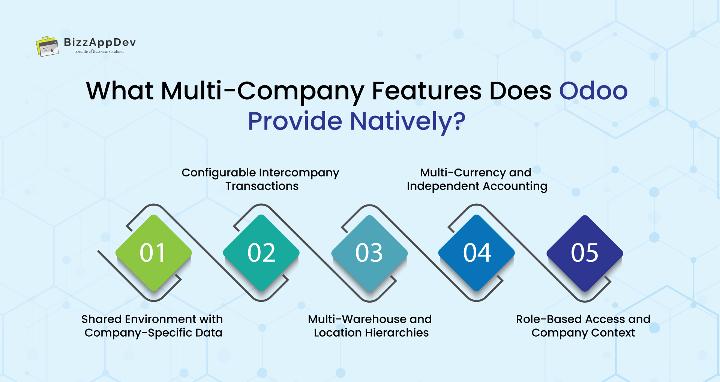
What Multi-Company Features Does Odoo Provide Natively?
Shared Environment with Company-Specific Data
Organizations can manage several legal entities in one system. Some master data (e.g., products, contacts) may be shared, while financial data, journals, taxes, and policies remain company-specific.
Users may access one or multiple companies and switch between them. Accounting entries are recorded within the active company context, although consolidated reports can aggregate data across companies when properly configured.
Configurable Intercompany Transactions
Odoo can automate transactions between companies, for example, generating a purchase order in one company from a sales order in another. However, this requires explicit configuration.
Automation depends on:
- Enabled intercompany rules
- Compatible product records
- Proper partner setup
- Aligned pricing and tax structures
- Matching currencies and accounting configurations
Each company typically needs to be configured as a customer and supplier of the other to enable intercompany flows.
Without alignment, automation will not function correctly.
Appropriate journals and fiscal settings must also be defined in each company to ensure transactions post correctly.
Operational constraints such as stock availability, lead times, and procurement rules also affect how intercompany transactions execute in practice.
Multi-Warehouse and Location Hierarchies
Odoo supports complex inventory structures, including:
- Central distribution centers
- Regional warehouses
- Store locations
- Transit locations
These structures enable visibility into stock movement across facilities and regions.
Multi-Currency and Independent Accounting
Each company maintains its own accounting settings, fiscal positions, and currencies while operating within a shared system.
Role-Based Access and Company Context
Access rights determine which companies and records a user can view or modify. Users may belong to multiple companies simultaneously, but visibility is governed by permissions, company context, and record rules.
Key takeaway: Standard features are powerful when business processes across entities are aligned.
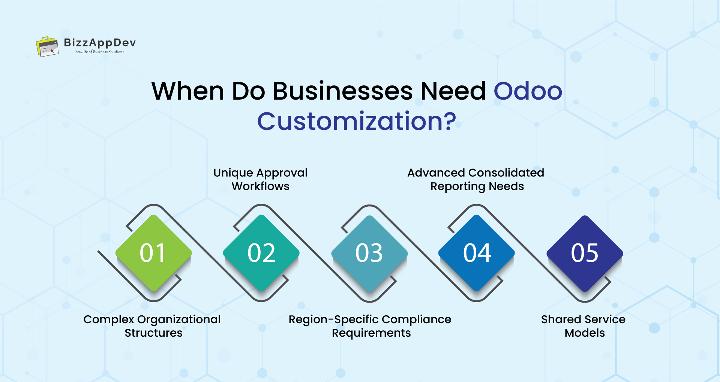
When Do Businesses Need Odoo Customization?
As organizations grow, differences between entities often exceed what configuration alone can support. Targeted Odoo Customization becomes valuable when standard functionality cannot reflect real operational needs.
Complex Organizational Structures
Holding companies, franchise networks, joint ventures, and shared ownership models often require custom logic for governance and reporting.
Unique Approval Workflows
Odoo provides approval tools, but cross-company approval chains, such as centralized capital expenditure approvals, typically require additional configuration or customization.
Region-Specific Compliance Requirements
Different jurisdictions may require specialized reporting formats, tax treatments, or audit controls beyond standard settings.
Advanced Consolidated Reporting Needs
Odoo can generate consolidated views, but accurate group reporting depends on aligned charts of accounts, elimination rules, and consistent accounting policies. Companies must also use compatible charts of accounts and fiscal structures for meaningful consolidation.
Shared Service Models
Centralized HR, finance, or procurement teams supporting multiple companies often require specialized permissions and allocation mechanisms.
Where Does Odoo Customization Deliver the Most Value?
Customization should solve real operational problems, not cosmetic preferences.
Organizational Structure Alignment
Customized configurations can support:
- Parent–subsidiary relationships
- Franchise operations
- Joint ventures
- Internal cost allocations
This ensures transactions reflect actual governance structures.
Inventory and Supply Chain Optimization
Multi-location operations often require advanced rules such as:
- Coordinated replenishment across warehouses
- Priority fulfillment locations
- Central purchasing with distributed delivery
- Regional stock policies
Cross-company stock movements typically occur through intercompany sales/purchase flows or transit locations rather than simple internal transfers.
Standard internal transfers apply only within a single company. Movements between companies represent a change of ownership and therefore require commercial transactions. These transactions typically generate corresponding accounting entries in each company. The financial impact of these movements depends on each company’s inventory valuation method and transfer pricing policies.
Financial Consolidation and Compliance
Group-level reporting often involves:
- Eliminating intercompany transactions
- Standardizing accounting structures
- Producing consolidated financial statements
- Maintaining audit-ready records
Highly complex multinational organizations may require additional tools, especially when dealing with multiple accounting standards, currencies, or statutory reporting requirements.
Some advanced consolidation scenarios may require additional configuration or specialized modules.
Native consolidation features apply to companies within the same database; consolidating entities across separate databases typically requires additional tools or integrations.
Access Control and Data Governance
Segregation of duties is critical in multi-entity environments. Custom rules can ensure sensitive financial or operational data is accessible only to appropriate users.
Organizations pursuing the best Odoo customization approach focus on scalability, governance, and long-term maintainability rather than short-term fixes.
Data visibility is enforced through company context settings and record rules that control access to company-specific data.
Real-World Multi-Company Use Cases
Manufacturing Groups
Multiple plants may share suppliers and products but operate independently. Centralized procurement combined with plant-level accounting improves efficiency without sacrificing control.
Retail Chains
Head offices manage purchasing and pricing while stores handle sales. Multi-location visibility supports better stock allocation and demand planning.
Logistics and Distribution Networks
Companies with geographically distributed warehouses benefit from real-time tracking of inventory flows and capacity utilization.
Service Organizations
Firms operating multiple legal entities can centralize financial oversight while maintaining operational autonomy for each business unit.
Best Practices for Implementing Multi-Company Odoo Solutions
Successful deployments prioritize architecture and governance before customization.
Configure First, Customize Second
Many requirements can be addressed through standard settings. Customization should focus on genuine functional gaps.
Design for Future Growth
Consider expansion plans, acquisitions, and new business units to avoid costly redesign later.
Standardize Core Processes
Align workflows across entities wherever practical to reduce complexity and training requirements.
Establish Strong Data Governance
Define ownership, approval authority, and security policies early. Weak governance undermines system reliability.
Engage Experienced Implementation Experts
Multi-company ERP design requires deep expertise. Organizations often work with specialists in Odoo implementation to analyze processes and design scalable solutions.
What Are the Risks of a Poor Multi-Company ERP Setup?
An inadequate architecture can create long-term operational problems.
Key risks include:
- Inaccurate financial reporting
- Compliance and audit exposure
- Duplicate or inconsistent data
- Inefficient intercompany processes
- Upgrade and scalability challenges
Fixing structural issues after deployment is far more disruptive than addressing them early.
Business Benefits of a Well-Customized Odoo Environment
When properly configured and enhanced, a unified system becomes a strategic asset.
Unified Visibility Across the Organization
Leadership can gain consolidated insights across companies when data structures, policies, and reporting configurations are aligned.
Improved Operational Efficiency
Automation reduces manual work, delays, and errors across departments.
Lower Technology Complexity
Maintaining one integrated platform is typically more efficient than managing multiple disconnected systems.
Scalable Foundation for Growth
New companies or locations can be added without rebuilding the system architecture.
Many organizations also use Odoo integration services to connect external platforms while respecting company boundaries and data ownership rules.
Is Odoo Customization Necessary for Your Business?
Customization is most valuable when complexity creates operational friction or limits visibility.
You may benefit if your organization has:
- Multiple legal entities with different policies
- Distributed warehouses or branches
- Complex approval structures
- Consolidated reporting requirements
- Shared service functions
- Expansion plans
Organizations with simple, uniform operations may achieve excellent results using standard features alone.
Key Takeaways
- Odoo supports multi-company operations within a single system
- Legal entities remain financially independent
- Configuration handles many requirements
- Customization is needed for complex structures
- Governance and alignment are critical for success
- Proper setup enables scalable growth
Conclusion: Turning Multi-Entity Complexity into Strategic Control
Managing multiple companies and locations does not have to mean juggling disconnected systems or manual processes. With careful planning, disciplined configuration, and targeted Odoo Customization, organizations can operate as a unified enterprise while preserving the independence of each entity.
The key is balance: leverage built-in capabilities wherever possible, customize only where it delivers measurable value, and design for governance and scalability from the start. When implemented correctly, Odoo becomes a reliable single source of truth that supports growth, compliance, and operational efficiency across the entire organization.
If you are evaluating how to structure a multi-entity ERP environment, a structured assessment can help determine which needs can be addressed through configuration and where customization will deliver the greatest long-term impact.
Need clarity on managing multiple companies or locations in Odoo?
Request a personalized assessment to identify the right configuration and customization strategy for your business.