
Manufacturers dealing with multi-stage processes, custom products, and fluctuating demand often wonder whether Odoo Manufacturing ERP can truly support complex production. Choosing the wrong system can disrupt operations, inflate costs, and limit growth for years. Odoo has gained popularity for being flexible and cost-effective, but decision-makers still ask a critical question: can it handle real-world manufacturing complexity, not just basic assembly?
This guide provides a clear, practical evaluation of how Odoo performs in demanding production environments, including strengths, limitations, and ideal use cases, so you can determine whether it’s the right ERP for your operations.
Quick answer: Odoo Manufacturing ERP can handle most complex production scenarios for SMEs and mid-market manufacturers, especially those requiring flexibility, customization, and integrated operations. However, extremely large-scale or highly specialized environments may require additional tools or enterprise systems.
In short: Odoo is powerful enough for most complex discrete manufacturing environments but is not designed to replace highly specialized enterprise planning or automation platforms.
Odoo Manufacturing ERP provides comprehensive capabilities for multi-level production, capacity-aware scheduling, subcontracting, quality management, maintenance integration, and real-time operational visibility within a unified platform. It is particularly well suited for discrete manufacturers and growing enterprises that require end-to-end coordination without the cost and rigidity of traditional enterprise systems.
Key Takeaways
- Supports complex multi-level production and custom workflows
- Strong fit for SMEs and mid-market manufacturers
- Fully integrated platform across departments
- Highly adaptable to engineer-to-order and make-to-order models
- Cost-effective alternative to traditional enterprise ERPs
- Not ideal for extreme scale or advanced optimization environments
What Defines “Complex Production” in Modern Manufacturing?
“Complex” means different things depending on the business. For most mid-market manufacturers, complexity arises from a combination of product variation, process depth, planning uncertainty, and organizational scale.
Product complexity involves configurable or custom items, multi-level assemblies, or engineer-to-order designs. Each order may require unique specifications, drawings, or materials.
Process complexity includes multi-stage routing, parallel operations, rework loops, or dependencies between machines and teams. Production rarely follows a straight line.
Planning complexity emerges when demand is unpredictable, lead times vary, or capacity constraints must be balanced continuously.
Organizational complexity appears in multi-site operations, subcontracting networks, or distributed warehouses.
An effective manufacturing ERP must coordinate all these variables without slowing down the shop floor while maintaining visibility and control.
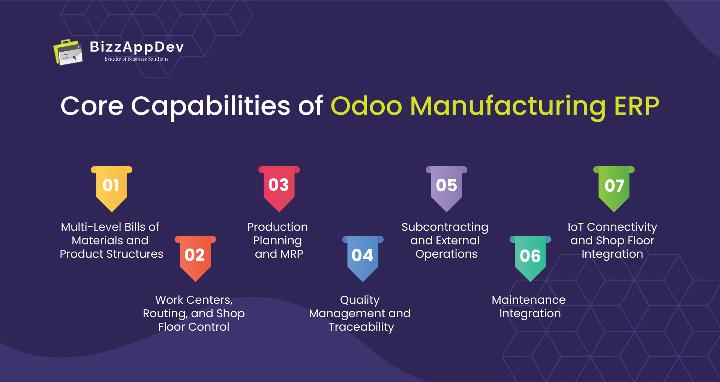
Core Capabilities of Odoo Manufacturing ERP
Odoo’s manufacturing module is built around integrated planning, execution, and inventory control within a unified business platform. Production is tightly connected with purchasing, sales, quality, maintenance, and accounting, eliminating data silos that often cause delays and costly errors.
Multi-Level Bills of Materials and Product Structures
Odoo supports multi-level BoMs, including subassemblies, phantom assemblies, variant-specific structures, by-products, and alternative components. This allows manufacturers to model complex products accurately.
Engineering changes can be managed through formal Engineering Change Orders (ECOs), particularly when product lifecycle management features are enabled. Variant-specific BoMs linked to product attributes help handle configurable products efficiently.
While not equivalent to dedicated enterprise PLM systems, the built-in capabilities are sufficient for most mid-market product development workflows.
For organizations transitioning from manual systems, accurate data migration is essential, often requiring structured Odoo implementation planning to reflect real production practices.
Work Centers, Routing, and Shop Floor Control
Odoo tracks operations by work center, providing real-time visibility into workloads, progress, and delays.
Operators can record production through tablet-friendly interfaces. Time tracking, machine usage, worksheets, and completion data feed directly into planning and costing.
Work orders can include instructions, checklists, and technical documents, ensuring consistent execution on the shop floor.
Production Planning and MRP
Material Requirements Planning calculates material needs based on forecasts, confirmed orders, lead times, and stock levels, automatically generating procurement or manufacturing orders.
The system supports forward production planning using demand forecasts, reordering rules, and planning tools.
Odoo provides capacity-aware scheduling based on work center availability, though it does not perform advanced finite constraint optimization found in specialized planning systems
Make-to-stock, make-to-order, and hybrid strategies are supported. Production can be triggered directly by sales orders in MTO scenarios, reducing manual planning.
Operation-level lead times and dependencies allow realistic sequencing across work centers. Replenishment rules and routes determine how and when products are manufactured, purchased, or transferred, enabling automated planning aligned with inventory policies.
Quality Management and Traceability
Quality control points can be configured at receiving, during production, or at final inspection stages.
Lot and serial tracking provide full traceability across the supply chain. Traceability reports allow manufacturers to track components from supplier to finished product and vice versa, which is essential for recalls and compliance.
Failed quality checks can block progression until issues are resolved, maintaining process integrity.
Subcontracting and External Operations
Odoo manages subcontracting by tracking materials sent to vendors, external operations performed, and finished goods returned.
Both company-supplied and vendor-supplied component models are supported. Subcontracted operations can be integrated into multi-level product structures.
Inventory ownership, valuation, and logistics movements to and from subcontractors are recorded automatically, ensuring accurate financial and operational visibility. Subcontracted components can themselves contain subassemblies, allowing multi-tier supply chains to be modeled. Materials can be supplied directly to subcontractors or shipped from company inventory, supporting various outsourcing models.
Maintenance Integration
Preventive maintenance (rather than predictive analytics-driven maintenance) can be scheduled based on time or equipment usage. Maintenance activities linked to equipment used in work centers help reduce downtime and support reliable scheduling.
IoT Connectivity and Shop Floor Integration
Odoo’s IoT framework connects devices such as barcode scanners, printers, scales, and sensors.
While not a full manufacturing execution system (MES), it supports automated data capture and device triggers and can integrate with external MES platforms for advanced automation.
Hardware integration typically requires an IoT Box or compatible configuration to connect devices securely. The IoT framework focuses on data capture and device interaction rather than direct machine control.
Where Odoo Excels for Complex Production
Odoo stands out in areas that matter most to growing manufacturers: adaptability, visibility, and cost efficiency.
Adaptability to Unique Processes
Manufacturing rarely fits standardized templates. Odoo’s modular architecture allows workflows to be tailored without rebuilding the system.
Low-code tools enable many changes without custom development, while the open framework supports deeper extensions. Organizations often enhance functionality through Odoo customization services to meet industry-specific needs.
Additional modules can be activated as requirements evolve, supporting long-term scalability. Low-code tools such as visual customization interfaces allow many workflow changes without development.
Real-Time End-to-End Visibility
Because all departments operate on a single platform, managers can view material availability, production status, delivery commitments, and financial impact in real time.
This unified visibility reduces firefighting and improves coordination across teams.
Cost Efficiency Compared to Enterprise Systems
Traditional enterprise manufacturing ERPs often require substantial investment and lengthy deployment timelines. Odoo delivers comparable capabilities for many use cases at a significantly lower total cost of ownership.
Unified Data Model Across Departments
All modules share one database, eliminating synchronization challenges. A confirmed sales order can automatically trigger procurement and production activities.
Limitations to Consider for Highly Advanced Manufacturing
No ERP is ideal for every scenario.
- Advanced constraint-based scheduling may require specialized tools
- Extremely large global operations need careful architecture
- Automation-heavy plants may still require MES platforms
- Highly regulated industries may need additional compliance processes
- Large multi-site deployments may require performance optimization
- Advanced Planning and Scheduling (APS) or complex constraint-based optimization may require specialized software.
For most mid-market manufacturers, these limitations are manageable.
Industry Use Cases Where Odoo Performs Best
Odoo is particularly strong in discrete manufacturing environments:
- Machinery and equipment manufacturing
- Fabricated components
- Electronics assembly
- Engineer-to-order production
- Make-to-order businesses
- Mixed make-to-stock and custom production
Batch and process manufacturing are supported, though industries requiring complex formulations, regulatory compliance, or yield optimization may need additional modules.
Organizations moving from spreadsheets or disconnected systems typically see the greatest improvements.
Odoo vs Traditional Enterprise Manufacturing ERPs
The table below highlights practical differences between Odoo and traditional enterprise manufacturing ERP systems.
Evaluation Factor | Odoo Manufacturing ERP | Traditional Enterprise ERPs |
Target Company Size | SMEs to mid-market | Large global enterprises |
Implementation Time | Months | 1–3+ years |
Total Cost | Based on users' number | Very high |
Flexibility | Highly adaptable | Often rigid |
Production Complexity | Moderate to high | Extremely high |
Planning | Capacity-aware MRP | Advanced optimization |
Multi-Site Support | Strong | Massive networks |
User Adoption | Easier | Complex |
Integration | Strong APIs | Extensive but costly |
Deployment | Flexible | Structured |
Scalability | Modular | Built for scale |
Best Fit | Discrete, ETO, MTO | High-volume standardized |
What This Means in Practice
Odoo delivers strong functionality for most complex SME and mid-market environments where processes evolve frequently. Enterprise systems excel when operations involve extreme scale or highly specialized planning requirements.
How to Determine if Odoo Is the Right Fit
Odoo is a strong choice if:
- Production complexity is moderate to high
- Flexibility is more important than rigid standardization
- Integrated operations are needed at manageable cost
- The organization is growing
Alternatives may be better if:
- Operations span many tightly synchronized global plants
- Advanced real-time optimization is mission-critical
- Regulatory demands are exceptionally strict
- Deep integration with specialized systems is required
A structured evaluation of real workflows provides the most reliable answer.
Implementation Considerations for Complex Manufacturing
Successful ERP adoption depends as much on implementation as on software capabilities.
Key factors include:
- Accurate data migration
- Integration planning
- Employee training and change management
- Proper configuration of routes and replenishment rules
- Realistic modeling of work center capacities
- Clear definition of workflows
- Ownership of decisions during implementation
- Thorough testing with real production scenarios
- Clean and consistent master data (products, BoMs, routing, vendors) is critical for accurate planning and reporting.
Getting these elements right ensures the system reflects operational reality.
Final Verdict: Is Odoo Manufacturing ERP Powerful Enough?
For most SMEs and mid-market manufacturers, yes, with conditions.
Odoo Manufacturing ERP can manage substantial production complexity while delivering flexibility, visibility, and integration across departments. It is especially effective for organizations seeking a modern platform without enterprise-level costs.
Extremely large or highly specialized operations may require additional solutions.
The key is alignment between system capabilities and business requirements.
Make a Confident Decision for Your Production Future
If production management is becoming difficult with spreadsheets or disconnected tools, evaluating whether Odoo aligns with your operational complexity is a logical next step.
Mapping real workflows against system capabilities provides clarity, reduces implementation risk, and helps ensure the chosen ERP will support long-term growth rather than constrain it.
Evaluate Whether Odoo Can Truly Handle Your Production Complexity
Assess your real workflows, constraints, and growth plans to determine if Odoo Manufacturing ERP will streamline operations or create limitations before you commit.
FAQs
Yes. It supports multi-level BoMs, subassemblies, and complex routing structures.
It can scale significantly, but very large global operations may require additional architecture planning.
No. It integrates with MES platforms but does not replace advanced shop-floor control systems.
Yes. Its flexibility makes it well suited for custom and project-based manufacturing.