
Yes, AI can predict project delays in Odoo by analyzing historical project data, task dependencies, timesheets, and workload patterns. When integrated with Odoo, AI models detect early warning signals, such as effort overruns and dependency risks, and forecast delays before they happen. This allows teams to act early, reduce last-minute disruptions, and improve delivery timelines.
Most software project delays don’t start when deadlines are missed, they start when patterns are ignored.
A task slips slightly. A dependency gets delayed quietly. A developer logs more hours than expected. Individually, these seem minor. Together, they create delays.
This is where teams begin to see real, measurable improvements with AI project delay prediction in Odoo. By integrating AI with your existing Odoo data, you can identify these signals early and predict project delays using AI before they impact delivery.
Odoo already provides a strong foundation with structured data.
The opportunity lies in how you use that data, not just how you store it.
AI helps you turn that data into early decisions, not late reactions.
Before we go deeper, here are the key insights that define how AI changes project management in Odoo:
Key Takeaways
- AI predicts delays by identifying patterns in Odoo project data
- Early signals often come from effort inconsistencies, not missed deadlines
- Dependencies and workload imbalance are common hidden risk factors
- LLMs uncover risks from communication and project updates
- The biggest gains come from acting early, not reacting late
The Real Opportunity: Extending Odoo with Predictive Intelligence
Odoo already gives you strong visibility into:
- Tasks and deadlines
- Timesheets
- Resource allocation
- Dependencies
But here’s what most teams don’t realize:
- Delays rarely start in critical tasks
- They often begin in low-priority dependencies that quietly slip
This is where AI changes how teams manage projects.
Instead of only tracking progress, teams can:
- Detect early delay risk indicators
- Identify patterns across past projects
- Move toward AI for project management in Odoo that supports real decisions
How AI Predicts Project Delays Using Odoo Data (In Practice)
When AI is integrated with Odoo, it doesn’t just analyze data, it learns from how your projects behave over time.
What AI Actually Detects
- Tasks that appear on track but consistently exceed effort
- Dependencies that trigger cascading delays
- Workload spikes before delivery issues
- Patterns from past projects that signal risk
Real Scenario (What Teams Often Miss)
- A developer logs 30% more hours than estimated across multiple sprints
- Tasks are completed on time
- No visible delays yet
👉 Most teams ignore this
👉 But in real implementations, this pattern is one of the earliest indicators of upcoming delays
AI flags it as:
“High probability of delay in the next milestone”
Because similar patterns have repeatedly led to timeline issues.
Why This Matters
Instead of asking:
“Are we delayed?”
AI helps you ask:
“Where are delays likely to start?”
That’s the shift from tracking to predicting outcomes.
The Hidden Signals Inside Odoo Data Most Teams Overlook
To make AI project delay prediction in Odoo effective, success depends on identifying the right signals, not just collecting more data.
High-Impact Indicators
1. Effort vs Estimate Gaps
Even small overruns across multiple tasks can predict delays 1–2 sprints in advance
2. Dependency Fragility
Tasks linked to unstable components often create cascading issues
3. Resource Imbalance
When one team member consistently handles more load, delays follow, even if tasks appear on track
4. Inconsistent Task Velocity
Stable deadlines with unstable effort patterns indicate delivery risk
This is where Odoo project analytics with AI becomes powerful, turning scattered signals into clear predictions.
Real Use Cases That Deliver Measurable Impact
Early Delay Prediction
Teams identify delay risks before they affect timelines
➡️ In practice, this often means spotting issues 1–2 sprints earlier
Bottleneck Forecasting
AI predicts workflow slowdowns before they happen
➡️ Teams can adjust workloads mid-sprint instead of reacting later
Risk-Based Task Prioritization
Tasks are ranked based on likelihood of delay
➡️ Teams focus on what’s likely to fail, not just what seems urgent
LLM-Powered Context Insights
AI analyzes communication and updates
➡️ Identifies risks like unclear requirements or blocked dependencies
These use cases highlight one thing clearly, AI doesn’t replace Odoo, it enhances how decisions are made within it.
Why AI Integration Enhances Odoo (Not Replaces It)
Odoo is designed to manage workflows and structured data effectively.
With AI integration, it evolves into a system that:
👉 Not only tracks work
👉 But helps teams make better decisions earlier
Businesses are now:
- Integrating external AI models and LLMs
- Building custom delay prediction systems
- Extending ERP capabilities with intelligent layers
This is where implementation becomes critical.
At BizzAppDev, we specialize in integrating custom AI solutions into Odoo, helping businesses transform their ERP data into predictive, decision-ready systems.
What This Looks Like in Real Projects
Instead of reviewing reports after a sprint ends, teams can:
- Detect delay risks mid-sprint
- Adjust resources before bottlenecks form
- Make decisions while there’s still time to act
This is where predict project delays using AI in Odoo becomes practically useful.
What Actually Improves When You Start Predicting Delays Early
Earlier Risk Detection
Teams identify potential delays before deadlines are affected
Smarter Resource Decisions
Workloads are adjusted before imbalance impacts delivery
Fewer Last-Minute Surprises
Teams reduce sudden timeline shifts by acting earlier
Better Visibility into Patterns
Recurring issues become easier to identify and fix
More Reliable Project Delivery
Predictability improves client confidence and planning
What Most Companies Get Wrong
Expecting AI to Fix Poor Data
AI improves decisions, but only when data is consistent
Treating AI Like a Dashboard Feature
AI is not just reporting, it’s decision support
Trying to Do Too Much at Once
The biggest gains come from starting small and scaling
Is AI Project Delay Prediction in Odoo Right for Your Business?
It Makes Sense If:
- You manage multiple active projects
- You have consistent Odoo data
- You face recurring delays or planning issues
- You want to move toward data-driven project management
It May Not Be the Right Fit If:
- Your data is incomplete or inconsistent
- Your workflows are not standardized
- Your team is not ready to act on AI insights
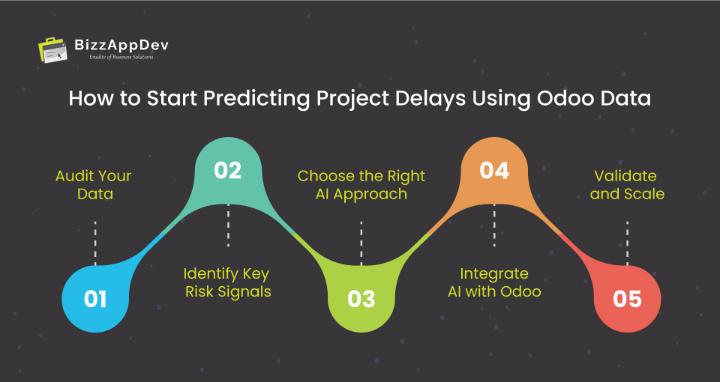
How to Start Predicting Project Delays Using Odoo Data
If you're exploring how to predict project delays using Odoo data, start with a focused approach:
Step 1: Audit Your Data
Ensure accuracy in task tracking and timesheets
Step 2: Identify Key Risk Signals
Focus on effort gaps and dependency patterns
Step 3: Choose the Right AI Approach
- Machine learning → structured data
- LLMs → contextual insights
Step 4: Integrate AI with Odoo
Use APIs or middleware to connect systems, often as part of a broader Odoo customization and development approach.
Step 5: Validate and Scale
Test predictions, refine models, and expand gradually
The Future: From Tracking Projects to Predicting Outcomes
Project management is evolving from tracking progress to predicting outcomes.
Teams are moving toward systems that:
- Detect risks in real time
- Recommend actions early
- Continuously improve with data
Businesses that start predicting delays instead of reacting to them are already seeing a shift, not just in timelines, but in how confidently they plan and execute projects.
Conclusion: Turning Odoo Data into Early Decisions
AI project delay prediction in Odoo is about improving timing, so teams can act earlier, not later.
The difference is simple:
- Without AI → You react after delays happen
- With AI → You act before they begin
Odoo provides the structure.
AI provides the foresight.
And together, they help teams deliver with more confidence, consistency, and control.
Want to predict project delays before they impact your deadlines?
Explore how AI integration with Odoo can help you act earlier and plan smarter.
FAQs
AI models analyze historical patterns in tasks, timesheets, and dependencies to identify signals like effort overruns and workflow inefficiencies. These patterns are used to forecast potential delays before they impact delivery timelines.
AI detects subtle indicators such as consistent estimate vs. effort gaps, dependency instability, and uneven resource allocation. These signals often emerge before visible delays, enabling proactive intervention.
AI shifts project management from reactive tracking to predictive decision-making by identifying risks mid-cycle. This allows teams to rebalance workloads and address bottlenecks before deadlines are affected.
Accurate predictions rely on structured data like task timelines, timesheets, dependencies, and resource allocation. Consistency and data quality are critical for AI models to generate reliable insights.
Yes, provided teams maintain consistent workflows and data discipline. Starting with focused use cases allows smaller teams to gain early value and scale AI capabilities progressively.