
Unplanned downtime remains one of the most expensive operational risks in manufacturing. Equipment failures, reactive maintenance, production overload, and delayed spare parts can quietly erode margins and disrupt delivery commitments.
Manufacturers already using Odoo ERP have a structured operational backbone in place. It manages production workflows, maintenance scheduling, inventory control, and reporting effectively. By integrating AI LLM with Odoo ERP for manufacturing, companies add a predictive intelligence layer that transforms operational data into forward-looking insight.
In practical terms:
AI LLM integration securely connects external large language models to Odoo’s manufacturing, maintenance, and production data. This enables predictive maintenance, downtime analytics, intelligent work order processing, and optimized production planning, reducing unexpected disruptions and improving operational efficiency.
Importantly, this approach enhances Odoo’s capabilities rather than replacing them. It turns structured ERP data into actionable operational foresight.
What Is AI LLM Integration in Odoo ERP?
AI LLM integration involves securely connecting external AI models to Odoo’s structured and unstructured datasets to extract deeper operational intelligence.
It allows manufacturers to:
- Analyze technician notes using natural language processing
- Detect recurring equipment failure patterns
- Predict maintenance needs based on usage data
- Identify production bottlenecks early
- Generate intelligent operational recommendations
Odoo manages workflows and captures operational data.
AI interprets patterns within that data.
Together, they create a predictive manufacturing environment aligned with Industry 4.0 transformation goals.
Common Causes of Manufacturing Downtime (And How AI Solves Them)
To understand the value of integration, it’s important to examine why downtime occurs in the first place.
Most manufacturing disruptions stem from recurring operational blind spots rather than isolated failures.
Downtime Cause | AI-Driven Enhancement in Odoo |
Reactive maintenance | Predictive maintenance using failure pattern detection |
Repeated unresolved issues | Automated root cause analysis |
Poor spare forecasting | AI-driven spare part demand prediction |
Machine overload | Intelligent production scheduling adjustments |
Hidden cross-plant trends | Enterprise-level downtime analytics |
By mapping operational challenges to AI-enhanced solutions, manufacturers gain clarity on how intelligence directly reduces downtime risk.
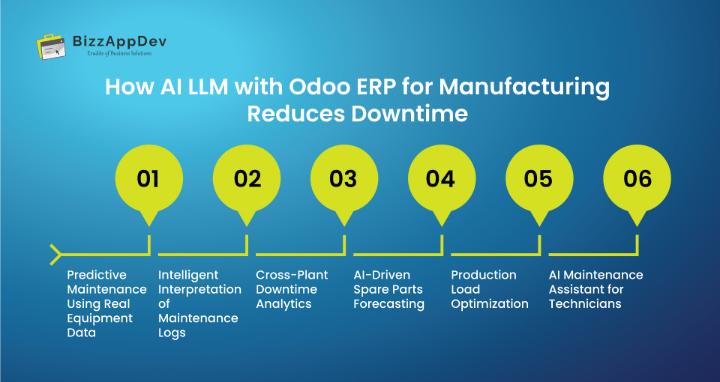
How AI LLM with Odoo ERP for Manufacturing Reduces Downtime
With the foundation established, the following applications demonstrate how AI integration drives measurable operational improvement.
1. Predictive Maintenance Using Real Equipment Data
Odoo’s maintenance module stores service logs, breakdown history, and scheduling records. When AI analyzes this data alongside IoT inputs and machine usage patterns, it enables advanced predictive maintenance execution.
AI can:
- Estimate equipment failure probability
- Identify declining performance trends
- Recommend condition-based service intervals
- Improve Mean Time Between Failures (MTBF)
Instead of relying solely on calendar-based servicing, maintenance becomes data-driven and proactive. This significantly reduces emergency repair incidents.
2. Intelligent Interpretation of Maintenance Logs
Technician reports often contain valuable diagnostic context, but patterns may not be immediately visible.
Using LLM in manufacturing ERP systems allows companies to:
- Convert free-text maintenance notes into categorized insights
- Detect recurring repair themes
- Identify systemic component issues
- Recommend probable corrective actions
This unlocks operational intelligence already stored within Odoo and accelerates root cause identification.
3. Cross-Plant Downtime Analytics
Multi-location operations require visibility beyond individual facilities.
AI-powered downtime analytics in Odoo ERP enables:
- Comparison of equipment failure rates across plants
- Identification of supplier-related part failures
- Detection of recurring production bottlenecks
- Improved Overall Equipment Effectiveness (OEE) visibility
This shifts operational management from reactive problem-solving to enterprise-level optimization.
4. AI-Driven Spare Parts Forecasting
Spare part shortages frequently extend downtime duration and increase repair costs.
AI integration within the Odoo manufacturing module supports:
- Risk-based spare inventory forecasting
- Identification of critical stock thresholds
- Alignment of procurement with predicted maintenance cycles
This ensures that maintenance planning and inventory strategy work together, strengthening operational continuity.
5. Production Load Optimization
Excessive machine utilization accelerates wear and increases failure probability.
AI-enhanced production planning helps manufacturers:
- Detect equipment overload risks
- Recommend balanced scheduling
- Identify early-stage bottlenecks
- Improve real-time production monitoring
Balanced production planning stabilizes output and reduces stress-related breakdowns.
6. AI Maintenance Assistant for Technicians
An AI assistant integrated with Odoo can support maintenance teams by:
- Retrieving similar historical breakdown cases
- Providing troubleshooting suggestions
- Summarizing equipment service history
- Reducing diagnostic time
This improves response efficiency while maintaining existing workforce capacity.
Real-World Application Scenario
Consider a mid-sized industrial components manufacturer experiencing recurring motor failures across two facilities.
Odoo maintenance logs consistently recorded breakdown data, yet the underlying pattern was not immediately visible.
After integrating AI LLM:
- The system detected recurring overload patterns tied to specific shift schedules.
- It identified similar technician notes referencing overheating symptoms.
- AI recommended adjusting load sequencing and modifying maintenance intervals.
Within months, emergency breakdown frequency declined significantly.
The ERP system already contained the data.
AI revealed the pattern within it.
When Should Manufacturers Integrate AI LLM with Odoo ERP?
AI integration becomes strategically valuable when:
- Downtime events repeat without clear root cause
- Maintenance costs increase year over year
- Spare shortages delay critical repairs
- Production strain causes frequent equipment stress
- Leadership prioritizes predictive maintenance
- Industry 4.0 adoption is part of long-term strategy
If Odoo is already central to operations, integrating AI LLM becomes a logical extension of digital transformation rather than a system overhaul.
How to Successfully Integrate AI LLM with Odoo ERP in Manufacturing
A structured and phased deployment ensures measurable ROI while protecting production continuity. AI LLM integration should strengthen existing Odoo workflows, not disrupt them.
Step 1: Downtime Analysis
Begin by identifying operational areas where downtime creates the highest financial and production impact.
Focus on:
- Top cost-driving equipment failures
- Recurring breakdown patterns
- Machines with declining reliability
- High-frequency maintenance categories
This ensures the AI initiative addresses real operational priorities.
Step 2: Data Preparation
AI models rely on structured, accurate operational data. Before deployment, consolidate and validate data from:
- Odoo Manufacturing Module
- Odoo Maintenance Module
- IoT and machine sensor inputs
- Historical production logs
Clean and standardized data improves predictive accuracy and strengthens model reliability.
Step 3: AI Model Deployment
Deploy external LLM models designed for manufacturing intelligence, including:
- Natural language processing for technician reports
- Predictive analytics for equipment reliability
- Downtime forecasting models
This stage introduces the intelligence layer to Odoo’s structured ERP foundation.
Step 4: Workflow Integration
AI insights should integrate directly into existing maintenance and production processes.
Embed AI-generated recommendations into:
- Maintenance scheduling
- Work order planning
- Production dashboards
The objective is operational enhancement, not added complexity.
Step 5: KPI Monitoring
To validate performance improvements, track measurable indicators such as:
- Reduction in unplanned downtime
- Improvements in Mean Time Between Failures (MTBF)
- Maintenance cost trends
- Overall Equipment Effectiveness (OEE) performance
Consistent KPI monitoring ensures the integration delivers sustained operational value.
Measurable Operational Impact
Manufacturers enhancing Odoo with AI capabilities often achieve:
- Lower unplanned downtime
- More accurate preventive maintenance
- Faster root cause identification
- Improved production stability
- Greater operational visibility
The advantage comes from combining Odoo’s structured ERP foundation with AI-driven interpretation and predictive insight.
Conclusion: Elevating Odoo into a Predictive Manufacturing Platform
Odoo ERP provides a strong operational foundation for manufacturing organizations. By integrating AI LLM with Odoo ERP for manufacturing, companies transform structured ERP data into predictive operational intelligence.
This enables:
- Smarter maintenance planning
- Reduced downtime risk
- Improved production efficiency
- Stronger competitive positioning
AI does not replace ERP. It amplifies its value.
For manufacturers focused on reducing downtime and strengthening operational resilience, AI LLM integration represents a strategic advancement aligned with modern smart factory initiatives.
Turn your Odoo data into predictive manufacturing insights.
Explore how AI LLM integration can reduce downtime and improve efficiency, start with a tailored assessment.
FAQs
No. AI enhances Odoo by analyzing ERP data and generating predictive insights that improve operational decisions.
Maintenance history, production records, equipment usage data, and inventory information typically provide sufficient predictive depth.
Enterprise-grade deployments follow strict data governance standards, encryption protocols, and controlled access management.
Timelines vary based on operational complexity, but structured deployments are phased and scalable to minimize disruption.