
This case study explores how a mid-sized retail company replaced fragmented legacy systems with Odoo ERP to gain operational visibility, improve inventory control, and build a scalable foundation for growth.
Background: A Retail Brand at a Turning Point
In 2014, this retail company began with a single storefront and a small, tightly knit team. Over the next decade, strong product-market fit and steady customer demand helped it grow into a national brand with more than 20 physical stores, a growing eCommerce presence, and multiple regional warehouses supporting daily operations.
By the time the company reached approximately 180 employees, leadership encountered a familiar challenge: growth had outpaced systems.
What once worked spreadsheets, basic POS software, and standalone accounting tools was now slowing the business down. Store managers lacked real-time inventory visibility. Finance teams spent weeks reconciling transactions. Operations leaders were forced to make decisions based on outdated or inconsistent reports.
The company wasn’t failing, but it was straining. Leadership recognized that continuing with disconnected systems would eventually limit scalability and operational control.
This realization triggered the search for an ERP system that could bring structure, visibility, and scalability, without introducing unnecessary complexity.
Retail Operations Before ERP: Disconnected Systems and Manual Processes
Before ERP adoption, the company operated a typical mid-sized retail business with several interconnected functions:
- Sales channels: Physical stores, a Shopify-based eCommerce site, and limited B2B wholesale orders
- Inventory: Central warehouses supplying stores, frequent stock transfers, and seasonal demand spikes
- Procurement: Dozens of local and international suppliers with varying lead times
- Finance: Invoicing, tax compliance, and reporting handled separately from operations
Each department worked hard, but systems didn’t communicate with each other.
Sales data from POS systems had to be exported manually. Inventory was tracked in Excel. Accounting ran in a standalone system that relied on delayed inputs from operations. Management reporting required pulling data from multiple sources and reconciling discrepancies by hand.
This fragmented setup created friction across nearly every part of the business.
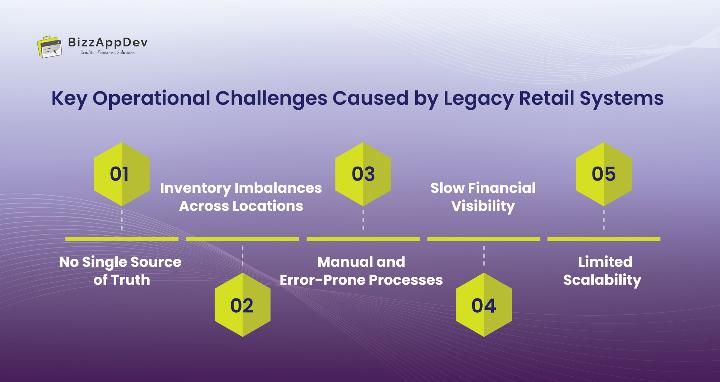
Key Operational Challenges Caused by Legacy Retail Systems
From an ERP consulting perspective, several issues quickly stood out.
1. No Single Source of Truth
Different teams trusted different numbers. Store stock did not align with warehouse records. Financial reports failed to match sales data. Decision-making slowed as teams debated which data was correct.
2. Inventory Imbalances Across Locations
Some stores were overstocked with slow-moving items, while others lost sales due to frequent stockouts. Without real-time inventory visibility, balancing supply across locations was nearly impossible.
3. Manual and Error-Prone Processes
Purchase planning, stock transfers, and month-end closing relied heavily on spreadsheets. Errors were common and fixing them consumed significant time and effort.
4. Slow Financial Visibility
Month-end closing took 10–15 days. By the time leadership reviewed financial results, the information was already outdated.
5. Limited Scalability
Opening a new store required new tools, new templates, and additional manual work. Each expansion added operational drag instead of efficiency.
At this stage, the company didn’t need more staff or tighter controls; it needed a better system.
Why Odoo ERP Was Selected
The company evaluated several ERP platforms, ranging from lightweight retail tools to large enterprise systems. Their criteria were practical and grounded in operational reality:
- One integrated system across sales, inventory, procurement, and finance
- Strong retail and warehouse management capabilities
- Flexibility to adapt processes without heavy custom development
- Predictable implementation and ownership costs
- A platform that could scale alongside the business
Odoo ERP stood out because it offered enterprise-level ERP coverage within a modular, understandable structure. Teams could stabilize core operations first and expand gradually, without forcing every department into rigid workflows on day one.
Just as important, Odoo allowed the ERP implementation to mirror how the business actually operated, rather than forcing the business to conform to the software.
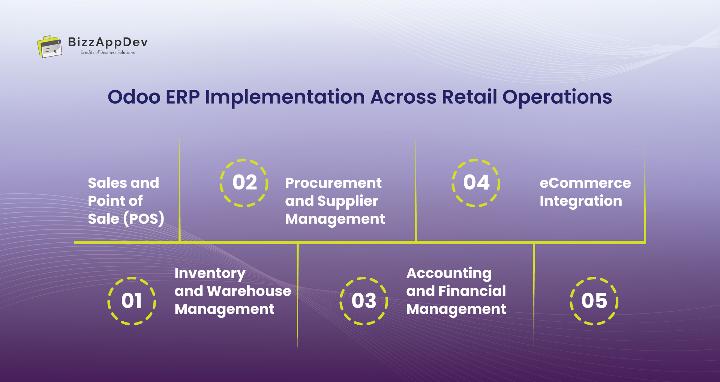
Odoo ERP Implementation Across Retail Operations
The ERP implementation focused on stabilizing critical operations first, then layering in optimization.
Sales and Point of Sale (POS)
Odoo Sales and POS replaced standalone retail systems.
All stores now operate with the same product catalog, pricing logic, and promotions. When a sale occurs online or in-store inventory updates immediately. Returns, exchanges, and refunds follow a standardized process across channels.
For store managers, this eliminated confusion. For finance teams, it created consistent, reliable transaction data.
Inventory and Warehouse Management
Inventory management was the most critical area of change.
Using Odoo Inventory, all warehouses and stores were configured as distinct locations within a single system. Real-time inventory visibility became the norm rather than the exception.
Reordering rules were introduced gradually. Instead of guessing future demand, the system now suggests purchase quantities based on actual sales movement and supplier lead times.
Barcode scanning improved accuracy during receiving, picking, and internal transfers. Stock discrepancies dropped sharply within the first few months.
Procurement and Supplier Management
Odoo Purchase replaced email-driven procurement workflows.
When stock falls below defined thresholds, the system automatically generates RFQs. Vendor price lists, delivery lead times, and purchasing history are stored centrally, making supplier comparison straightforward.
Procurement teams now spend less time chasing information and more time planning and negotiating.
Accounting and Financial Management
Odoo Accounting became the backbone of financial control.
Sales, purchases, inventory movements, and expenses automatically generate accounting entries. Finance teams no longer wait on manual inputs from operations.
Month-end closing time dropped from nearly two weeks to just a few days. Leadership gained real-time visibility into profitability and cash flow for the first time.
eCommerce Integration
Instead of syncing multiple platforms, the company unified online sales directly within Odoo.
Products, pricing, and inventory are managed once and used across all channels. Online orders follow the same fulfillment and accounting workflows as in-store sales, reducing errors and improving delivery performance.
Exploring AI-Assisted ERP Interactions Inside Odoo
With core ERP processes now stable, the company began exploring how everyday interaction with Odoo could be made simpler for the people using it most often. The focus is not on automation for its own sake, but on easing routine work especially for store teams, warehouse staff, and other non-technical users.
In collaboration with BizzAppDev, the company is exploring how natural language interaction can help users work more comfortably within the ERP. The aim is to see whether allowing people to interact with the system in a more human way can reduce friction in daily tasks and shorten the learning curve.
As part of this exploration, users are working with scenarios such as:
- Entering requests in plain language instead of navigating multiple screens
- Conversationally retrieving products, inventory levels, or orders
- Creating or updating product records through simple instructions
- Handling tasks like label printing without stepping through several menus
From the user’s perspective, Odoo continues to behave the same way it always has. All actions follow existing workflows, permissions, and validation rules. Odoo remains the single source of truth, while the LLM layer serves as a more intuitive interface for interacting with the system.
At this stage, the company is observing how these interactions affect day-to-day work particularly whether they make tasks feel easier, reduce training effort, and support smoother adoption across teams.
End-to-End ERP Workflow After Implementation
From a process standpoint, the transformation was significant:
- A customer places an order in-store or online
- Inventory updates instantly across all locations
- If stock runs low, Odoo triggers replenishment
- Purchase orders are sent to suppliers
- Goods are received and scanned into inventory
- Vendor bills and customer invoices post automatically
- Management dashboards update in real time
Each step connects naturally to the next. There is no re-entering data, no reconciliation effort, and no uncertainty about which numbers are correct.
Measurable Business Results After Odoo ERP Implementation
Within the first year, the company achieved clear, measurable improvements:
- Inventory accuracy exceeded 98%
- Inventory carrying costs reduced by approximately 20%
- Order fulfillment speed improved by 30%
- Manual data entry reduced by about 25%
- Month-end closing time reduced from 12 days to 3 days
Equally important, teams began to trust the system. Store managers stopped hoarding stock. Finance teams stopped firefighting. Leadership began planning based on real-time data rather than assumptions.
ERP Transformation at a Glance
- Industry: Retail
- Company Size: ~180 employees
- ERP Platform: Odoo ERP
- Key Focus Areas: Inventory visibility, financial control, scalability
- Outcome: Simplified operations, faster decisions, sustainable growth
What This Case Study Demonstrates
This ERP transformation was not about flashy features or aggressive automation. It was about clarity.
By replacing disconnected legacy systems with Odoo ERP, the company gained a reliable, real-time view of its operations. Processes became simpler, not more complex. Growth became manageable instead of stressful.
For retail leaders evaluating ERP systems, the lesson is clear: success does not come from choosing the biggest platform; it comes from choosing one that fits how your business actually operates and can grow with you.
Odoo proved to be that foundation.
Considering Odoo ERP for your retail operations?
See how a structured, phased ERP implementation can replace disconnected systems and support sustainable growth.