
Odoo is a powerful and modular ERP platform. But in 2026, businesses are no longer satisfied with automation alone, they want intelligence inside their workflows. That’s where AI LLM integration in Odoo ERP comes in.
Instead of replacing Odoo, integrating Large Language Models (LLMs) adds contextual intelligence, natural language processing, and smarter automation across CRM, accounting, HR, and support operations.
This guide explains what AI LLM integration really means, when it makes sense, what it costs, how it works technically, and whether it’s the right move for your business.
Quick Summary: What You Should Know
- AI LLM integration enhances Odoo, it does not replace it
- Best suited for CRM, support, reporting, and document-heavy workflows
- Requires secure API-based architecture
- ROI depends on use case clarity
- Not every business need AI integration immediately
This article will help you decide whether integrating LLM with Odoo ERP aligns with your operational goals.
What is AI LLM Integration in Odoo ERP?
AI LLM integration in Odoo ERP refers to connecting external Large Language Models (such as GPT-based APIs or enterprise AI platforms) with Odoo through APIs or custom modules.
This creates an intelligent processing layer on top of Odoo’s existing infrastructure.
It allows businesses to:
- Generate contextual responses
- Summarize large datasets
- Automate communication workflows
- Enable natural language ERP queries
- Improve decision support systems
Odoo remains the system of record. AI becomes the intelligence layer that augments it.
Why Businesses Are Choosing to Integrate LLM in Odoo ERP in 2026
Organizations are not replacing Odoo. They are enhancing it.
In 2026, companies are choosing Odoo ERP AI automation to improve operational speed, reduce repetitive tasks, and enable contextual automation.
Here’s why:
1. Intelligent Workflow Automation
Instead of static automation rules, LLM-powered workflows can:
- Draft personalized sales emails
- Generate proposal summaries
- Analyze customer communication tone
- Produce internal reports instantly
This shifts ERP from rule-based automation to intelligent augmentation.
2. Context-Aware Decision Support
By integrating AI with ERP systems, companies can:
- Summarize CRM pipelines
- Extract insights from financial notes
- Identify anomalies in transactions
- Improve reporting clarity
This improves managerial decision-making without disrupting core architecture.
3. Natural Language ERP Interaction
LLM-powered ERP environments allow users to:
- Ask questions in plain language
- Retrieve structured data summaries
- Generate contextual responses
This reduces training dependency and increases usability.
With AI Layer vs Without AI Layer in Odoo
Without LLM Integration | With AI LLM Integration |
Manual email drafting | AI-assisted communication |
Static reporting | Contextual summary generation |
Rule-based workflows | Adaptive intelligent workflows |
Keyword search | Natural language queries |
Manual document review | AI-powered document summarization |
The core ERP remains the same. The difference lies in intelligence depth and operational efficiency.
Real-World Use Cases of AI LLM in Odoo ERP
AI Chatbot in Odoo CRM
- Auto-respond to inbound leads
- Qualify prospects
- Suggest next actions
AI-Powered Quotation Drafting
- Generate tailored proposals
- Adapt tone by customer profile
- Support multilingual output
AI in Accounting
- Summarize invoice notes
- Suggest expense categorization
- Highlight irregular financial entries
AI Support Assistant
- Draft ticket responses
- Summarize long communication threads
- Extract next steps
These are practical examples of LLM-powered workflows inside Odoo ERP.
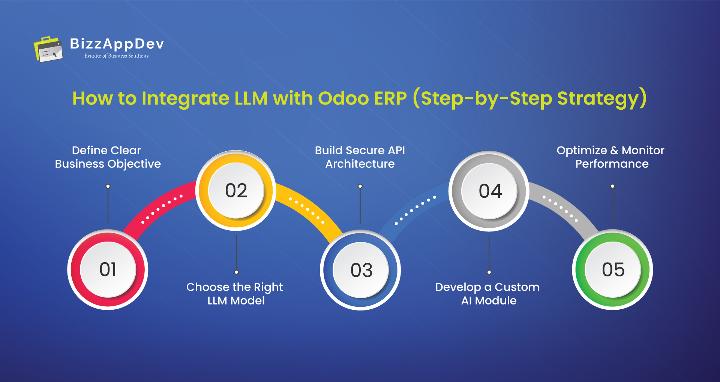
How to Integrate LLM with Odoo ERP (Step-by-Step Strategy)
A structured approach ensures secure and scalable step by step AI integration in Odoo.
Step 1: Define Clear Business Objective
Examples:
- Reduce CRM response time
- Automate financial summaries
- Improve internal documentation
Avoid vague goals like “add AI.”
Step 2: Choose the Right LLM Model
Options include:
- GPT-based APIs
- Enterprise AI platforms
- Self-hosted AI models
Your choice depends on:
- Data sensitivity
- Scalability needs
- Budget
Step 3: Build Secure API Architecture
Integration typically involves:
- Odoo API
- LLM API
- Middleware layer
- Logging system
If you are already investing in Odoo API development, AI integration becomes a natural architectural extension.
Step 4: Develop a Custom AI Module
A properly built module should include:
- Prompt engineering logic
- Data filtering before transmission
- Response validation
- Monitoring dashboard
Step 5: Optimize & Monitor Performance
AI integration is not “set and forget.”
It requires:
- Prompt refinement
- Output evaluation
- Workflow tuning
From our experience implementing AI modules in live ERP environments, structured monitoring significantly improves accuracy and long-term ROI.
At BizzAppDev, we help businesses integrate AI LLM with Odoo in a secure and structured way. Our focus is on making ERP systems smarter with AI while preserving Odoo’s performance, compliance, and operational stability.
When AI LLM Integration in Odoo ERP May Not Be the Right Step – Yet
AI LLM integration delivers meaningful value when it addresses a clearly defined operational challenge. However, it isn’t automatically the next step for every Odoo environment.
You may want to reconsider or delay integration if:
- Your ERP data is inconsistent or poorly structured
- Core workflows are still being stabilized
- Operational bottlenecks are process-related rather than intelligence-related
- There is no measurable productivity gap to improve
AI tends to amplify what already exists. If your processes lack clarity or your data needs refinement, introducing an LLM layer may add complexity instead of efficiency.
The most successful implementations happen when AI is introduced into a stable ERP environment with specific, outcome-driven goals, such as reducing response time, accelerating documentation, or improving reporting speed.
With that in mind, it’s helpful to look at how measurable impact can actually take shape in a practical scenario.
Mini ROI Scenario Example
Imagine a support team handling 500 tickets per week.
Without AI:
- Manual drafting takes 6–8 minutes per ticket.
With AI LLM integration:
- Draft suggestions reduce drafting time by 50–60%.
That could translate into:
- 20–30 hours saved weekly
- Faster response times
- Improved customer satisfaction
ROI depends on use case clarity, not AI hype.
Technical Architecture Overview
A typical AI powered Odoo ERP architecture includes:
- Odoo backend
- AI integration module
- API gateway
- External LLM
- Monitoring & audit logs
Advanced setups may use:
- Retrieval Augmented Generation (RAG)
- Vector search databases
- Private AI deployment
Because every organization’s ERP environment is different, integrating LLM often requires adjustments at the module and workflow level. Businesses that already invest in Odoo customization services usually find AI integration easier to align with their existing architecture.
If your organization is already exploring broader ERP automation services, LLM integration can become a strategic next phase.
Cost of Integrating AI in Odoo ERP
Costs depend on:
- Use case complexity
- API usage volume
- Custom development scope
- Security requirements
Typical cost components include:
- Development resources
- LLM API billing
- Infrastructure
- Ongoing optimization
For many businesses, phased implementation reduces risk and improves measurable ROI.
Security & Compliance Considerations
When implementing AI LLM integration in Odoo ERP, businesses should:
- Mask sensitive data before API transmission
- Avoid sending full database records
- Maintain encrypted communication
- Log AI outputs for auditing
Security should always align with your existing ERP governance framework.
Benefits of AI LLM Integration in Odoo ERP
When implemented strategically, benefits include:
- Reduced manual workload
- Faster internal communication
- Smarter reporting
- Context-aware automation
- Improved knowledge accessibility
The value lies in intelligent ERP augmentation, not system replacement.
Is AI Integration in Odoo Worth It?
If your organization:
- Handles high communication volume
- Requires faster reporting
- Manages complex documentation
- Seeks contextual automation
Then integrating LLM with Odoo ERP may offer measurable operational gains.
However, clarity, structure, and secure implementation determine success.
The Future of AI-Enhanced ERP Systems
ERP systems are evolving toward:
- AI copilots inside dashboards
- Predictive business insights
- Natural language ERP interaction
- Context-aware automation layers
Businesses that combine stable ERP foundations with intelligent AI augmentation are building adaptable operational ecosystems.
Conclusion
AI LLM integration in Odoo ERP represents a strategic evolution, not a system overhaul.
Odoo remains the operational backbone. AI adds contextual intelligence, language-based interaction, and smarter workflow execution.
When aligned with clear objectives and secure architecture, Odoo AI integration enhances productivity, improves decision support, and creates measurable efficiency gains.
The key is thoughtful implementation, guided by expertise, real use cases, and long-term operational clarity.
Not sure whether AI LLM integration is right for your Odoo environment?
A focused assessment of your workflows and data readiness can help you decide the smartest next step, before making any major changes.
FAQs
Yes, most modern Odoo versions support AI LLM integration through APIs or custom modules. The setup depends on your deployment and existing customizations.
Small use cases can take a few weeks. Broader, multi-module integrations may take longer depending on complexity.
It is secure when implemented with data masking, encrypted APIs, access control, and proper logging.
ROI depends on the use case. For example, AI-assisted drafting can reduce workload by 50% in communication-heavy teams
No. It enhances existing workflows by adding contextual intelligence and natural language capabilities.
If you have stable workflows, clean data, and measurable productivity gaps, AI integration can deliver meaningful results.