
Inventory imbalance is not just an operational issue; it directly affects profitability.
Stockouts reduce revenue and damage customer trust. Overstock ties up working capital and increases carrying costs. Odoo provides a powerful and flexible inventory management foundation. Businesses that have already invested in Odoo ERP Implementation Services often reach a stage where enhancing forecasting precision becomes the next logical step. As demand complexity increases, organizations can extend Odoo’s capabilities through predictive AI integration to achieve deeper forecasting accuracy and smarter replenishment decisions.
This is where AI inventory management in Odoo, powered by external LLM (Large Language Model) integration, transforms inventory planning from structured control into predictive intelligence.
Executive Summary
- Odoo offers strong core inventory functionality.
- AI LLM integration enhances forecasting precision.
- Businesses often improve forecast accuracy by 20–40%.
- Stockouts and excess inventory decrease significantly.
- Secure API integration keeps Odoo central while adding intelligence.
If you are evaluating smarter inventory optimization within Odoo, this guide provides the clarity needed to make a confident decision.
What Is AI Inventory Management in Odoo?
AI inventory management in Odoo refers to integrating an external AI/LLM engine via secure API to enhance:
- Demand forecasting
- Safety stock optimization
- Replenishment planning
It does not replace Odoo’s inventory module.
It strengthens it.
The integration works by:
- Extracting historical sales data
- Analyzing SKU-level performance
- Detecting demand variability
- Running predictive forecasting models
- Feeding optimized replenishment recommendations back into Odoo
For organizations exploring advanced AI Integration Services, this approach allows Odoo to remain the operational core while AI enhances its intelligence layer.
The objective is simple: extend Odoo’s operational capabilities with data-driven intelligence.
Why Inventory Imbalance Impacts Profitability
Even with well-configured ERP systems, inventory challenges emerge when demand patterns shift faster than planning cycles.
The Cost of Stockouts
Businesses commonly experience revenue leakage due to:
- Missed sales opportunities
- Lower fill rate
- Service level drops
- Customer dissatisfaction
When planning remains reactive, supply disruptions escalate quickly.
The Cost of Overstock
Excess inventory creates pressure on:
- Inventory turnover ratio
- Cash flow
- Warehouse efficiency
It increases:
- Carrying cost
- Obsolescence risk
- Dead stock accumulation
Inventory optimization is ultimately about working capital efficiency, not just stock control.
Extending Odoo’s Forecasting Capabilities with AI
Odoo already provides configurable reordering rules, reporting tools, and inventory automation within its Odoo Inventory Module Guide, offering businesses structured visibility and stock control.
As supply chains become more dynamic, companies can build on this foundation by integrating predictive analytics that respond to:
- Seasonality shifts
- Supplier variability
- Multi-warehouse complexity
- Promotion-driven demand
- Shorter product lifecycles
Rather than replacing ERP logic, AI enhances decision-making depth and responsiveness.
How AI LLM Integration Works in Odoo
To ensure transparency, here is how integration typically works in practice.
Step 1: Secure API Data Synchronization
The AI engine connects securely to Odoo and extracts:
- Historical sales data
- SKU-level forecasting metrics
- Lead time history
- Purchase patterns
- Warehouse movements
- Inventory turnover performance
Access controls and encrypted APIs protect business data throughout the process.
Step 2: Predictive Demand Modeling
The AI forecasting system performs:
- Seasonality prediction
- Demand sensing analysis
- ABC inventory classification
- Lead time forecasting
- Safety stock recalibration
- Multi-location optimization
This improves:
- Forecast accuracy percentage
- Fill rate
- Service level
- Planning responsiveness
Many organizations observe 20–40% improvement in forecast accuracy after structured deployment.
Step 3: Intelligent Replenishment Recommendations
The AI system feeds insights back into Odoo for:
- Purchase order optimization
- Dynamic reorder quantities
- Supplier performance evaluation
- Demand-adjusted replenishment cycles
This enables predictive inventory management in Odoo while keeping Odoo as the central operational platform.
For manufacturers already leveraging the Odoo Manufacturing Module, AI forecasting ensures raw material planning aligns more closely with production variability and lead times.
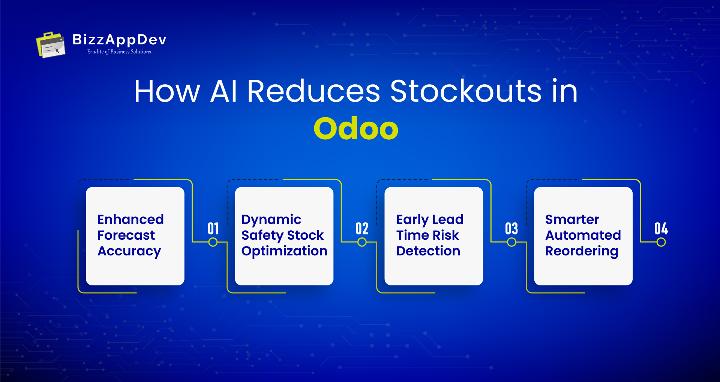
How AI Reduces Stockouts in Odoo
1. Enhanced Forecast Accuracy
AI models continuously analyze demand variability.
Impact:
- Improved fill rate
- Higher service level
- Fewer missed sales
2. Dynamic Safety Stock Optimization
Instead of fixed buffer levels, AI adjusts safety stock based on:
- Lead time variability
- Demand volatility
- Service-level targets
This supports stronger Odoo stock level optimization without disrupting existing workflows.
3. Early Lead Time Risk Detection
AI identifies potential supplier delays early and adjusts replenishment proactively, strengthening overall Supply Chain Optimization efforts across procurement and logistics.
4. Smarter Automated Reordering
With Odoo automated reordering using AI, replenishment cycles become more responsive and data-driven.
Result:
- Lower stockout rates
- Reduced emergency purchasing
- More stable operations
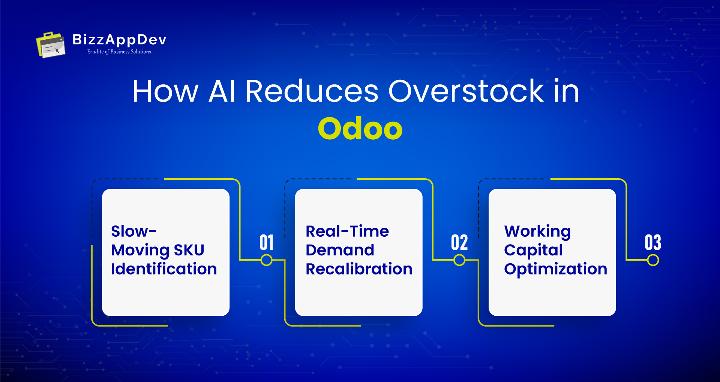
How AI Reduces Overstock in Odoo
Overstock often results from demand overestimation or delayed reaction to declining sales.
AI addresses this through structured intelligence.
1. Slow-Moving SKU Identification
The system highlights:
- Low turnover products
- Dead stock risk
- Excess stock accumulation
This improves inventory turnover ratio and warehouse efficiency.
2. Real-Time Demand Recalibration
When demand decreases, AI adjusts:
- Purchase quantities
- Reorder timing
- Distribution allocation
This enables businesses to reduce excess inventory using AI in Odoo without compromising service levels.
For businesses operating in fast-moving retail environments, combining AI forecasting with specialized ERP for Retail strategies improves responsiveness to demand shifts and seasonal trends.
3. Working Capital Optimization
Aligning stock levels with actual demand improves:
- Cash flow
- Carrying cost reduction
- Warehouse productivity
Organizations optimizing their Odoo inventory management processes often see measurable financial improvements.
Practical Application: How AI Inventory Management in Odoo Delivers Measurable Impact
When businesses integrate AI inventory management in Odoo through LLM-powered forecasting, the impact follows a structured pattern.
After secure API integration:
- Sales, SKU, warehouse, and lead-time data sync continuously
- Demand variability is analyzed at product level
- Safety stock levels are recalculated dynamically
- Reorder quantities adjust based on predictive insights
As the system runs:
- Forecast accuracy begins to improve
- Stockout risks are identified earlier
- Excess stock exposure becomes visible
- Slow-moving SKUs are flagged automatically
Within a few planning cycles:
- Replenishment decisions become more data-driven
- Emergency purchasing decreases
- Inventory turnover ratio starts improving
- Working capital allocation becomes more balanced
The most noticeable improvement is not only numerical performance, it is stronger demand visibility and greater planning confidence across inventory and procurement teams.
Key Inventory KPIs Improved by AI Integration
- Forecast accuracy
- Fill rate
- Service level
- Inventory turnover ratio
- Stockout rate reduction
- Carrying cost reduction
- Working capital optimization
These measurable KPIs demonstrate why AI enhances Odoo’s operational strength.
Who Should Consider AI Integration in Odoo?
AI-driven forecasting is particularly beneficial for:
- Retail businesses managing high SKU volumes
- Manufacturing companies facing raw material variability
- Wholesale distributors operating multiple warehouses
- E-commerce brands scaling rapidly
If your planning team spends significant time adjusting forecasts manually, AI integration can extend your existing Odoo ERP ecosystem intelligently.
Implementation Roadmap
1. Inventory Performance Audit
Measure:
- Forecast accuracy
- Stockout rate
- Excess inventory levels
2. Identify Planning Gaps
Determine where manual adjustments dominate decision-making.
3. Secure API Deployment
Integrate AI engine into Odoo with structured permissions.
4. Parallel Testing
Compare AI forecasts with existing planning methods.
5. Controlled Rollout
Expand AI-driven replenishment by category or warehouse.
Considerations for Successful Implementation
- Maintain clean historical data
- Define clear KPI benchmarks
- Monitor forecast performance regularly
- Ensure strong governance processes
AI enhances Odoo’s capabilities, but structured oversight ensures long-term success.
Key Takeaways
- Odoo provides a strong inventory management foundation.
- AI LLM integration enhances forecasting precision.
- Predictive analytics reduces stockouts and overstock.
- Inventory KPIs improve measurably with AI support.
- Secure API integration keeps Odoo at the center of operations.
Conclusion: AI Inventory Management in Odoo as a Strategic Advantage
Odoo already delivers a flexible and scalable inventory management framework.
By integrating LLM-powered predictive analytics, businesses extend that framework with intelligent forecasting, automated replenishment optimization, and measurable KPI improvement.
In today’s dynamic supply environment, AI inventory management in Odoo represents a strategic enhancement, enabling smarter decisions, stronger working capital control, and sustainable operational growth.
When implemented thoughtfully, AI does not replace Odoo.
It amplifies its capabilities.
Ready to reduce stockouts and overstock in Odoo with smarter forecasting?
Speak with our experts to implement AI inventory management in Odoo and unlock measurable inventory performance improvements.
FAQs
Integrate AI-based forecasting that dynamically adjusts safety stock and detects demand shifts early.
Use predictive inventory management tools that identify slow-moving SKUs and adjust replenishment cycles intelligently.
Odoo offers strong automation features. Advanced predictive forecasting can be added through external AI LLM integration.
Many organizations experience 20–40% improvement in forecast accuracy and meaningful reductions in inventory imbalance within months.