
Artificial intelligence is reshaping how modern ERP systems operate, and many organizations are exploring AI implementation in Odoo by integrating external large language models (LLMs), predictive analytics engines, and intelligent automation tools into their business workflows.
Odoo is widely known for its modular architecture and flexible integration capabilities, which allow businesses to extend the platform through APIs, custom modules, and third-party technologies. Because of this flexibility, many companies are now connecting external AI systems to Odoo to automate operations, analyze business data, and generate deeper insights across departments.
However, connecting AI systems to ERP workflows requires thoughtful planning. Integrating external LLM services, machine learning models, or automation platforms into enterprise systems introduces challenges related to data quality, integration architecture, and security management.
Many organizations begin deploying LLMs in Odoo ERP expecting immediate automation benefits. Without the right strategy, these projects may create operational complexity rather than meaningful improvements.
Understanding the common pitfalls in Odoo machine learning integration helps businesses build reliable intelligent ERP automation that delivers long-term value.
Common Mistakes When Integrating AI with Odoo
Businesses integrating AI with Odoo ERP most commonly struggle with:
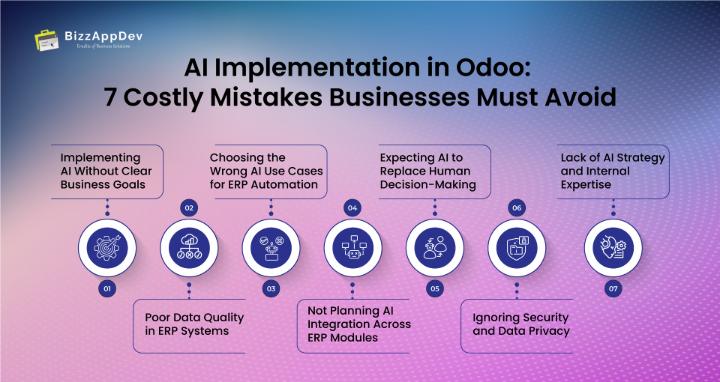
- Starting AI projects without clear business goals
- Using poor-quality ERP data for AI models
- Choosing AI use cases that provide limited value
- Not planning integration across ERP modules
- Expecting AI to replace human decision-making
- Ignoring security and data privacy concerns
- Implementing AI without a long-term strategy
Avoiding these mistakes allows organizations to successfully extend Odoo with AI-powered ERP workflows and automation capabilities.
Why Businesses Are Deploying LLMs in Odoo ERP
Organizations increasingly integrate external AI systems with ERP platforms to unlock smarter automation and operational intelligence.
When implemented correctly, AI can enable:
- Automated invoice and document processing
- Predictive demand forecasting for inventory
- AI assistants integrated into CRM workflows
- Automated financial or operational summaries
- AI-driven sales insights and analytics
These capabilities transform traditional ERP systems into data-driven operational platforms that help teams make faster and more informed decisions.
For many companies, these initiatives are part of a broader AI ERP integration strategy designed to improve productivity and decision-making.
Why Odoo Works Well for AI Integration
Odoo’s modular structure and open development framework make it a strong foundation for modern technologies such as AI services, automation tools, and predictive analytics.
Businesses working with experienced Odoo implementation partners often extend the platform with advanced integrations while maintaining stable ERP workflows.
With proper planning, organizations can enhance Odoo with AI-driven business insights and intelligent automation while preserving operational reliability.
Mistake #1: Implementing AI Without Clear Business Goals
One of the most common challenges in AI implementation in Odoo occurs when organizations begin experimenting with AI without clearly defining the business problem they want to solve.
AI initiatives should always begin with a well-defined operational objective rather than simply adding AI capabilities to an ERP system.
Why Undefined Goals Create Problems
When AI projects start without clear direction, businesses may experience:
- Automation that does not align with business processes
- AI models generating irrelevant insights
- Increased technical complexity without measurable ROI
- Confusion among operational teams
How to Define Clear Objectives for AI Integration
Before starting Odoo machine learning integration, organizations should identify:
- Which workflow needs improvement
- Which datasets support AI processing
- What measurable outcomes are expected
Common AI Use Cases in Odoo ERP
Organizations typically begin with high-value applications such as:
- AI invoice data extraction
- Demand forecasting for inventory planning
- AI-generated sales performance insights
- Automated reporting and business summaries
- CRM assistants that support customer interactions
Many companies also improve CRM automation in Odoo as an initial step toward intelligent workflow automation.
Mistake #2: Poor Data Quality in ERP Systems
Data quality is one of the most critical factors affecting the success of AI integration with Odoo ERP.
AI models rely on historical ERP data to identify patterns and generate predictions. If ERP data is inconsistent or incomplete, AI outputs may become unreliable.
Common Data Quality Problems in Odoo
Typical data challenges include:
- Duplicate customer records in CRM
- Inconsistent product or inventory information
- Missing transaction history
- Unstructured invoice and document formats
These issues reduce the accuracy of AI-driven ERP analytics.
Why Clean Data Is Essential for AI
Poor data quality can lead to:
- Incorrect predictions from AI models
- Automation errors in operational workflows
- Reduced trust in AI insights
Reliable datasets dramatically improve the performance of AI workflow automation systems.
Preparing ERP Data for AI Integration
Before integrating AI services with Odoo, businesses should:
- Remove duplicate records from CRM databases
- Standardize product and inventory information
- Organize invoice and document formats
- Validate historical data used for forecasting
This preparation ensures that enterprise AI automation operates reliably within ERP environments.
Mistake #3: Choosing the Wrong AI Use Cases for ERP Automation
Another common mistake occurs when organizations apply AI to workflows that do not require machine learning.
Some businesses attempt to automate simple tasks with complex AI systems, which increases cost and system complexity without delivering meaningful improvements.
Weak AI Applications
Examples of ineffective AI usage include:
- Using AI for simple rule-based processes
- Running predictive models without sufficient historical data
- Automating workflows that require strict compliance validation
Strong Opportunities for AI in ERP Systems
More effective AI use cases include:
- Document classification and invoice extraction
- Predictive inventory demand forecasting
- Sales pipeline analytics and forecasting
- AI-generated operational reports
These applications create measurable value through AI-powered ERP workflows.
Mistake #4: Not Planning AI Integration Across ERP Modules
Odoo ERP connects multiple business functions through integrated modules including CRM, sales, accounting, inventory, and manufacturing.
When organizations begin deploying LLMs in Odoo ERP, they sometimes underestimate how these modules interact.
Why Integration Planning Matters
ERP systems rely on structured data flows between modules. Without proper integration planning, AI models may access incomplete or incorrect data sources.
Common integration challenges include:
- AI retrieving data from incorrect modules
- Automation interfering with operational workflows
- Performance issues caused by inefficient API architecture
Best Practices for AI Integration Architecture
Successful projects typically follow a structured approach:
- Map workflows across ERP modules
- Design secure APIs for AI communication
- Test AI outputs with real operational data
- Continuously monitor integration performance
Organizations implementing AI capabilities often incorporate these changes as part of a broader Odoo ERP customization strategy to ensure scalability.
Mistake #5: Expecting AI to Replace Human Decision-Making
Some organizations believe AI can completely replace human decision-making within ERP systems.
In reality, AI works best as a decision-support tool rather than a full replacement for human expertise.
Risks of Over-Automation
Over-reliance on AI may cause:
- Incorrect predictions affecting operations
- Reduced transparency in automated processes
- Compliance challenges in regulated industries
A Balanced Approach
AI should support business teams by:
- Identifying patterns in operational data
- Detecting anomalies in financial records
- Generating insights for decision makers
- Automating repetitive administrative tasks
Human oversight ensures reliable intelligent ERP automation.
Mistake #6: Ignoring Security and Data Privacy
Security is an important factor when integrating external AI services with ERP systems.
ERP platforms contain sensitive business information such as financial data, supplier contracts, and customer records.
Data Risks When Integrating AI Systems
Potential risks include:
- Unauthorized data access
- Data leaks during API communication
- Compliance issues involving customer information
Security Best Practices
Organizations integrating AI with ERP platforms should:
- Use secure API connections
- Restrict AI access to necessary datasets
- Encrypt data transfers between systems
- Implement role-based access controls
These practices strengthen the reliability of AI-enabled ERP environments.
Mistake #7: Lack of AI Strategy and Internal Expertise
Another reason AI initiatives struggle is the absence of a clear long-term strategy.
Successful Odoo machine learning integration requires collaboration between multiple teams.
Teams Needed for Successful AI Projects
Effective AI implementations often involve:
- ERP consultants
- AI engineers and developers
- Data engineers responsible for data preparation
- Business leaders defining strategic goals
Building a Sustainable AI Roadmap
Organizations should create a roadmap that includes:
- Prioritizing high-impact AI use cases
- Establishing data governance policies
- Designing scalable integration architecture
- Continuously evaluating AI performance
A structured roadmap ensures that enterprise AI automation evolves alongside business growth.
Best Practices for Successful AI Implementation in Odoo
Businesses integrating AI with ERP platforms should follow several practical principles.
Focus on High-Impact Workflows
Start with processes such as forecasting, document automation, or analytics.
Prepare Data Before Integration
Clean datasets significantly improve AI model performance.
Implement AI Gradually
Start with small improvements and expand successful initiatives.
Maintain Human Oversight
AI should assist decision-making rather than replace it.
Build Scalable Architecture
A structured integration strategy ensures long-term stability.
Conclusion
Artificial intelligence offers powerful opportunities to improve operational efficiency, automation, and data-driven decision-making.
However, successful AI implementation in Odoo requires thoughtful planning, strong data foundations, and well-designed integration architecture. Organizations that rush into connecting AI systems without clear objectives often encounter avoidable challenges.
By focusing on strategic goals, reliable data preparation, and scalable integration design, businesses can successfully deploy LLMs in Odoo ERP and build sustainable intelligent ERP automation.
When implemented thoughtfully, AI implementation in Odoo enhances ERP workflows, improves decision-making, and supports long-term digital transformation.
Planning AI Implementation in Odoo but unsure where to start?
Talk to our experts to design a secure, scalable AI integration strategy for your ERP workflows.
FAQs
Yes. Odoo supports integration with external AI systems using APIs and custom modules. Businesses often connect LLM models, automation tools, and analytics platforms to enhance ERP workflows.
The most common risks include poor data quality, unclear automation goals, weak integration planning, and security concerns when connecting external AI services.
High-value AI applications include invoice processing automation, predictive demand forecasting, AI-assisted CRM workflows, and intelligent operational reporting.
In most cases, yes. Integrating external AI models typically requires APIs or custom modules to connect AI services with ERP workflows. Businesses often work with Odoo developers or customization experts to ensure the integration is secure, scalable, and aligned with their processes.
Yes, when focused on practical use cases. Many businesses start with invoice automation, sales forecasting, or AI-powered reporting. Beginning with smaller projects allows teams to test AI capabilities before expanding into broader AI-driven ERP workflows.