
Choosing the right CRM is no longer just about keeping track of customer contacts. It’s about building meaningful relationships, improving sales efficiency, and giving your team the tools to work smarter. With so many CRM platforms on the market, the decision can feel overwhelming.
Two names come up often in the conversation: Odoo and Salesforce. Both are powerful, but they serve different kinds of businesses and needs. If you’re asking yourself “Which CRM is better, Odoo or Salesforce?” this guide is for you.
We’ll walk you through a side-by-side comparison of features, pricing, customization, scalability, and use cases, so you can decide which platform is the right fit for your business.
Why Compare Odoo and Salesforce?
CRM software isn’t a one-size-fits-all investment. A startup looking for flexibility and affordability won’t have the same needs as an enterprise managing thousands of customer relationships worldwide.
- Odoo is well-known as an open-source ERP and CRM solution. Its modular approach makes it attractive for businesses that want flexibility. You can start small and scale by adding apps for inventory, accounting, HR, or even eCommerce.
- Salesforce, on the other hand, has built its reputation as the world’s #1 cloud-based CRM platform. It’s a go-to choice for larger companies that want enterprise-grade features, robust integrations, and a strong ecosystem of third-party apps.
This comparison matters because while both platforms aim to improve customer relationship management, they approach the goal very differently.
High-Level Overview
What is Odoo?
Odoo started as an open-source ERP platform but quickly evolved into an all-in-one suite for businesses. With Odoo CRM, you can manage leads, opportunities, and pipelines with new AI-powered capabilities.
Key highlights in Odoo 19:
- AI lead scoring & insights – Estimate your chances of winning each lead with predictive analytics.
- Business card scanning – Instantly generate leads by scanning business cards.
- Smart lead assignment – Leads from external sources can be auto-assigned to team leaders for follow-up.
- Priority filters for routing – Apply filters like language or region to assign leads to the right salesperson.
- Quick contact creation – Link new contacts directly from the Kanban view for faster entry.
Odoo also stands out for its flexibility in customization and deployment. Whether you’re looking at cloud hosting or on-premise installation, Odoo gives you options. And because it’s open source, customization and integrations are widely accessible through a global network of developers and partners.
What is Salesforce?
Salesforce is often considered the “gold standard” in the CRM industry. As a fully cloud-based solution, Salesforce offers a suite of applications that cover sales, service, marketing, and analytics.
What makes Salesforce stand out is its ecosystem, AppExchange, Lightning platform, Einstein AI, and robust APIs. Enterprises with complex sales cycles and global teams often turn to Salesforce for its scalability and enterprise-grade reliability.
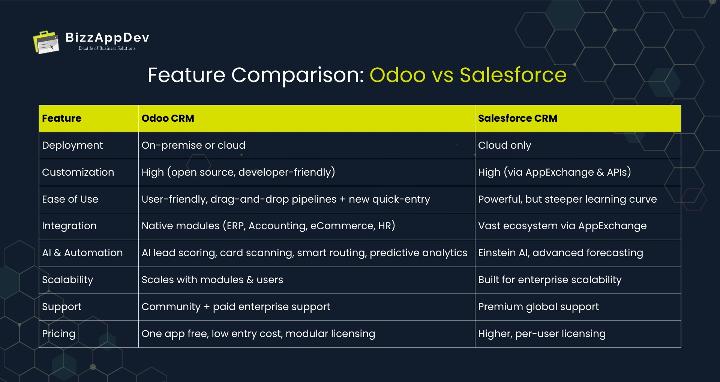
Feature Comparison: Odoo vs Salesforce
Feature | Odoo CRM | Salesforce CRM |
Deployment | On-premise or cloud | Cloud only |
Customization | High (open source, developer-friendly) | High (via AppExchange & APIs) |
Ease of Use | User-friendly, drag-and-drop pipelines + new quick-entry | Powerful, but steeper learning curve |
Integration | Native modules (ERP, Accounting, eCommerce, HR) | Vast ecosystem via AppExchange |
AI & Automation | AI lead scoring, card scanning, smart routing, predictive analytics | Einstein AI, advanced forecasting |
Scalability | Scales with modules & users | Built for enterprise scalability |
Support | Community + paid enterprise support | Premium global support |
Pricing | One app free, low entry cost, modular licensing | Higher, per-user licensing |
Core CRM Functions
Both Odoo and Salesforce cover the basics: lead management, opportunity tracking, pipeline visualization, and sales forecasting.
- Odoo CRM keeps things intuitive with drag-and-drop pipeline views and smart AI features like auto-assignment, lead scoring, and quick contact creation.
- Salesforce CRM takes a more advanced approach, with granular tracking, AI-driven forecasts, and in-depth automation, though it often requires more setup and training.
Customization and Extensibility
- Odoo: Because it’s open source, developers can tailor it to industry-specific workflows (e.g., connecting CRM with manufacturing, inventory, or accounting).
- Salesforce: Offers extensive customization through AppExchange and APIs, but deep customization usually requires certified consultants, which adds cost.
Integration and Ecosystem
- Odoo: Offers native integration with other Odoo apps, creating a true end-to-end ERP+CRM experience.
- Salesforce: Connects seamlessly with thousands of third-party apps, making it a hub for diverse business ecosystems.
Analytics and AI
- Odoo CRM: AI-powered lead scoring, demand forecasting, natural-language reporting, business card scanning, and priority-based routing.
- Salesforce CRM: Einstein AI provides predictive analytics, advanced customer insights, and AI-driven recommendations for sales and service.
Pricing & Total Cost of Ownership (TCO)
- Odoo: Free Community edition and “one app free” offer for smaller teams. Paid Enterprise plans scale affordably with users and modules. Lower entry cost makes it attractive for startups and SMEs.
- Salesforce: Subscription model ranging from $25–$300+ per user/month. Predictable pricing but expensive as your team grows.
Hidden Costs to Consider:
- Setup & implementation
- Ongoing support
- Third-party apps
- Training & adoption
Pros and Cons
Odoo Pros
- Flexible and open source
- Affordable pricing (community edition + one app free)
- Native ERP modules for full business management
- On-premises and cloud options
- AI-powered CRM features in v19
Odoo Cons
- May require technical expertise for advanced setup
- UI less polished than Salesforce for very complex workflows
- Some advanced features locked in Enterprise edition
Salesforce Pros
- Market leader with proven reliability
- Einstein AI and advanced automation
- Massive third-party app ecosystem
- Strong global support
Salesforce Cons
- Higher cost, especially for scaling teams
- Steeper learning curve
- Often requires certified consultants for customization
Which CRM Is Best for Your Business?
- Odoo CRM: Best for startups and SMEs looking for flexibility, affordability, and native ERP integration. With Odoo 19’s AI-powered features, automation, and modular design, it grows with your business.
- Salesforce CRM: Best for large enterprises that need robust automation, global scalability, and an extensive third-party ecosystem.
Implementation Best Practices
- Define objectives (lead management, automation, retention).
- Plan data migration carefully.
- Train teams for adoption.
- Start small pilot before scaling.
- Choose the right partner: Odoo implementation experts or Salesforce certified consultants.
Conclusion: The Right Fit Depends on You
The Odoo vs Salesforce CRM debate comes down to your business needs.
- If you value affordability, flexibility, and ERP integration, choose Odoo CRM.
- If you need global scalability, advanced analytics, and an enterprise ecosystem, choose Salesforce CRM.
No matter what you choose, remember: a CRM is only as effective as the strategy and adoption behind it.
Still Unsure?
Book a free CRM consultation with our experts. Whether you’re exploring Odoo, Salesforce, or both, we’ll help you find the best fit for your business.