
When manufacturing orders change from job to job, fixed Bills of Materials quickly stop working. Many manufacturers struggle to balance flexibility with control when every order has unique specifications. This guide explains how Odoo for Manufacturing Businesses supports custom manufacturing workflows without disrupting purchasing, costing, or production discipline.
Manufacturing rarely follows a straight line. One order may involve a minor size or material change, while the next requires a completely different configuration. Managing this variability while keeping teams aligned is a common operational challenge.
This article explores how Odoo handles custom orders and variable BOMs in real manufacturing environments, and what best practices help businesses stay in control as complexity grows.
Why Custom Orders and Variable BOMs Are So Challenging
In standard manufacturing, a fixed BOM works well. The product is defined once, the components are known, and production repeats the same steps. Custom manufacturing breaks that model.
When orders are unique or semi-custom, several problems appear quickly:
- BOMs vary by configuration or order
- Raw material requirements are harder to predict
- Purchasing teams face last-minute or non-standard requests
- Accurate costing becomes difficult to maintain
Many manufacturers try to manage this complexity with spreadsheets or manual ERP overrides. In practice, this approach does not scale. Errors accumulate, approvals are bypassed, and planners lose confidence in production and cost data.
The real challenge is not custom manufacturing itself; it is the lack of a structured system that can adapt without losing control.
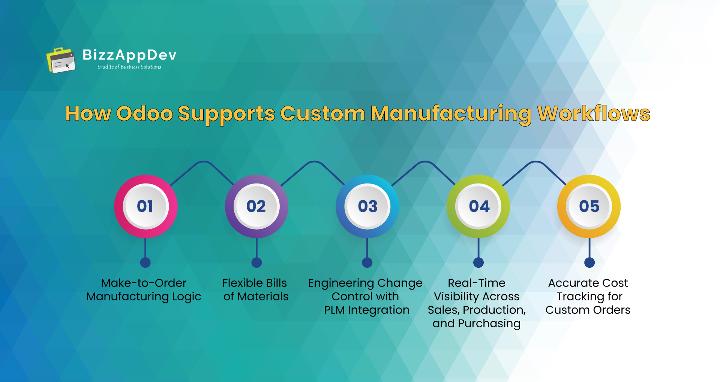
How Odoo Supports Custom Manufacturing Workflows
Odoo is designed as a flexible manufacturing ERP that supports real-world production variability while maintaining traceability and governance.
In short, Odoo helps manufacturers by:
- Driving production and purchasing from actual customer demand
- Managing configurable and variant-driven BOM structures
- Maintaining cost control and change discipline across departments
Below is how this works in practice.
Make-to-Order Manufacturing Logic
For businesses that manufacture only after receiving confirmed orders, Make-to-Order (MTO) is essential. In Odoo, sales orders can trigger manufacturing orders using routing rules such as Manufacture or Buy. This ensures that production and procurement are driven by real demand rather than forecasts.
In day-to-day operations, this means:
- Manufacturing begins only after order confirmation
- Required components are procured through defined routes and procurement rules
- Inventory is not built or committed in advance unless intentionally planned
Manufacturers using this approach often find it especially effective for custom machinery, fabricated products, and project-based manufacturing where demand is irregular.
Flexible Bills of Materials (How It Actually Works)
Odoo does not rely on constant ad-hoc BOM edits at the manufacturing order level. Instead, flexibility comes from structured BOM design, which protects data integrity as complexity increases.
Manufacturers typically manage variability using:
- Variant-specific BOM lines controlled by product attributes
- Phantom (kit) BOMs for configurable sub-assemblies
- Multi-level BOMs where sub-assemblies automatically trigger their own manufacturing orders
Order-level adjustments are intentionally limited to component consumption tweaks or manual additions. This prevents uncontrolled BOM changes while keeping planning, costing, and reporting reliable.
In real manufacturing environments, this approach delivers flexibility without sacrificing operational discipline.
Engineering Change Control with PLM Integration
Engineering changes are common in custom manufacturing. Odoo strengthens change management through close integration with Product Lifecycle Management (PLM).
With PLM-enabled workflows, teams can:
- Maintain versioned BOMs with clear revision histories
- Apply approval workflows before changes take effect
- Propagate approved changes without disrupting active manufacturing orders
This allows designs to evolve while protecting ongoing production and ensuring traceability across revisions, a critical requirement for regulated or engineering-driven manufacturers.
Real-Time Visibility Across Sales, Production, and Purchasing
One of the most common operational complaints in custom manufacturing is misalignment between teams. Odoo addresses this by linking sales orders, manufacturing orders, and purchasing documents in a single flow.
When requirements change, teams can immediately see:
- How production schedules are affected
- Whether additional components must be sourced
- If existing inventory can still be used
This shared visibility reduces internal back-and-forth and helps teams respond quickly without relying on emails or spreadsheets.
Accurate Cost Tracking for Custom Orders
Custom manufacturing often struggles with margin visibility. When BOMs vary and changes occur mid-process, understanding true order-level profitability becomes difficult.
Odoo tracks production costs across the workflow, including:
- Material costs based on actual purchase prices
- Labor costs captured from work centers
- By-product and scrap valuation where applicable
For accurate labor costing, Work Orders must be enabled so operation time is recorded consistently. When production data is maintained correctly, Odoo provides reliable order-level costing that supports better pricing and margin decisions.
Managing Purchasing for Variable BOMs
Custom BOMs usually lead to custom purchasing. Components may differ by order, suppliers may vary, and lead times can change.
Automatic Purchase Triggers from Manufacturing
When required components are not available in stock, Odoo generates purchase RFQs or purchase orders automatically based on defined routes and procurement rules.
This ensures:
- Purchasing is driven by actual production demand
- Manufacturing and procurement stay aligned
- Manual follow-ups and delays are reduced
Vendor Management for Changing Requirements
Odoo supports multiple vendors per product, including vendor-specific pricing, lead times, and conditions. Supplier flexibility is handled through vendor records and purchase agreements rather than informal mid-order changes.
Supplier selection typically occurs at the RFQ or purchase order stage and may require approval depending on purchasing rules. This keeps sourcing flexible while maintaining auditability and cost control.
Approval Workflows for Control
Custom purchases often involve higher costs or non-standard items. Odoo supports configurable approval workflows that enforce control without slowing operations unnecessarily.
Approvals can be structured based on:
- Purchase value thresholds
- Component categories
- Departmental or project-based rules
This ensures accountability while allowing teams to move forward efficiently.
Automation That Reduces Manual Effort (Without Losing Oversight)
One of Odoo’s strengths is how automation connects departments without removing human control.
- Manufacturing orders drive procurement actions
- Inventory levels update in real time
- Cost data flows into accounting without duplicate entry
For growing manufacturers, this level of integration often determines whether complexity remains manageable or becomes overwhelming.
Real-World Manufacturing Scenarios
Custom Equipment Manufacturing
A business builds equipment based on client specifications. Each order may require different components. Odoo selects the appropriate BOM based on configuration and generates purchasing documents for required materials. Approved changes flow through production without confusion.
Furniture or Modular Product Manufacturing
Dimensions and materials vary by order. Instead of creating new products repeatedly, manufacturers rely on variant-driven BOMs. Inventory and costing remain accurate despite frequent changes.
Fabrication and Assembly Businesses
Each job has unique requirements but reporting and planning remain consistent across projects thanks to order-driven production workflows.
Best Practices for Handling Variable BOMs in Odoo
Technology alone does not solve complexity. How it is used matters just as much.
- Keep variant structures simple and intentional
- Enable Operations Time and Quality apps early
- Use native multi-level BOMs and procurement rules before custom code
- Avoid over-customization many issues are process-related
- Train teams on workflows and change discipline, not just screens
A well-planned Odoo implementation often delivers better results than heavy customization. For unique needs, selective use of Odoo customization services can extend functionality without compromising system stability.
Is Odoo the Right Fit for Your Manufacturing Model?
Odoo works particularly well for businesses that:
- Manufacture based on confirmed customer orders
- Handle frequent but manageable product variations
- Require strong coordination between sales, production, and purchasing
Odoo also supports many engineer-to-order scenarios through configurators and variant-driven BOM logic. Highly complex environments may extend native capabilities using community or OCA modules.
The key is not expecting software to fix broken processes. When aligned with clear workflows and governance, Odoo becomes a reliable operational backbone.
Final Thoughts
Custom manufacturing will always involve complexity. The goal is not to eliminate it, but to manage it with clarity and confidence.
Odoo for Manufacturing Businesses provides a flexible, structured framework that connects custom orders, variable BOMs, purchasing, and production into a single controlled flow. When implemented thoughtfully, it helps teams move faster, make better decisions, and scale without losing operational control.
If you are looking to bring structure to custom manufacturing without sacrificing flexibility, Odoo is worth serious consideration, not as a quick fix, but as a long-term operational partner.
Not sure if your manufacturing workflows fit Odoo’s model?
Explore how Odoo handles custom production before making a decision.
FAQs
Yes. Odoo supports configuration-based BOM selection and controlled adjustments while maintaining traceability and reporting accuracy.
Changes can be reviewed, approved, and applied through structured PLM and manufacturing workflows.
Yes. Manufacturing demand can automatically generate RFQs or purchase orders based on procurement rules.
Yes. Odoo supports many ETO scenarios effectively when variant logic and governance are clearly defined.