
Running a hotel involves far more than managing rooms and reservations. Modern properties operate as complex service organizations with front office teams, housekeeping, food and beverage units, maintenance crews, finance departments, and procurement staff working simultaneously. When these functions rely on disconnected tools, inefficiencies quickly build up. That’s why many operators are exploring Odoo for hospitality industry operations, not as a hotel booking system, but as a unified platform to coordinate business processes across departments.
Instead of juggling separate systems for accounting, inventory, purchasing, HR, and reporting, an integrated ERP approach provides leadership with real visibility into operations. Odoo can also integrate with existing reservation or property management systems (PMS) through APIs, middleware, or custom connectors, allowing hotels to keep their booking tools while improving back-office efficiency and consolidated reporting. The result isn’t just smoother operations, its better cost control, faster decisions, and a more consistent guest experience.
This guide explains how Odoo supports hospitality businesses, where it fits alongside PMS systems, and whether it is the right ERP for your property.
Why Hotel Operations Become Inefficient at Scale
Most operational challenges in hospitality don’t appear overnight. They grow gradually as services expand, departments multiply, or multiple properties are added.
Departmental Silos Create Blind Spots
Front office teams focus on occupancy and guest interactions. Housekeeping tracks room readiness. F&B monitors stock and service. Finance manages payments and budgets. Without a shared platform, each department operates independently, making it difficult for leadership to see the full picture.
Manual Purchasing Slows Operations
Hotels consume large quantities of supplies, linens, toiletries, food ingredients, maintenance materials, and cleaning products. Many properties still rely on emails, phone calls, or spreadsheets for approvals. This slows procurement and makes budget control difficult.
Vendor Coordination Becomes Complex
Hospitality businesses typically depend on numerous vendors for daily operations. Tracking contracts, pricing agreements, delivery schedules, and payment status across multiple suppliers can become time-consuming without a centralized system.
Limited Real-Time Visibility
Managers often identify problems only after they affect service, stock shortages during peak occupancy, delayed maintenance work, or unexpected cost overruns.
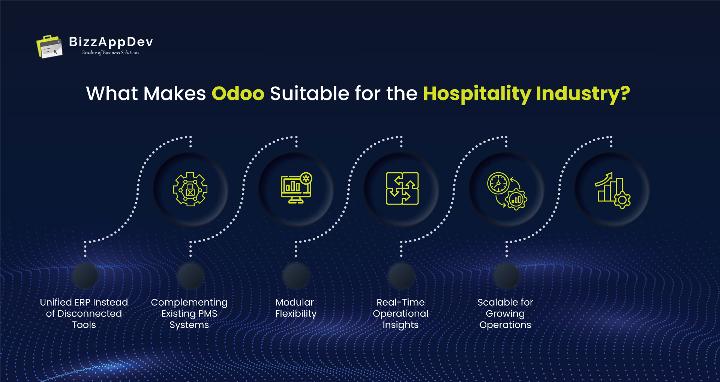
What Makes Odoo Suitable for the Hospitality Industry?
Traditional hotel systems focus mainly on reservations and guest stays. Odoo takes a broader approach by managing the business side of hospitality operations.
Unified ERP Instead of Disconnected Tools
Odoo connects finance, procurement, inventory, HR, and back-office operations in a single database. Departments share information automatically, reducing manual coordination.
Complementing Existing PMS Systems
Odoo is not a native hotel PMS. Instead, it integrates with booking engines or property management systems through APIs or custom connectors while handling accounting, purchasing, payroll, and supply chain processes behind the scenes.
Modular Flexibility
Organizations can deploy only the modules they need, accounting, inventory, purchasing, HR, CRM, maintenance, or POS, and expand later as requirements grow.
Real-Time Operational Insights
Dashboards provide live data on expenses, stock levels, vendor performance, and workforce utilization, enabling proactive decision-making.
Scalable for Growing Operations
As properties add services, departments, or locations, Odoo can scale without requiring a complete system replacement.
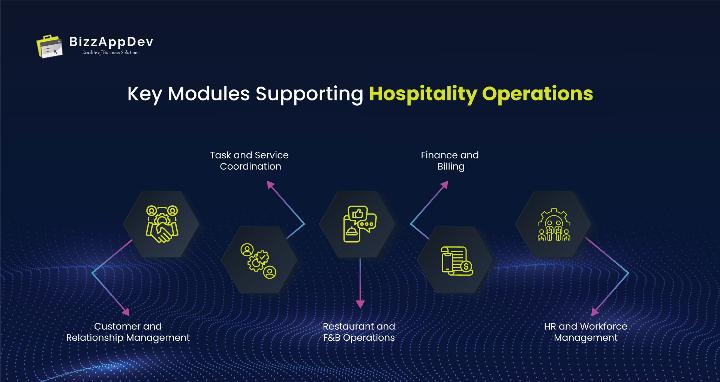
Key Modules Supporting Hospitality Operations
While Odoo is not a hotel-specific solution out of the box, its modules align well with hospitality workflows when configured properly.
Customer and Relationship Management
Guest data, corporate clients, travel partners, and communication history can be managed centrally. This supports marketing initiatives, loyalty programs, and repeat business.
Task and Service Coordination
Operational activities such as housekeeping tasks or maintenance requests can be managed using modules like Projects, Field Service, or Maintenance. These workflows typically require configuration or customization to reflect hotel-specific processes.
Restaurant and F&B Operations
Odoo’s point-of-sale system supports restaurant operations, including table management, kitchen workflows, and real-time sales tracking. Transactions automatically update inventory and accounting records.
Finance and Billing
All revenues and expenses flow into one accounting system, simplifying financial reporting, compliance, and profitability analysis across departments or properties.
HR and Workforce Management
Staff scheduling, attendance tracking, payroll, and performance data can be handled centrally, helping managers align labor resources with demand.
Streamlining Procurement and Vendor Management
Procurement is one of the most complex areas in hospitality due to high consumption volumes and fluctuating demand.
Centralized Purchasing Across Departments
Departments can submit purchase needs through structured workflows (such as approval requests or requisitions configured using the Approval or Purchase modules) instead of emails or paper forms. Procurement teams can consolidate orders, negotiate pricing, and prevent duplicate purchases.
Structured Approval Workflows
Approval rules can be configured based on budget limits, departments, or user roles, ensuring accountability while maintaining speed for routine purchases.
Vendor Records and Performance Tracking
A centralized vendor database stores contracts, pricing agreements, delivery timelines, and transaction history. This helps organizations evaluate supplier reliability over time.
Inventory Integration
Procurement connects directly to inventory levels. When stock falls below predefined thresholds, replenishment actions can be triggered automatically, reducing the risk of shortages.
For properties planning a full rollout, experienced partners providing Odoo implementation support can help map procurement workflows accurately and ensure smooth adoption across departments.
Automation That Reduces Daily Operational Load
Automation helps hospitality teams focus on service rather than administrative work.
Automated Replenishment
The system can generate purchase orders automatically based on reordering rules, minimum stock levels, and supplier lead times, ensuring essential supplies remain available.
Demand Planning Using Historical Data
Consumption patterns and historical usage can guide procurement planning through forecasting tools, reporting analytics, and replenishment rules.
Invoice Matching and Payment Tracking
Supplier invoices can be matched with purchase orders and delivery receipts (three-way matching), reducing manual verification and errors.
Alerts and Notifications
Managers can receive warnings about delayed deliveries, unusual spending, or inventory risks before they disrupt operations.
How a Typical Department Workflow Might Look
Consider a common operational scenario:
- Housekeeping identifies low stock of linens or amenities.
- A requisition or approval request is submitted through the system.
- The request is reviewed according to approval rules.
- Procurement converts the approved request into a purchase order.
- Upon delivery, inventory levels update automatically.
- Finance processes the supplier invoice.
This structured workflow replaces fragmented communication and improves accountability across teams.
Business Benefits Beyond Efficiency
An integrated ERP platform affects both internal performance and guest satisfaction.
Better Cost Control
Real-time expense tracking helps prevent overspending and supports data-driven budgeting.
Faster Decision-Making
Leadership teams can access consolidated reports instantly rather than waiting for departmental updates.
Consistent Service Delivery
Efficient back-office operations allow staff to focus on guest interactions and service quality.
Compliance and Audit Readiness
Centralized records simplify reporting and documentation for audits or regulatory requirements.
Scalable Growth
Standardized processes help maintain operational consistency as organizations expand.
Organizations with unique requirements may benefit from tailored configurations through Odoo customization services, ensuring workflows reflect actual hospitality operations rather than generic business processes.
ERP vs PMS: Understanding the Difference
ERP platforms and PMS solutions serve different purposes but work best together.
Function | PMS | Odoo ERP |
Room reservations | ✔ | ✖ |
Check-in / Check-out | ✔ | ✖ |
Channel management | ✔ | ✖ |
Guest folios | ✔ | ✖ |
Finance & accounting | Limited | ✔ |
Procurement & vendors | Limited | ✔ |
Inventory management | Limited | ✔ |
HR & payroll | ✖ | ✔ |
Multi-department reporting | Limited | ✔ |
Integration between PMS and ERP enables consolidated financial and operational reporting across guest services and back-office functions.
When Odoo Is the Right Choice for Hospitality Businesses
Odoo is particularly valuable if your organization:
- Operates multiple departments or service lines
- Manages large volumes of procurement and vendors
- Runs restaurants, events, retail, or additional facilities
- Needs centralized financial control across properties
- Wants to reduce reliance on disconnected systems
Who Benefits Most
Growing Boutique Properties
As services expand, entry-level tools become insufficient. A unified platform prevents future fragmentation.
Resorts and Multi-Service Facilities
Properties offering dining, events, recreation, or retail services require coordination across many teams.
Multi-Location Hospitality Groups
Centralized reporting and standardized processes help leadership manage performance across properties.
Organizations Pursing Digital Transformation
Replacing manual workflows with structured digital processes improves efficiency and transparency.
Implementation Considerations Before Adopting Odoo
ERP adoption is a strategic initiative that affects people, processes, and technology.
Workflow Mapping
Existing processes should be documented carefully to ensure the system supports real operational needs.
Integration Requirements
Connections with booking platforms, payment gateways, or legacy systems may be required.
Data Migration
Financial records, vendor lists, inventory data, and employee information must be transferred accurately.
Training and Change Management
User adoption is critical. Structured training programs help teams transition smoothly.
Final Thoughts: Building a More Connected Hotel Operation
Hospitality businesses face constant operational pressure, fluctuating demand, rising costs, staffing challenges, and increasing guest expectations. Fragmented systems make these challenges harder to manage. A unified platform brings structure, visibility, and control across departments.
Exploring Odoo for hospitality industry operations is less about replacing booking systems and more about strengthening the backbone of the business. When procurement, finance, inventory, HR, and service teams share the same information, organizations can operate more efficiently and respond faster to change.
If your property is evaluating ways to streamline operations, improve cost control, and support long-term growth, an integrated ERP approach can provide a strong foundation while allowing your existing guest-facing systems to continue doing what they do best.
Not sure if Odoo is the right fit for your hotel operations?
Get a tailored walkthrough of your workflows, departments, and systems – and see what a unified ERP could realistically improve.
FAQs
Odoo is not a native PMS. It is typically used alongside or integrated with reservation systems to manage business operations.
Yes. Modular deployment allows organizations to start with core functions and expand later.
Centralized requests, automated approvals, vendor tracking, and inventory integration streamline procurement and reduce manual effort.
Yes. The integrated POS system can manage restaurant sales, tables, orders, inventory, and accounting.
Yes. Odoo’s multi-company capabilities allow centralized reporting and standardized processes across locations.
Timelines vary depending on property size, complexity, and customization needs.
Most properties require some configuration or customization to align the system with hotel-specific workflows.