
Agriculture businesses operate under constant pressure volatile input prices, seasonal demand, perishable inventory, and complex distribution networks. Many organizations still rely on spreadsheets or disconnected tools to manage procurement, inventory, and sales, which limits visibility and increases operational risk. This is where Odoo ERP for agriculture businesses provides a practical advantage.
Odoo is not a pre-built farming ERP. Instead, it is a flexible, modular ERP platform that agriculture and agribusiness organizations can adapt to manage supply chain, inventory, sales, and customer relationships efficiently. When configured correctly and extended where needed Odoo becomes a strong foundation for digital transformation across agriculture-related operations.
Why Agriculture Businesses Need an ERP for Supply Chain and Sales
Agriculture differs from most industries in one keyway: uncertainty. Production cycles are seasonal, demand can fluctuate unexpectedly, and inventory often has a limited shelf life. Managing these variables without an integrated system increases costs, waste, and operational complexity.
Unique Challenges in the Agricultural Supply Chain
Agricultural supply chains are typically multi-layered, involving suppliers, warehouses, transport partners, distributors, and end buyers. Without centralized data, businesses face:
- Limited real-time visibility across procurement and storage
- Difficulty managing lot numbers, batches, and expiry dates
- Inefficient coordination between inventory and logistics
- Weak traceability from supplier to customer
An ERP for agricultural supply chain management helps centralize these processes by connecting inventory, purchasing, logistics, and sales data within a single system. While Odoo does not include agriculture-specific supply chain workflows out of the box, its core Inventory, Purchase, and Logistics capabilities can be configured—or extended using industry-specific modules to function effectively as agriculture supply chain software.
The Importance of Integrated Sales and Distribution
Sales in agriculture are rarely straightforward. Pricing often varies by season, volume, or contract. Customers may include distributors, cooperatives, processors, or exporters, each with different fulfillment and billing requirements.
An ERP system integrates sales orders directly with inventory and accounting, enabling better control over order fulfillment, invoicing, and revenue tracking. This integration is essential for maintaining consistency and accuracy across high-volume agricultural operations.
Odoo as a Flexible ERP Platform for Agriculture
Odoo should be viewed as an ERP platform, not a ready-made agriculture product. Its strength lies in its modular architecture, which allows businesses to combine core ERP modules with third-party extensions or custom logic.
Core Odoo modules commonly used in agriculture-related businesses include:
- Inventory
- Purchase
- Sales
- CRM
- Accounting
- Quality
- Reporting and Dashboards
As an agribusiness management software, Odoo supports a wide range of business models, from input suppliers and cooperatives to processors and agricultural distributors, by adapting workflows rather than enforcing rigid processes.
Managing Agricultural Supply Chain with Odoo ERP
Procurement and Supplier Management
Procurement in agriculture often depends on seasonal availability and fluctuating prices. Odoo’s Purchase module enables structured supplier management and procurement planning.
With proper configuration, businesses can:
- Maintain supplier price lists and contracts
- Automate purchase orders using reorder rules and procurement configurations based on forecasted stock levels
- Implement approval workflows for cost control
Through Odoo supply chain management, procurement decisions become more data-driven, reducing last-minute purchases and improving supplier coordination.
Inventory Management for Agriculture
Inventory is one of the most sensitive areas in agriculture. Whether managing seeds, fertilizers, harvested produce, or processed goods, accuracy is critical.
Odoo’s Inventory module supports inventory management for agriculture through:
- Lot and batch tracking
- Expiry and shelf-life control
- Multi-location and multi-warehouse operations
- Forecasted stock views showing incoming and outgoing quantities
These capabilities enable reliable agricultural inventory tracking. Agriculture-specific workflows, such as linking harvest activities to inventory entries, are typically implemented using third-party modules or custom development layered on top of core inventory features.
Forecasting and Traceability
Odoo provides forecasted inventory reports that display expected stock levels based on confirmed sales orders, purchase orders, and internal operations. These tools help businesses plan replenishment more effectively.
It is important to clarify that Odoo does not automatically predict agricultural demand. Instead, forecasting is based on historical data and configured rules. Advanced demand forecasting may require additional analytics tools or optional add-on modules.
Traceability is handled through lot and serial number tracking across inventory movements. This supports quality assurance, recalls, and compliance needs related to traceability in the agricultural supply chain. Sector-specific traceability—such as linking field-level data to inventory lots—usually requires customization or specialized extensions.
Optimizing Sales Operations with Odoo for Agriculture Businesses
Sales Management for Seasonal and Contract-Based Pricing
Agricultural sales often involve bulk pricing, seasonal discounts, and long-term agreements. Odoo’s Sales module supports these scenarios through flexible price lists, quotation templates, and order workflows.
With Odoo sales management for agriculture, businesses can:
- Apply customer- or season-specific pricing
- Automate quotations and order confirmations
- Track deliveries and invoicing in sync with inventory
This structure supports accurate ERP for agricultural sales tracking while reducing manual errors.
Customer and Dealer Management with Odoo CRM
Relationship management is essential in agriculture, where trust and repeat business matter. Odoo’s CRM module centralizes customer and dealer data, enabling better visibility into sales pipelines and interactions.
Using Odoo CRM for agriculture, organizations can:
- Track leads and opportunities
- Maintain customer and distributor histories
- Improve follow-ups and service consistency
CRM in Odoo is enhanced by AI-assisted insights such as lead scoring and activity suggestions, which support but do not replace structured sales workflows.
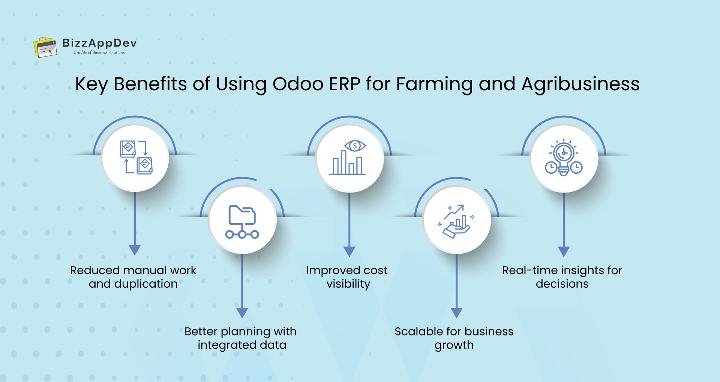
Key Benefits of Using Odoo ERP for Farming and Agribusiness
ERP adoption is a strategic investment. When implemented properly, Odoo delivers long-term operational value.
Agriculture ERP Solution Benefits
- Reduced manual work and data duplication
- Better planning through integrated procurement, inventory, and sales data
- Improved cost visibility across operations
- Scalability to support growth and diversification
- Real-time dashboards for informed decision-making
These agriculture ERP solution benefits help agribusinesses remain competitive in dynamic and regulated markets.
Odoo ERP Implementation and Customization for Agribusiness
No two agriculture businesses operate the same way. Crop types, compliance requirements, and distribution models vary widely, making implementation strategy critical.
A well-executed Odoo implementation focuses on configuring core modules to match real workflows inventory structures, procurement logic, sales processes, and reporting needs.
In many cases, Odoo customization services or third-party agriculture modules are used to support:
- Seasonal production or harvest tracking
- Custom reporting for yield, cost, or compliance
- Integration with external systems such as logistics or weighing solutions
Customization should enhance usability while maintaining upgrade compatibility.
Odoo ERP Use Cases in the Agriculture Industry
Odoo’s flexibility allows it to support diverse agriculture-related operations.
Common Use Cases
- Agricultural cooperatives: Centralized purchasing, shared inventory, and member sales tracking
- Agri-input distributors: Seed and fertilizer inventory management with lot and expiry control
- Processors and distributors: Quality checks, traceability, and distribution coordination
These examples represent practical Odoo ERP use cases in the agriculture industry, where core ERP functionality is extended to meet sector-specific needs.
How Odoo Compares to Other Agriculture ERP Systems
Some ERP systems marketed for agriculture are highly specialized but lack flexibility. Others are comprehensive but costly to scale.
Odoo stands out by offering:
- Modular deployment instead of full-suite lock-in
- Flexibility to adapt across multiple agribusiness models
- Potentially lower long-term ownership costs when implemented and maintained correctly
This makes Odoo a strong option when evaluating the best ERP software for agriculture businesses, especially for organizations seeking adaptability rather than rigid industry templates.
Conclusion: Building a Resilient Agriculture Business with Odoo ERP
Agriculture businesses face unique operational challenges that require adaptable, scalable systems. Odoo ERP for agriculture businesses provides a reliable foundation for managing supply chain, inventory, sales, and customer relationships, when implemented with the right configuration and extensions.
By leveraging Odoo’s core ERP strengths and tailoring them to industry-specific needs, agribusinesses can improve visibility, reduce inefficiencies, and make more informed decisions across their value chain. The result is a more resilient, future-ready organization capable of navigating the complexities of modern agriculture.
Ready to bring more control and visibility to your agriculture operations?
Explore how Odoo ERP can be configured to manage your supply chain, inventory, and sales, aligned with the real needs of your agribusiness.
FAQs
Yes. While not agriculture-specific out of the box, Odoo can be configured and extended to support agribusiness supply chain, inventory, and sales operations.
Yes. Odoo supports lot tracking, expiry dates, and traceability across inventory movements.
Yes. Flexible price lists and sales workflows support seasonal and contract-based pricing.
Odoo offers greater flexibility and scalability, making it suitable for diverse agribusiness models.