
If you manage an online store with hundreds or thousands of products, you know the quiet chaos behind the scenes. Variants multiply. Categories get messy. Prices change in one place but not another. Stock levels don’t match what customers see. What starts as a simple catalog slowly becomes a daily operational headache.
An Odoo eCommerce website is built for this exact situation. Not as a standalone storefront, but as part of a connected system where products, inventory, pricing, purchasing, and vendors all live in one place. That structure changes how large catalogs are managed day to day and why many growing businesses stop fighting their catalog and start controlling it.
Why Large Product Catalogs Break Traditional eCommerce Systems
Most eCommerce tools work well when catalogs are small and simple. Trouble begins when:
- One product has 10–50 variants (size, color, specs, material)
- Categories are added reactively instead of by design
- The same product appears in multiple places with slight differences
- Pricing rules vary by customer type or quantity
- Inventory is tracked in a separate system from the website
Over time, teams start using workarounds:
- Duplicate listings for variants
- Manual stock updates
- Spreadsheets to track pricing
- Extra categories just to make filters work
This creates operational confusion, poor browsing experience, and SEO issues from duplicate or messy product pages. The platform isn’t failing because it’s bad. It’s failing because it was never designed for large product catalog management.
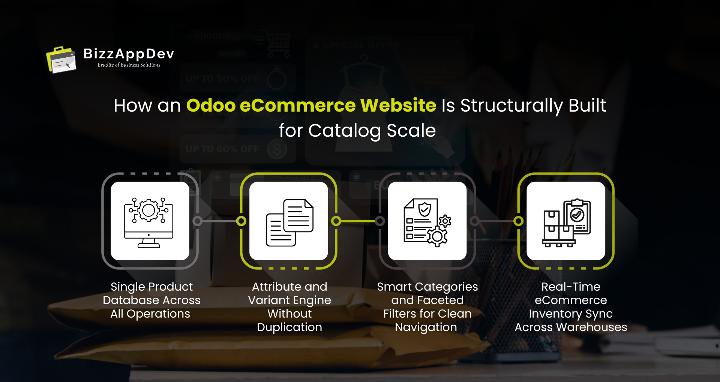
How an Odoo eCommerce Website Is Structurally Built for Catalog Scale
An Odoo eCommerce website manages large catalogs using product templates and variants, where each variant is a real SKU connected to inventory, pricing, vendors, and purchasing while appearing as a single product page to customers.
What makes this possible inside Odoo is the shared foundation between website, sales, inventory, and procurement.
Within Odoo, inventory is exclusively tracked at the variant level, and variant-level pricelist or vendor settings take precedence over template-level defaults.
These variants are presented on the website using selectors such as dropdowns, color swatches, or buttons, based on how attributes are configured.
Single Product Database Across All Operations
When a product is created, it becomes instantly available for:
- Website listing
- Sales orders
- Inventory tracking
- Procurement planning
- Pricing configuration
You update it once. It updates everywhere because there is no duplication of data between systems.
Attribute and Variant Engine Without Duplication
Attributes like size, color, or specifications are used to generate variants. For very large attribute sets, Odoo allows selective variant creation, so you choose which combinations become actual SKUs.
This means:
- No duplicate listings
- No SEO issues from variant URLs
- Easier product variant management at scale
Each variant behaves independently in the backend while appearing unified on the frontend, and can have its own vendor, cost, barcode, and stock level.
Smart Categories and Faceted Filters for Clean Navigation
Odoo uses two category systems:
- Internal Product Categories (inventory, accounting, reporting)
- eCommerce Categories (website navigation)
Internal categories support operations, while eCommerce categories support browsing.
Filters on the website are driven primarily by attributes and product tags, while eCommerce categories control navigation structure.
This enables true faceted search filters without creating category clutter. As products grow, filters update automatically from attributes.
Real-Time eCommerce Inventory Sync Across Warehouses
Stock visibility on the website is based on live inventory data. You can configure whether to show:
- On Hand quantity
- Forecasted quantity
- In stock / Out of stock messages
This is controlled through stock settings, including whether out-of-stock products are hidden, displayed, or allowed for backorder.
On the website, available quantity is calculated from stock levels (On Hand or Forecasted), and can be configured to account for reserved quantities depending on inventory settings.
Managing Thousands of Product Variants Without Chaos
Variants are where most catalogs break down.
- Apparel: 6 sizes × 8 colors stays one product with selectable options
- Electronics: specs become attributes customers filter by
- Furniture/Industrial: material and dimensions as attributes, not new listings
Each variant is a real SKU, but customers browse one page.
Inventory, Pricing, and Website Sync in Real Time
Catalog complexity is often pricing and stock complexity.
Centralized Stock Management
Stock per variant, per warehouse, updates the website automatically.
Advanced Pricelists and Pricing Rules
Pricelists can apply by:
- Product or variant
- Category
- Customer
- Minimum quantity
- Date range
Pricelists can be layered, for example, a customer-specific rule may override a category rule, and applied automatically based on defined conditions.
This supports retail, wholesale, and bulk pricing without manual edits.
Multi-Warehouse Visibility
Website availability can be calculated from a specific warehouse or across all warehouses.
Purchasing, Vendors, and Reordering Automation
Odoo prepares procurements through reordering rules and routes. The procurement scheduler runs at scheduled intervals to evaluate stock rules and generate RFQs for the appropriate vendors.
Vendors can also be prioritized so Odoo automatically selects the preferred supplier during procurement.
Purchase approvals can be tailored according to company policy, including multi-step approvals for high-value procurements.
Sales orders from the website or other channels increase inventory demand, and when that demand triggers reordering rules, Odoo will create procurements accordingly.
Who Benefits Most from an Odoo eCommerce Website
This structure is ideal for:
- Fashion & lifestyle
- Electronics & spare parts
- Furniture & home goods
- Industrial suppliers
- Wholesale & B2B catalogs
These businesses struggle with SKU management and navigation more than traffic.
From Catalog Chaos to Controlled Growth
When the structure is right:
- Teams stop correcting listings
- Customers find products faster
- Pricing stays consistent
- Stock reflects reality
- Purchasing becomes proactive
This transformation often begins during a thoughtful Odoo implementation where catalog structure is planned correctly from day one.
As needs evolve, Odoo Customization Services help adapt catalog logic without breaking the foundation.
The difference is not the website design. It’s the system behind the catalog.
A Practical Way to Think About Catalog Management
Large catalogs don’t fail because teams are careless. They fail because the system underneath wasn’t built for complexity.
An Odoo eCommerce website connects products, inventory, pricing, and purchasing into one process. Once that connection exists, catalog management becomes predictable instead of stressful.
Explore how your current catalog would look inside this system with a practical walkthrough.
FAQs
Yes. Odoo uses templates and variants where each variant is a real SKU connected to inventory, pricing, and vendors while customers see one product page.
Variants are created through attributes under one template, so customers select options instead of browsing separate listings.
Yes. Stock updates at the variant level are reflected on the website in real time.
Filters come from attributes and tags, while eCommerce categories manage navigation.
Yes. Reordering rules, routes, and the procurement scheduler generate RFQs based on stock levels.
Yes. Customer-specific pricelists, bulk pricing, minimum quantities, and portal reordering support B2B needs.