
Cross-functional projects rarely fail because teams lack skill. They fail because work happens in disconnected systems, approvals sit in inboxes, and external dependencies aren’t visible until deadlines slip. This is where Odoo project management can make a real difference. Rather than acting as a standalone task tracker, it serves as a central workspace connected to sales, purchasing, accounting, HR, inventory, and communication tools.
For growing organizations managing multiple departments and external partners, that shared visibility helps teams coordinate work without constant follow-ups. The goal is not just tracking tasks; it’s aligning the operational processes that drive delivery.
This guide explains how Odoo project management helps businesses coordinate teams, approvals, vendors, and timelines on a single platform.
At a Glance: How Odoo Aligns Cross-Functional Teams
- Centralizes tasks, documents, and communication
- Connects projects with sales, purchasing, and finance
- Provides real-time visibility for stakeholders
- Tracks costs, revenue, and profitability
- Supports resource planning across departments
- Improves accountability and reduces delays
Why Cross-Functional Projects Fail as Organizations Grow
As organizations expand, coordination becomes more complex. Departments adopt tools optimized for their own needs, but those tools rarely integrate well.
Siloed Tools and Fragmented Communication
Marketing may use campaign platforms, operations rely on spreadsheets, finance uses accounting software, and project teams communicate through email or chat. Information becomes scattered, and updates do not reach everyone who needs them.
Approval Delays That Stall Execution
Budget approvals, procurement requests, and scope changes often sit outside the project environment. Teams only discover delays when work cannot proceed.
Vendor Dependencies Without Visibility
External suppliers frequently determine whether timelines hold. When vendor communication lives in procurement systems instead of project workflows, risks remain hidden.
Limited Real-Time Accountability
Without shared dashboards, leaders depend on status meetings rather than live data. By the time problems surface, corrective action becomes harder and more costly.
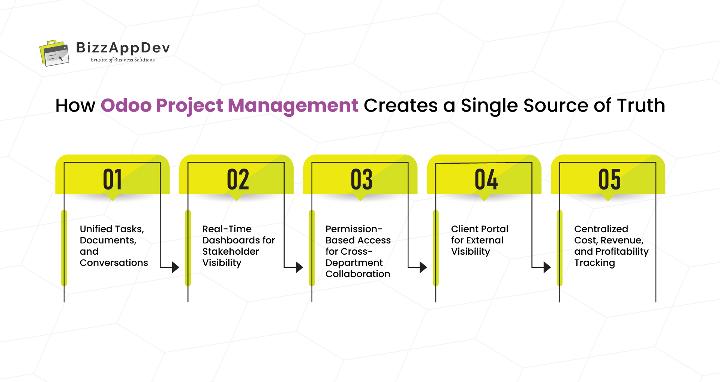
How Odoo Project Management Creates a Single Source of Truth
The strength of Odoo lies in integration. Projects connect directly to the business processes that support them.
Odoo project management software centralizes tasks, files, discussions, timesheets, and deadlines while linking them to related records such as sales orders, invoices, purchases, and documents from other modules.
Each project is typically associated with an analytic account that consolidates related costs, revenues, and operational data.
Unified Tasks, Documents, and Conversations
Each task becomes a collaboration hub. Teams can attach files, log time, add internal notes, schedule activities, and discuss issues using the built-in communication thread. This reduces scattered communication across email chains and shared drives.
Real-Time Dashboards for Stakeholder Visibility
Managers can monitor progress, workload, and deadlines through configurable views such as Kanban boards, lists, and Gantt charts, while financial performance is tracked through linked analytic accounting, timesheets, and dedicated reporting tools.
Permission-Based Access for Cross-Department Collaboration
Access controls ensure users see only relevant information based on their responsibilities. Finance teams can track costs, procurement teams manage orders, and project managers oversee delivery without exposing sensitive data.
Organizations adopting the platform typically benefit from a structured Odoo implementation to define project templates, permissions, and workflows that support collaboration from the start.
Client Portal for External Visibility
Odoo allows controlled sharing of project information with customers through a secure portal. The exact information available depends on project configuration and sharing settings, and internal discussions can remain private.
For service businesses, this transparency builds trust and reduces misunderstandings about scope, timelines, or deliverables.
Centralized Cost, Revenue, and Profitability Tracking
Projects can be linked to analytic accounts that consolidate financial data from across the system. Costs from purchases, expenses, and timesheets, along with revenue from sales or invoices, feed into a single profitability view.
This enables decision-makers to evaluate not only progress but also financial performance in real time.
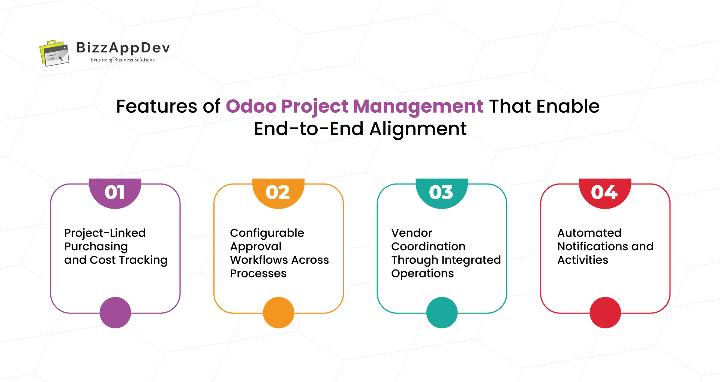
Features of Odoo Project Management That Enable End-to-End Alignment
Odoo’s value comes from connecting project activities with operational workflows across the ERP.
Project-Linked Purchasing and Cost Tracking
Procurement activities are handled in the Purchase application but can be tied to projects through analytic accounts, analytic distributions, or related documents, depending on configuration.
In service-based workflows, projects or tasks may also originate from sales orders, linking delivery activities directly to customer commitments.
Materials or subcontracted services required for a project can therefore be purchased through standard procurement processes while remaining financially connected to the project.
Configurable Approval Workflows Across Processes
Approval mechanisms exist across several modules, such as purchasing, expenses, and dedicated approval workflows each configurable according to business rules.
Requirements may depend on amount thresholds, department ownership, or internal policies. Requests move through predefined approval chains, improving transparency and reducing manual follow-ups.
Vendor Coordination Through Integrated Operations
Supplier orders, delivery receipts, and vendor bills are managed in purchasing and inventory modules but can be associated with project costs and monitored alongside project timelines.
Delivery status is typically managed through inventory workflows while remaining financially linked to the project.
Automated Notifications and Activities
Automated actions can trigger emails, reminders, or task updates when specific conditions are met. For example, when a task changes stage or a purchase order is confirmed, relevant stakeholders can be notified automatically.
Managing Dependencies Across Departments in Odoo
Complex initiatives involve sequences of work across sales, operations, procurement, finance, and delivery teams.
Linking Sales, Procurement, and Execution
Projects often originate from confirmed sales orders. This connection ensures teams understand contractual commitments, scope, and deadlines throughout execution.
Resource Planning Across Functions
Workforce allocation typically uses the Planning application for scheduling resources based on availability, while timesheets track the actual effort spent on tasks. Managers can compare planned versus actual utilization to identify overload or underuse.
Identifying Bottlenecks Early
Task dependencies and scheduling tools help teams visualize sequences of work. If one stage slips, downstream impacts become visible, enabling proactive adjustments.
Advanced project scheduling scenarios may require additional configuration or specialized planning approaches.
Real-World Use Cases of Odoo Project Management
Organizations across industries use Odoo to coordinate complex initiatives.
Product Launch Coordination
Launching a new product requires alignment between marketing, procurement, production, sales, and support teams. Shared project plans help ensure readiness across all functions.
Client Delivery Projects
Service organizations can manage deliverables, track billable hours through timesheets, monitor costs, and generate invoices based on timesheets, milestones, or contractual terms.
Infrastructure or Implementation Initiatives
Internal projects such as facility upgrades or system deployments involve technical teams, external vendors, and business stakeholders. Integrating external tools through Odoo integration services can further streamline these initiatives.
This is common in ERP deployments, system migrations, and digital transformation programs.
Marketing–Sales Campaign Alignment
Campaign planning, lead follow-up, and performance tracking can be coordinated as interconnected tasks linked to CRM activities.
Implementation Best Practices for Enterprise Teams
Technology alone does not guarantee alignment. Successful adoption requires thoughtful configuration and governance.
Structure Projects Around Deliverables
Organize tasks by outcomes rather than departmental ownership to encourage shared accountability.
Define Clear Governance
Specify decision owners, approval authorities, and escalation paths so teams know how issues will be handled.
Configure Approval Hierarchies Carefully
Balance control with speed. Too many approvals slow execution, while too few increased risk.
Drive User Adoption Through Training
Teams must understand how the system simplifies their work. Demonstrating practical benefits fewer emails, clearer priorities, and faster approvals improves engagement.
Is Odoo Project Management the Right Fit for Your Organization?
Odoo delivers the most value when projects intersect with broader business operations.
Ideal for Process-Driven Organizations
Companies coordinating multiple departments, vendors, or complex deliverables benefit most from centralized visibility.
Strong ROI When Projects Impact Financials and Operations
When project activities affect purchasing, inventory, staffing, or billing, integrated systems reduce manual reconciliation and improve financial oversight.
Simpler Tools May Suffice for Small Teams
Organizations with minimal cross-department coordination may find lightweight tools adequate.
Key Benefits of Odoo Project Management for Decision-Makers
When properly configured, Odoo supports more predictable execution across teams.
- Faster delivery cycles through reduced handoff delays
- Improved financial control via real-time profitability insights
- Stronger accountability with visible responsibilities and progress
- Lower coordination overhead by reducing status-chasing
Organizations that centralize project data typically spend less time managing communication and more time delivering outcomes.
From Siloed Execution to Aligned Delivery
Cross-functional alignment requires more than better communication. It requires systems that connect planning, execution, resources, and finances.
Odoo project management provides a unified workspace where project activities remain linked to the business processes that support them, including sales commitments, procurement, staffing, vendor coordination, and billing. Instead of managing projects in isolation, organizations gain a coordinated operating model.
In short, Odoo enables teams to move from reactive coordination to proactive execution.
If your organization struggles to keep departments aligned as projects grow in complexity, evaluating a unified platform can help identify gaps and opportunities for improvement.
See how your teams could work on one connected platform, request a practical walkthrough tailored to your workflows.
FAQs
Odoo project management is an ERP-integrated system for planning, executing, and monitoring projects while connecting them to operational processes such as sales, procurement, staffing, and billing.
By centralizing tasks, communication, documents, and business data in one environment, teams gain shared visibility and reduce misunderstandings.
Yes. Purchases and expenses can be associated with projects for cost tracking and budget control, even though procurement is managed through dedicated purchasing workflows.
It is well suited for mid-sized and growing enterprises that require coordination across departments and external partners.
Standalone tools focus primarily on task management. Odoo connects projects to financial, operational, and resource data, providing end-to-end visibility across the organization.