
Selling online today isn’t just about having a functional website. Customers move fluidly between online stores, physical locations, and digital touchpoints, expecting a consistent experience at every step. When systems don’t communicate with each other, this experience quickly breaks down—affecting both customer satisfaction and internal efficiency.
Odoo eCommerce integration addresses this challenge by bringing online sales, in-store operations, inventory, customer data, and backend processes into a single, connected platform. Instead of managing fragmented tools, businesses gain a unified commerce setup that supports omnichannel growth without operational complexity.
In this blog, we’ll explore how Odoo enables centralized commerce operations, why omnichannel readiness is critical today, and how businesses can build a scalable digital commerce ecosystem using one integrated platform.
What Is Odoo eCommerce Integration?
Odoo eCommerce integration refers to the direct connection between an online store and core business systems such as inventory, sales, accounting, CRM, and point of sale. Instead of managing separate tools for each function, businesses operate from a unified platform where data flows automatically across modules.
This integrated ERP and eCommerce approach reduces manual work, minimizes errors, and provides real-time visibility across the entire sales lifecycle. Orders placed online immediately update stock levels, customer profiles remain synchronized, and financial records stay aligned without manual reconciliation.
For growing retailers and B2B sellers, this creates a digital commerce ecosystem where sales, operations, finance, and support teams all work with the same accurate and up-to-date information, improving coordination and decision-making across the organization.
Why Unified and Omnichannel Commerce Matters Today
Customer behavior has evolved significantly. A buyer may discover a product online, compare options on a mobile device, and complete the purchase in a physical store—or follow the journey in reverse. When systems are disconnected, this experience often feels inconsistent and fragmented.
A strong omnichannel retail strategy ensures customers experience consistent pricing, availability, and service across every channel. Unified commerce goes a step further by centralizing backend operations, allowing businesses to respond faster and scale more efficiently.
Without centralized commerce operations, companies commonly face:
- Inventory mismatches across sales channels
- Delayed or inaccurate order fulfillment
- Inconsistent customer communication
- Limited visibility into overall performance
Odoo addresses these challenges by acting as a single source of truth, supporting operational efficiency while delivering a smoother cross-channel customer experience.
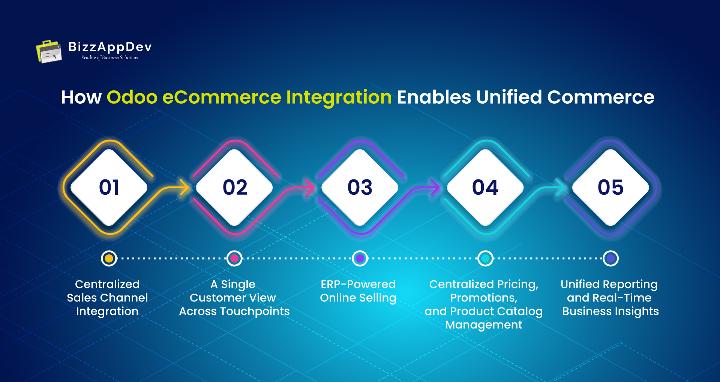
How Odoo eCommerce Integration Enables Unified Commerce
Centralized Sales Channel Integration
One of Odoo’s core strengths is managing multiple sales channels from a single platform. Businesses can run online stores, physical outlets, and B2B portals without switching between systems.
Through Odoo multichannel selling, all orders, regardless of source, flow into one centralized workflow. This makes Odoo sales channel integration ideal for handling diverse customer journeys and changing order volumes.
Key advantages include:
- Centralized order processing across channels
- Unified fulfillment, invoicing, and reporting
- Reduced duplication and operational friction
A Single Customer View Across Touchpoints
Modern commerce requires more than order history alone. Odoo builds a single customer view by combining online activity, in-store purchases, communication records, and preferences into one profile.
With Odoo customer data integration, sales, support, and marketing teams work from the same customer information, ensuring consistency across every interaction.
This enables businesses to:
- Personalize communication and offers
- Deliver consistent support across channels
- Strengthen long-term customer relationships
ERP-Powered Online Selling
Odoo differs from standalone eCommerce platforms by being built on a full ERP foundation. Online sales are directly linked to accounting, inventory, logistics, and operations.
Through ERP-powered online selling, orders automatically update financial records, tax calculations, and delivery workflows, removing the need for manual reconciliation.
This results in:
- Higher financial accuracy
- Better compliance management
- More efficient daily operations
Centralized Pricing, Promotions, and Product Catalog Management
Unified commerce depends on consistent pricing and product data. Odoo centralizes product catalogs, pricing rules, and promotions in one system.
Businesses can maintain consistent pricing across channels while still applying customer- or channel-specific rules when needed. Changes are reflected instantly across all sales touchpoints.
Key benefits include:
- Reduced pricing errors
- Faster promotion updates
- Consistent brand experience across channels
Unified Reporting and Real-Time Business Insights
Odoo eCommerce integration brings sales, inventory, customer, and financial data into a single reporting framework. Instead of working with fragmented reports, teams access real-time dashboards across channels.
Unified reporting helps businesses:
- Monitor performance in real time
- Identify trends and demand shifts early
- Make data-driven decisions with confidence
By working from one reliable data source, leadership teams gain clearer visibility and stronger control over both strategy and daily operations.
Odoo Omnichannel Retail Capabilities
Odoo supports omnichannel retail by combining flexibility with built-in automation. Businesses can design and manage online storefronts, control pricing rules, and launch promotions without heavy technical dependency.
Key Odoo online store features include:
- Mobile-optimized shopping experiences
- Dynamic product pages with advanced filtering
- Automated checkout and payment workflows
- Seamless integration with inventory and fulfillment
Together, these capabilities support a scalable eCommerce infrastructure that grows with the business while maintaining operational consistency and performance.
Real-Time Inventory and Order Management
Inventory inaccuracies are one of the most common challenges in omnichannel commerce. Odoo addresses this through real-time inventory management that synchronizes stock levels across all connected sales channels.
With Odoo inventory sync eCommerce, product availability updates instantly when a sale is made, online or in-store. This prevents overselling, reduces backorders, and builds long-term customer trust.
Order handling is managed through Odoo’s centralized sales workflows across Website and Sales modules. This allows teams to:
- Track order status in real time
- Manage returns and exchanges efficiently
- Optimize fulfillment based on stock location and availability
This level of visibility is essential for businesses managing high order volumes or multiple fulfillment points.
POS and eCommerce Integration for Online and Offline Sales
Modern retail blends digital and physical experiences. Odoo POS and eCommerce integration ensures both channels operate together rather than in silos.
Customers can:
- Buy online and pick up in-store
- Return online purchases at physical locations
- Receive consistent pricing and promotions
For businesses, this creates smoother operations and a better experience for both customers and store staff. It also simplifies how to manage online and offline sales with Odoo during peak demand periods.
Odoo eCommerce Automation: Reducing Manual Work
Manual processes slow growth and increase the risk of errors. Odoo’s automation capabilities help streamline repetitive tasks across the commerce lifecycle.
Through Odoo eCommerce automation, businesses can:
- Automatically confirm orders and payments
- Trigger inventory replenishment rules
- Send order and delivery notifications
- Generate invoices without manual input
This approach to eCommerce process automation improves accuracy, saves time, and allows teams to focus on strategic initiatives rather than routine administration.
How AI Integration in Odoo Simplifies Daily Commerce Operations
Beyond automation, AI capabilities within Odoo further enhance how teams manage unified and omnichannel commerce. AI-driven assistance is embedded directly into workflows, reducing the need to juggle multiple tools, tabs, or dashboards throughout the day.
Instead of switching between systems to check orders, inventory, customer history, or reports, users can access contextual insights within the same interface. AI helps surface relevant information, highlight exceptions, and support faster, more informed decision-making.
AI-supported workflows help businesses:
- Access order, inventory, and customer insights in one workspace
- Identify trends, delays, or stock risks early
- Reduce manual checks by highlighting priority actions
- Simplify reporting through summarized insights
To enable these capabilities effectively, organizations often need expertise beyond standard configuration. BizzAppDev helps with AI LLM integration within Odoo, allowing businesses to embed intelligent assistance directly into their commerce workflows. By leveraging large language models alongside Odoo, BizzAppDev enables contextual data retrieval, guided workflows, and intelligent summaries—without adding complexity or forcing users to move between systems.
By keeping information centralized and actionable, AI improves productivity while supporting a smoother cross-channel customer experience, especially for teams managing multiple sales channels and growing transaction volumes.
Want to make your Odoo workflows smarter without adding complexity?
Explore how AI LLM integration can simplify daily operations, surface the right insights at the right time, and help your teams work from one connected system instead of multiple tools.
Want to make your Odoo workflows smarter without adding complexity?
Explore how AI LLM integration can simplify daily operations, surface the right insights at the right time, and help your teams work from one connected system instead of multiple tools.
Benefits of Odoo Omnichannel Commerce for Growing Businesses
Adopting a unified commerce model with Odoo delivers clear benefits, particularly for businesses planning long-term growth.
Key benefits include:
- Operational efficiency: One platform instead of multiple disconnected tools
- Scalability: Add new channels without rebuilding workflows
- Better decision-making: Real-time visibility across sales and inventory
- Improved customer experience: Consistency across every touchpoint
These advantages make Odoo a practical omnichannel solution for growing businesses that require flexibility without losing control.
Why Integrate eCommerce with Odoo ERP Instead of Using Separate Tools?
Many businesses start with standalone eCommerce tools and integrate later. Over time, this fragmented setup becomes expensive and difficult to maintain.
Integrating eCommerce directly with Odoo ERP offers:
- Lower long-term operational costs
- Reduced reliance on third-party connectors
- Unified reporting and analytics
- Greater control over data and workflows
The advantages of omnichannel selling with Odoo lie in its ability to evolve alongside business needs rather than forcing frequent system changes.
Is Odoo eCommerce Integration Right for Your Business?
Odoo eCommerce integration is well suited for businesses that:
- Sell through both digital and physical channels
- Manage complex inventory or multiple locations
- Require centralized customer and order data
- Plan to scale without operational disruption
To achieve optimal results, many organizations work with experienced partners offering Odoo implementation expertise to ensure correct system setup. As business requirements evolve, Odoo customization services help adapt workflows, integrations, and user experiences without disrupting operations.
Final Thoughts
Unified and omnichannel commerce is no longer optional, it is a competitive necessity. By leveraging Odoo eCommerce integration, businesses can replace fragmented systems with a connected, efficient, and scalable commerce ecosystem.
With centralized data, automated workflows, AI-supported insights, and seamless channel integration, Odoo enables organizations to deliver consistent customer experiences while maintaining operational control. For businesses navigating complex markets and rising customer expectations, this unified approach provides clarity, confidence, and sustainable growth.
Ready to unify your eCommerce, retail, and backend operations on one platform?
Discover how a well-planned Odoo eCommerce integration can help you scale faster, operate smarter, and deliver consistent customer experiences across every channel.
FAQs
It connects the online store with inventory, sales, accounting, CRM, and POS modules so data flows automatically across all channels.
Odoo combines ERP and eCommerce into one system, providing centralized control over operations, customer data, and finances.
Yes. POS and eCommerce integration allows businesses to handle online orders, in-store sales, returns, and promotions from one platform.
Odoo supports omnichannel strategies through real-time visibility, automation, and scalable infrastructure.
Improved efficiency, accurate inventory, consistent customer experience, and easier scalability.