
Enterprise systems have always played a foundational role in how organizations manage operations, finances, and data at scale. Platforms like Odoo already offer a strong baseline for intelligent ERP through unified modules, automation, and real-time visibility.
As business environments become more dynamic and data continues to grow in volume and complexity, many organizations are beginning to explore how ERP systems could become more intuitive, more conversational, and more supportive in day-to-day decision-making.
This is where the potential of AI-powered ERP with Odoo begins to emerge, not as a replacement for existing ERP logic, but as an additional layer that could reshape how users interact with enterprise data.
Why Expectations from ERP Systems Are Shifting
Traditional ERP systems were designed around structured workflows, predefined reports, and rule-based automation. Odoo already goes beyond many legacy limitations through its modular architecture and integrated processes.
However, as organizations scale, some common friction points still appear:
- Business data distributed across multiple modules
- Reports that require interpretation or technical customization
- Heavy reliance on trained ERP users for insights
- Limited flexibility for ad-hoc, business-level questions
Increasingly, ERP users expect systems not only to store and process data, but also to help explain it.
This shift opens the door for AI-enhanced ERP experiences that focus on accessibility and understanding, rather than replacing structured systems.
Odoo as an Intelligent ERP: A Strong Foundation for AI
Odoo’s unified data model already connects sales, finance, inventory, HR, manufacturing, and operations within a single system. This interconnected structure is what makes AI integration technically viable.
Rather than altering Odoo’s core behavior, AI integration can act as an interpretive layer helping users navigate, summarize, and reason about information that already exists within the ERP.
In this model:
- Odoo remains the system of record
- Business rules, workflows, and approvals remain unchanged
- AI focuses on interpretation, explanation, and guidance
This distinction is critical for organizations that value governance, auditability, and control.
What AI LLMs Could Add to Odoo’s ERP Experience
Large Language Models do not replace ERP logic. Their value lies in how information is accessed and understood.
When combined with Odoo, LLMs could enable:
- Natural language queries across ERP modules
- Context-aware summaries of operational or financial data
- Business-friendly explanations of trends and exceptions
- Faster understanding without building custom reports
AI, in this context, acts as an advisor, not an executor. It interprets results but does not post transactions, approve actions, or bypass workflows.
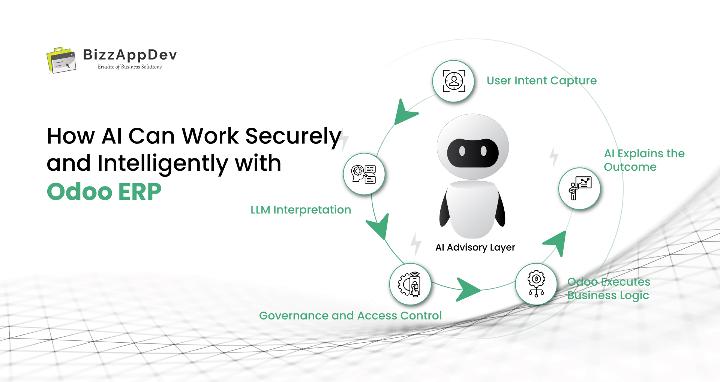
How AI Can Work Securely and Intelligently with Odoo ERP
For AI-enhanced ERP to be reliable, it must follow a structured, permission-aware model that respects Odoo’s architecture.
A typical interaction might look like this:
1. User Intent Capture
Users ask questions through a conversational interface inside Odoo, such as “How are today’s sales compared to last week?”
At this stage, no data is accessed, only intent is captured.
2. LLM Interpretation
The AI interprets the request and determines what information is needed, not how to retrieve it.
3. Governance and Access Control
Before any data request reaches Odoo, permissions, roles, and policies are validated.
4. Odoo Executes Business Logic
Only approved queries are processed by Odoo, applying its standard workflows, calculations, and validations.
5. AI Explains the Outcome
Results are summarized into clear, business-friendly language for the user.
This approach preserves security, accuracy, and compliance, while improving usability.
Areas Where AI Could Enhance Odoo Today
Many organizations are already exploring AI-enhanced ERP in practical ways:
Sales and CRM
AI could help summarize pipelines, highlight stalled deals, or explain performance trends without navigating multiple views.
Finance and Accounting
Instead of manually reviewing reports, users could ask for explanations of variances, cash flow movements, or unusual patterns, while Odoo maintains accounting accuracy.
Inventory and Supply Chain
AI could surface insights on stock imbalances, demand patterns, or supplier performance across modules.
HR and Operations
From policy-related queries to workforce insights, AI could make information easier to access while respecting role-based permissions.
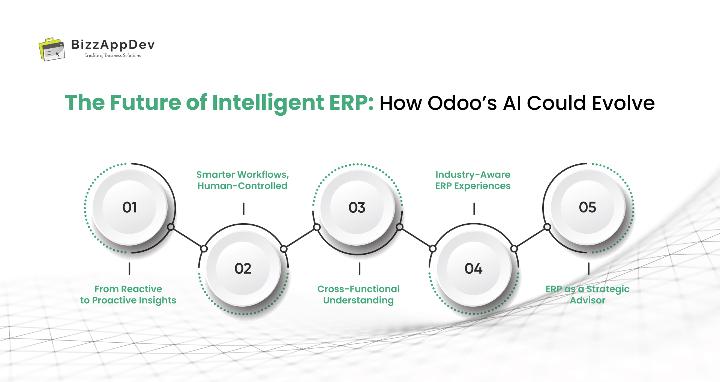
The Future of Intelligent ERP: How Odoo’s AI Could Evolve
The long-term opportunity goes beyond faster answers.
From Reactive to Proactive Insights
AI could help surface early indicators such as margin pressure or operational bottlenecks before they escalate.
Smarter Workflows, Human-Controlled
AI may suggest improvements to approvals, reorder points, or scheduling, while final decisions remain with users.
Cross-Functional Understanding
LLMs could help connect insights across sales, finance, and operations reflecting Odoo’s integrated design.
Industry-Aware ERP Experiences
Explanations and insights could adapt to industry context without heavy customization.
ERP as a Strategic Advisor
Rather than just reporting data, ERP systems could help leadership understand trade-offs and scenarios more clearly.
The Business Value of Exploring AI-Enhanced Odoo
When AI is layered responsibly on top of an existing ERP, organizations may experience:
- Faster access to insights
- Higher ERP adoption across teams
- Reduced reliance on technical reporting skills
- Better ROI from existing Odoo investments
Crucially, this value comes without sacrificing control or governance.
Responsible Innovation Matters
AI in ERP is not just a technical upgrade, it requires discipline. Data privacy, cost management, accuracy, and explainability must remain central.
A governance-first approach ensures AI enhances trust in ERP systems rather than undermining it.
Closing Thoughts: Odoo and AI as a Thoughtful Evolution
Odoo already functions as an intelligent ERP. AI LLMs represents an opportunity to extend that intelligence, making systems more accessible, insights easier to understand, and decisions better informed.
When approached thoughtfully, AI-powered ERP with Odoo does not disrupt existing processes, it builds on them. For growing organizations, this evolution could turn ERP into a more responsive, supportive platform that aligns better with how people actually work.
Ready to transform Odoo into a more intelligent, insight-driven ERP
See how AI and LLMs can unlock faster understanding, better decisions, and greater ROI from your existing Odoo investment without sacrificing control or governance.
FAQs
AI can make Odoo easier to use by letting users ask questions in plain language and get clear explanations of data, instead of digging through reports or dashboards.
No. AI works as an extra layer on top of Odoo. Core workflows, approvals, and accounting logic stay exactly the same.
No. AI only works within Odoo’s existing permission and role-based access controls, so users only see what they’re already allowed to see.
Users could ask things like sales comparisons, reasons for financial variances, stock level concerns, or general performance summaries across modules.
Is AI in Odoo meant to make decisions or post transactions?
No. AI doesn’t execute actions or approve transactions. It explains data and highlights insights so humans can make informed decisions.
It helps teams get faster insights, reduces dependence on technical reports, improves ERP adoption, and increases the return on existing Odoo investments.