
In a food unit, one small mistake can travel a long way.
A supplier reports contamination in a raw material batch. Your team must quickly identify which finished products used it, where those products were shipped, and how much affected stock is still in your warehouse. Spreadsheets are opened. Paper logs are checked. Production slows. Distributors keep calling.
This is what batch traceability failure looks like in real life.
It’s the moment a business realizes it cannot confidently answer a simple question:
“Where did this batch go?”
A properly configured system like Odoo is designed to prevent this situation — when it is set up correctly for food manufacturing workflows.
What Is Batch Traceability Failure in Food Manufacturing?
Batch traceability is the ability to track every lot of raw material from receipt through production and into finished product delivery.
Batch traceability failure occurs when this chain breaks at any stage — during receipt, production, storage, or dispatch.
In food manufacturing, this typically means:
- You cannot identify which supplier lot went into a finished product
- You cannot identify which customers received products from a specific lot
- You cannot respond confidently to audits or recalls
This is not a documentation problem.
It is a system visibility problem.
In short: if lot information is missing at any movement, traceability fails — regardless of intent or effort.
Why Batch Traceability Fails in Food Manufacturing Units
Traceability usually fails not because teams are careless, but because systems don’t support consistent, enforced workflows.
Across many food manufacturing setups, common failure points include:
- Wrong batch recorded during production
- Manual registers not updated in real time
- Raw material lots mixed without proper logging
- Finished goods not digitally linked to production lots
- Difficulty identifying which customer received which batch
- Audit data spread across files, sheets, and emails
These problems are especially common where Excel sheets, paper logs, or disconnected inventory tools are still used.
In practice: traceability fails when recording depends on memory or manual discipline instead of system control.
What Are the Risks of Poor Batch Traceability in the Food Industry?
When lot traceability breaks, the impact is immediate.
Operational risks
- Production delays while records are searched
- Confusion between purchase, production, and dispatch data
- Stock wastage due to uncertainty
Compliance and food safety risks
- Difficulty during audits and inspections
- Risk of shipping near-expiry or expired lots
- Non-compliance with food safety standards
- Inability to execute targeted product recalls
Financial and brand risks
- Expensive and slow recalls
- Legal exposure
- Loss of distributor and customer trust
Recall readiness depends entirely on traceability speed.
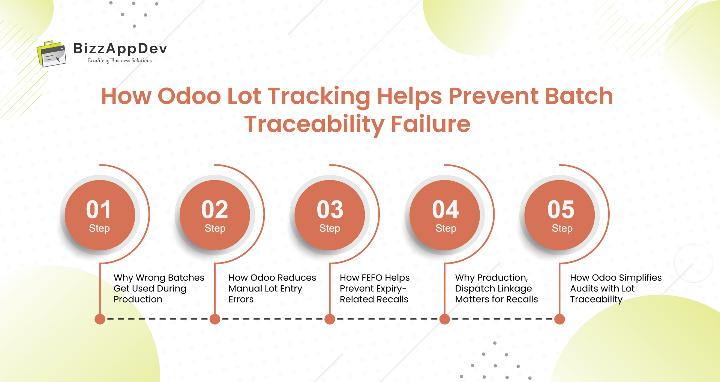
How Odoo Lot Tracking Helps Prevent Batch Traceability Failure
With Odoo, lot traceability becomes part of daily operations after:
- Enabling Lots & Serial Numbers in Inventory
- Setting products to track by lots
- Defining removal strategies (FIFO / FEFO)
- Using Barcode or Work Orders during operations
Below are the most common failure scenarios and how Odoo addresses them when configured correctly.
Why Wrong Batches Get Used During Production
When the wrong batch is consumed during production, there is no clear linkage to the raw material used.
Odoo records lot usage, and removal strategies like FIFO or FEFO influence which lots are reserved for production or delivery. Ensuring the correct lot is actually consumed during manufacturing is best controlled using Work Orders (tablet view), Barcode scanning, and proper stock reservation before production.
Key takeaway: reservation suggests the lot; controlled workflows ensure it is actually consumed.
How Odoo Reduces Manual Lot Entry Errors
Manual data entry often leads to mismatches between inventory and production records.
Barcode scanning for products and lots significantly reduces these errors by ensuring accurate lot capture at every movement.
In short: fewer manual steps means fewer traceability gaps.
How FEFO Helps Prevent Expiry-Related Recalls
Using or shipping expired lots creates a serious food safety risk.
FEFO (First Expiry First Out) influences which lots are reserved and suggested by the system based on expiration dates and removal strategy configuration. Actual lot selection depends on stock reservation, barcode enforcement, and user workflows.
FEFO improves decision-making; enforcement comes from process design.
Why Production, Dispatch Linkage Matters for Recalls
When production and dispatch are not linked, businesses cannot identify affected customers.
Odoo maintains lot history from production into stock and suggests lots for delivery during reservation based on the configured removal strategy (FIFO/FEFO). Whether the correct lot is shipped without manual intervention depends on those settings, barcode usage, and operational discipline.
This linkage enables forward and backward traceability during recall situations.
How Odoo Simplifies Audits with Lot Traceability
During audits, teams often panic because records are scattered.
Odoo’s Lot Traceability report provides full forward and backward history allowing businesses to trace any batch from supplier to customer within seconds, provided lots are captured at every inventory and production movement.
Audit confidence comes from connected data, not last-minute preparation.
For food businesses, the combination of Lot Tracking + FEFO removal strategy + Barcode / Work Orders + Quality checks is what makes traceability dependable in Odoo.
How Expiry Dates and FEFO Work Together in Food Lot Management
Odoo allows expiration dates to be assigned to every lot.
You can group lots by expiration and trigger FEFO so lots closest to expiry are prioritized for consumption or shipment.
This ensures expiry dates actively guide inventory decisions instead of sitting as passive data.
How Quality Checks Strengthen Lot Traceability
Food manufacturers often connect quality processes directly to lot movements.
Using Quality Control Points (QCPs), quality checks can be automatically created on receipts, production steps, or deliveries tied to specific lots.
This creates a complete quality + traceability history for every batch.
Why Barcode Scanning Is a Practical Control Layer
Barcode scanning turns lot tracking into real control on the shop floor and in the warehouse.
You can require scanning of lot or serial barcodes per operation type to make scanning mandatory on receipts or deliveries.
This dramatically reduces the risk of incorrect lot selection.
What Auditors Expect vs What Odoo Provides
Auditors typically ask:
- Which supplier lot was used in this product?
- Where was this batch delivered?
- What production and quality checks were performed?
Odoo’s Lot Traceability report answers these questions instantly because purchase, inventory, manufacturing, quality, and delivery data are connected.
This is where a thoughtful Odoo implementation for food manufacturing becomes critical.
Checklist: Signs Your Batch Traceability Is at Risk
If you answer “yes” to any of these, there is hidden risk:
- You rely on Excel or registers to record batch numbers
- Production teams write lot details manually
- You cannot identify affected customers within minutes
- Expiry dates are tracked manually
- Finished goods are not digitally linked to raw material lots
Many food units require Odoo customization services to make lot tracking mandatory across these stages.
A Real-World Scenario We Often See in Food Units
Before Odoo
- Teams search through files and sheets
- Production halts for hours
- Distributors wait for confirmation
After Odoo (properly configured)
- Lot number entered into the traceability report
- Instant list of affected products generated
- Lots suggested based on FEFO rules when expiration dates, stock reservations, and removal strategies are correctly configured
- Exact customers identified within minutes
Conclusion: Traceability Failure Is a System Problem
Batch traceability should not depend on memory, paper logs, or scattered files.
When configured correctly in Odoo using lot tracking, FEFO, barcode workflows, and quality checks, traceability becomes reliable, audit-ready, and recall-resilient.
If your team cannot answer “where did this batch go?” in under five minutes, your current system is a risk.
Not sure if your batch traceability would survive a real recall?
Talk to the Odoo experts at BizzAppDev to see how lot tracking, FEFO, and barcode workflows can secure your food operations.
FAQs
The ability to track raw material lots through production into finished goods and deliveries.
Within minutes. Longer delays indicate system gaps and recall risk.
Yes, when lot tracking and expiration dates are configured.
Not mandatory but strongly recommended to prevent manual errors.
A removal strategy that prioritizes lots closest to expiry for use or shipment.
.