
Enterprise Resource Planning (ERP) systems help businesses manage finance, inventory, procurement, sales, and other core operations from a single platform. While they are excellent at storing and organizing business data, they often rely on manual processes for reporting, analysis, and decision-making.
That's where AI for ERP makes a difference.
Instead of replacing your ERP system, AI works alongside it to automate repetitive tasks, analyze data faster, and provide insights that help teams make better decisions. The result is a smarter ERP environment that improves efficiency without disrupting existing business processes.
If you're wondering whether AI is worth adding to your ERP system, this guide explains what it does, where it delivers the most value, and how businesses are using it to improve day-to-day operations.
Many organizations are adopting AI as a practical way to improve existing ERP systems rather than replacing them. This approach helps businesses modernize operations while protecting their current technology investments.
What Is AI for ERP?
AI for ERP is the use of artificial intelligence to improve how an ERP system supports business operations. Rather than changing the ERP itself, AI adds capabilities that help businesses work more efficiently.
In simple terms:
- ERP manages business data and processes.
- AI analyzes that data and recommends the best next action.
Unlike traditional ERP automation, which follows predefined rules, AI can identify patterns, learn from historical data, and adapt its recommendations as business conditions change.
For example, an ERP system can show current inventory levels. AI can use the same data to predict future demand, identify potential stock shortages, and recommend when to reorder inventory.
The same approach applies to finance, procurement, customer service, and sales. AI helps businesses move beyond recording information to making faster, data-driven decisions.
Why it matters: Instead of replacing systems that already work, businesses can unlock more value from their existing ERP investment.
Why Businesses Are Adopting AI for ERP
Businesses today need to respond faster to changing customer demands, supply chain disruptions, and market conditions. While ERP systems provide reliable operational data, many everyday processes still require manual effort.
Adding AI helps reduce that workload while improving decision-making.
Businesses are investing in AI for ERP to:
- Automate repetitive administrative tasks.
- Improve forecasting and business planning.
- Reduce manual errors.
- Speed up approvals and workflows.
- Turn ERP data into actionable insights.
- Increase productivity without adding more resources.
The biggest advantage isn't automation alone. AI helps employees spend less time processing information and more time solving business problems.
Instead of asking, "What happened?", teams can start asking, "What should we do next?"
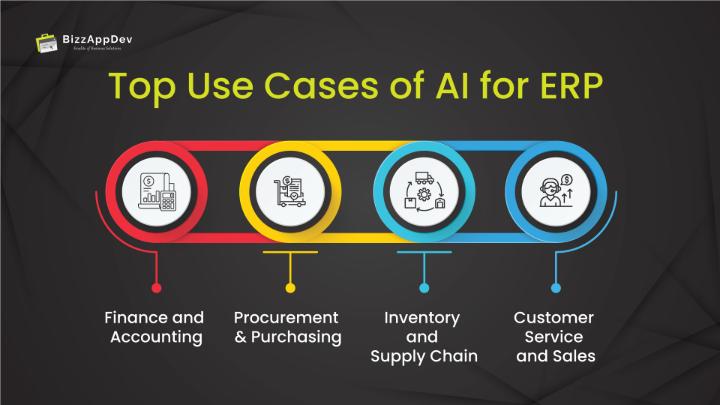
Top Use Cases of AI for ERP
The best AI projects focus on business processes that are repetitive, data-driven, and easy to measure. Here are some of the most common ways organizations are using AI to improve ERP operations.
Finance and Accounting
Finance teams handle large volumes of invoices, payments, and financial records every day.
AI can help by:
- Matching invoices automatically.
- Detecting unusual transactions.
- Predicting cash flow trends.
- Supporting account reconciliation.
Business value: Finance teams spend less time reconciling transactions and more time analyzing financial performance, helping improve cash flow management and support faster business decisions.
Procurement and Purchasing
Procurement often involves multiple approvals, supplier evaluations, and purchasing decisions.
AI improves these processes by:
- Recommending suppliers based on historical performance.
- Automating approval workflows.
- Identifying unusual purchasing activity.
- Highlighting potential supply risks.
Business value: Procurement teams can make faster purchasing decisions, improve supplier selection, and reduce delays caused by manual approval processes.
Inventory and Supply Chain
Managing inventory becomes more challenging as products, suppliers, and customer demand grow.
AI helps businesses:
- Forecast demand more accurately.
- Recommend reorder quantities.
- Detect slow-moving inventory.
- Predict stock shortages before they happen.
Business value: Better demand planning helps reduce stock shortages, avoid excess inventory, and improve customer satisfaction by keeping products available when they're needed.
Customer Service and Sales
Sales and support teams need quick access to accurate customer information.
AI can:
- Prioritize support requests.
- Summarize customer interactions.
- Recommend follow-up actions.
- Identify promising sales opportunities.
Business value: Teams can respond faster, prioritize high-value opportunities, and deliver a more consistent customer experience without increasing workload.
How to Get Started with AI for ERP
One of the biggest mistakes businesses make is trying to automate everything at once.
A better approach is to begin with one process that is:
- Repetitive.
- Time-consuming.
- Backed by reliable ERP data.
- Easy to measure.
Starting small makes it easier to demonstrate results, gain employee confidence, and build a clear roadmap for expanding AI across other business functions.
Good starting points include invoice processing, inventory forecasting, purchase approvals, or customer support workflows because these processes are repetitive, rely on structured ERP data, and produce measurable business outcomes.
How AI Works with ERP Systems
AI works by using the data already stored in your ERP system. It analyzes information, identifies patterns, and provides recommendations or automates repetitive tasks—all without changing your existing ERP platform.
A typical workflow is simple:
- ERP collects business data.
- AI analyzes the data for trends, risks, or opportunities.
- AI recommends actions or automates routine tasks.
- Teams review and approve decisions when needed.
For example, if customer demand increases unexpectedly, AI can identify the trend early and recommend replenishing inventory before shortages affect sales.
The result is faster decision-making while keeping your ERP as the trusted source of business data.
Business Benefits of AI for ERP
The biggest advantage of AI isn't automation, it's helping businesses make better decisions with less effort.
Organizations using AI with ERP commonly see measurable improvements across day-to-day operations, including:
- Faster decision-making by turning ERP data into timely business insights.
- Higher productivity by reducing repetitive administrative work.
- Better forecasting for inventory, sales, and financial planning.
- Lower operational costs through smarter workflow automation.
- Greater operational visibility with real-time insights across departments.
Instead of replacing employees, AI helps them focus on work that requires expertise, collaboration, and problem-solving.
Best Practices for Successful Implementation
AI projects deliver better results when they solve a specific business problem instead of trying to automate everything at once.
Before getting started:
- Choose one repetitive, high-volume process.
- Make sure your ERP data is clean and reliable.
- Define success using measurable business KPIs.
- Keep employees involved in important decisions.
- Expand AI gradually after proving value.
Businesses often achieve the fastest return on investment by improving one well-defined process before expanding AI across multiple departments.
Starting small reduces risk and makes it easier to scale AI across other business functions.
How to Measure Success
The success of AI should be measured by business outcomes—not by the number of automated processes.
Useful KPIs include:
- Time saved on manual tasks.
- Faster approval cycles.
- Reduced operational costs.
- Improved forecasting accuracy.
- Fewer processing errors.
- Higher employee productivity.
- Better customer response times.
Tracking these metrics helps businesses understand whether AI is creating measurable value.
Measuring these outcomes regularly helps businesses identify which AI initiatives deliver the highest value and where additional automation can create further operational improvements.
The Future of AI for ERP
As AI continues to evolve, ERP systems are becoming more intelligent rather than more complex.
Businesses are moving beyond automating individual tasks to improving entire workflows. Future AI capabilities will help organizations predict operational risks, recommend actions in real time, and support better planning across finance, procurement, inventory, and customer service.
The future isn't about replacing ERP, it's about making ERP smarter.
Conclusion
ERP systems remain the foundation of business operations, but organizations need more than accurate records to stay competitive. They need faster insights, smarter workflows, and better decision-making.
That's where AI for ERP delivers real value. By combining AI with existing ERP systems, businesses can automate routine work, improve forecasting, and help employees focus on higher-value activities without replacing the technology they already trust.
The most successful AI initiatives don't start with large-scale transformation. They begin with one measurable business challenge, prove the value, and expand strategically over time.
Ready to make your ERP smarter with AI?
Discover how AI can automate workflows, improve forecasting, and unlock greater value from your existing ERP system. Contact our experts to explore the right AI strategy for your business.
FAQs
AI for ERP uses artificial intelligence to automate tasks, analyze ERP data, and provide recommendations that improve business operations and decision-making.
Yes. AI is typically added to an existing ERP system, allowing businesses to improve workflows and gain intelligent insights without replacing their current platform.
Finance, procurement, inventory management, supply chain, customer service, and sales often see the fastest improvements because these functions rely on structured ERP data and repetitive processes.
Start with a single, measurable use case—such as invoice processing or demand forecasting—and expand once you see measurable improvements in efficiency and productivity.
No. ERP remains the system of record, while AI enhances it with automation, predictive insights, and decision support.
Yes. Many small and medium-sized businesses start by applying AI to one high-impact process, such as invoice processing or inventory forecasting. This approach delivers measurable improvements without requiring major changes to the existing ERP system.