Businesses can apply artificial intelligence (AI) across customer service, finance, manufacturing, sales, software development, and many other functions. The challenge is deciding which opportunities solve meaningful problems, fit existing workflows, and justify the investment.
Business leaders need to understand the potential value, while IT leaders must assess data readiness, integration requirements, security, and technical feasibility. Both perspectives are essential when deciding whether an AI initiative is worth pursuing.
This guide explains common AI use cases for business and provides a practical framework for identifying, evaluating, and prioritizing opportunities before committing resources.
The Short Answer: How to Choose the Right AI Use Case
The right AI use case for a business is a specific, measurable problem where AI can deliver practical value that justifies its cost, risk, and implementation effort.
Start with a recurring or costly business problem. Establish what needs to improve, check whether the necessary data is available, and compare AI with simpler alternatives. Then evaluate the opportunity against consistent business and technical criteria.
Before committing resources, ask:
- Is the business problem clearly defined, with an owner responsible for the outcome?
- Can the expected improvement be measured against a current baseline?
- Is the required data accessible, reliable, and appropriate to use?
- Can security, compliance, and output accuracy be managed?
- Does the expected benefit justify the total cost and complexity?
The strongest candidates have a clear business purpose, a realistic path to delivery, and a way to test whether the proposed solution works. The goal is not to build AI for its own sake, but to solve the right problem.
What Are AI Use Cases for Business?
An AI use case describes a specific business task or problem where an AI capability could improve an outcome.
Examples include helping support agents find accurate answers, extracting information from invoices, analyzing production records, summarizing customer conversations, and retrieving information from internal documents.
A well-defined use case connects three elements:
- Business problem: What takes too much time, creates errors, or limits performance?
- AI application: What capability could address the problem?
- Measurable outcome: What should improve if the solution works?
For example, a support team may spend considerable time searching documentation for troubleshooting instructions. An AI assistant could retrieve relevant information from approved sources. The team could then measure search time, answer accuracy, and how often agents need to correct the results.
This is more useful than simply deciding to introduce an AI chatbot. It starts with a real workflow and defines what success looks like.
Common AI Use Cases Across Business Functions
The most relevant AI applications depend on an organization's workflows, data, and business objectives. These examples illustrate opportunities to investigate, not guaranteed results.
1. Customer Service and Support
Support teams often spend time categorizing requests, searching for information, and documenting conversations.
Where AI fits:
- Classifying incoming requests and suggesting appropriate routing.
- Drafting responses using approved company information.
- Summarizing customer conversations and identifying follow-up actions.
Example: A support team could test an AI assistant that retrieves troubleshooting instructions for agents. The team would assess whether the information is accurate, whether agents spend less time searching, and how often answers need correction.
2. Finance and Administration
Finance teams handle structured transactions alongside documents that require interpretation and verification.
Where AI fits:
- Extracting invoice details for review.
- Classifying financial documents.
- Identifying unusual transactions for further investigation.
Example: AI could extract supplier names, invoice numbers, dates, and amounts. Existing accounting rules could validate those fields against purchase orders and supplier records. Discrepancies would be routed for review rather than accepted automatically.
3. Sales and Marketing
Sales and marketing teams work with customer records, campaign data, conversations, and market information.
Where AI fits:
- Summarizing sales calls and identifying follow-up actions.
- Drafting campaign content for human review.
- Analyzing customer feedback to identify recurring themes.
Example: Sales representatives who check multiple systems before customer meetings could use an AI-assisted workflow to retrieve relevant account information. Its usefulness would depend on data accuracy, access permissions, and how well the workflow fits the team's existing process.
4. Manufacturing and Operations
Manufacturers manage production schedules, equipment, quality records, and inventory.
Where AI fits:
- Analyzing maintenance records for patterns associated with equipment failures.
- Examining suitable images or inspection records to help identify quality issues.
- Forecasting demand using historical sales and other relevant information.
Example: A manufacturer experiencing repeated downtime could investigate whether maintenance history and sensor data contain useful warning patterns. Before proceeding, the company would need to assess data quality, prediction reliability, and whether maintenance teams could act on the findings.
5. People, Knowledge, and Business Systems
Employees often need information distributed across policies, documents, ERP systems, CRM platforms, and internal applications. HR and operational teams may also spend time answering recurring questions or explaining procedures.
Where AI fits:
- Answering employee questions using approved policies and documentation.
- Retrieving relevant customer or supplier information from business systems.
- Summarizing business records and helping employees understand operational procedures.
Example: An internal knowledge assistant could help employees find current procedures or retrieve relevant information from an ERP environment. Its usefulness would depend on answer accuracy, document freshness, access permissions, and how well it fits existing workflows.
BizzAppDev's Odoo AI Knowledge Assistant is a relevant example of applying AI to information access in a business-system environment.
6. IT and Software Development
Technology teams often spend time understanding existing code, maintaining documentation, reviewing changes, and investigating technical issues.
Where AI fits:
- Explaining unfamiliar code and software modules.
- Supporting test creation and code review.
- Generating or updating technical documentation for developer review.
Example: A development team could evaluate whether AI-assisted documentation helps developers understand an existing codebase more efficiently. Documentation accuracy, review quality, and time spent on representative tasks would provide useful evidence.
These examples provide a starting point. The next step is to identify which problems matter most in your own organization.
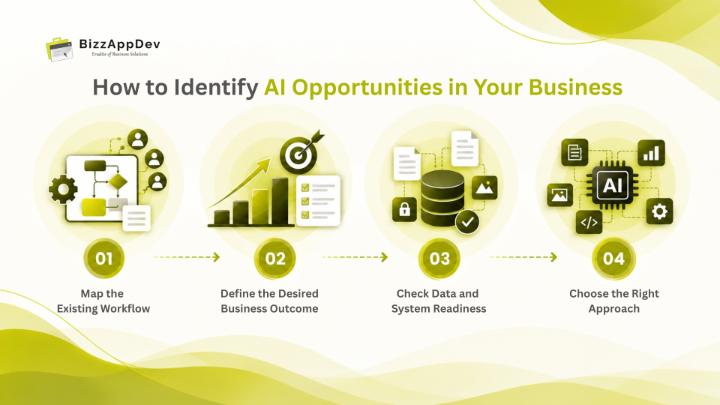
How to Identify AI Opportunities in Your Business
1. Map Existing Workflows
Start by examining how work gets done today. Talk to the employees who perform the process and identify repetitive tasks, information bottlenecks, frequent handoffs, recurring errors, and delays.
Ask:
- Which activities consume more time than they should?
- Where does work regularly get stuck?
- Which tasks require employees to interpret large volumes of documents or information?
- What errors lead to rework?
- What information is difficult to find when it is needed?
Document the current process, the systems involved, and the consequences of the problem. This creates a practical starting point for evaluating possible solutions.
2. Define the Desired Business Outcome
Turn each problem into a specific objective.
Instead of saying, "We need AI for customer service," define the objective as reducing the time agents spend searching for approved answers.
Establish a baseline where possible, such as current processing time, error frequency, or time spent searching for information. Without a baseline, it becomes difficult to determine whether a proposed solution has delivered value.
3. Check Data and System Readiness
Determine what information the use case requires and whether it is available, reliable, current, and accessible with appropriate permissions.
A knowledge assistant may need searchable documents and permission-aware retrieval. A predictive maintenance solution may require consistent maintenance records and suitable equipment data.
Also consider integration requirements, operating costs, security controls, employee adoption, and who will maintain the solution. A technically possible application is not necessarily a practical business investment.
4. Choose the Right Approach
AI is not always the best answer. Compare it with simpler alternatives before committing resources.
Business problem | Approach to consider |
A task follows predictable, fixed rules | Conventional automation |
Unnecessary approvals create delays | Process redesign |
Information is fragmented across systems | Data cleanup or integration |
Documents require interpretation | AI-assisted document processing |
Employees need answers from large document collections | AI-assisted knowledge retrieval |
Historical data may contain useful forecasting patterns | Predictive analytics or machine learning |
AI business process automation can be useful when a workflow combines predictable steps with unstructured information, such as documents or messages. Conventional automation can handle defined rules while AI interprets information where appropriate.
The best solution may combine several approaches. Choose the simplest approach that reliably addresses the underlying problem.
How to Evaluate and Prioritize AI Use Cases
Once you have identified potential applications, compare them using consistent criteria. A promising opportunity should have meaningful business value and a credible path to delivery.
Evaluate each candidate against six factors:
- Business value: Could it reduce costs, save time, improve quality, support revenue, or address an important operational problem?
- Technical feasibility: Can the proposed approach perform the task reliably enough?
- Data readiness: Is the required information available, suitable, and accessible?
- Risk and governance: Can privacy, security, permissions, and inaccurate outputs be managed?
- Integration effort: Can the solution fit existing systems and workflows without disproportionate complexity?
- Time to evidence: Can the main assumptions be tested within a reasonable period?
A Practical AI Use Case Prioritization Framework
Before scoring an opportunity, apply three preliminary pass/fail checks.
Data access: Can the organization legitimately access the information the solution requires?
Security and compliance: Can the proposed approach meet applicable security, privacy, and compliance requirements?
Verifiability: Can the team determine whether the AI's outputs are sufficiently accurate and useful for the intended task?
An opportunity that fails one of these checks should be deferred until the issue is resolved, or rejected if it cannot be addressed. A high score must not override an unacceptable risk.
For candidates that pass, use the following illustrative weighting model.
Evaluation criterion | Weight |
Business value, considering total cost | 35% |
Technical feasibility | 15% |
Data readiness | 15% |
Risk and governance | 15% |
Integration effort | 10% |
Time to evidence | 10% |
Total | 100% |
Score each criterion from 1 to 5, where a higher score indicates a more favorable assessment. For integration effort, this means easier integration; for risk and governance, it means more manageable risks.
Calculate the weighted score: Multiply each rating by its weight as a decimal, then add the results. For example, a business value rating of 4 contributes (4 \times 0.35 = 1.40) points. The final score ranges from 1 to 5.
Consider expected benefits against implementation, integration, usage, maintenance, and oversight costs. Record the assumptions behind each rating, including any process changes or employee adoption required.
If business value scores below 3 out of 5, pause and reconsider the opportunity before proceeding. A high overall score must never override unresolved security, compliance, or data-access issues.
These weights are illustrative, not an industry standard. Adjust them to your business priorities and risk tolerance.
Applying the Framework: An Example
Consider a company evaluating two opportunities: an internal knowledge assistant and predictive maintenance.
The knowledge assistant could be a reasonable first candidate if the company already has suitable documentation, can manage access permissions, and can test whether employees retrieve accurate information more efficiently.
Predictive maintenance might offer substantial potential value where equipment downtime is costly. However, it could require better maintenance records, reliable sensor data, more complex integration, and a longer testing period.
Under the proposed scoring framework, the knowledge assistant might rank higher as an initial project because it is easier to evaluate with the information already available. Predictive maintenance could remain a strategic opportunity while the company improves its data foundation.
This is an illustrative scenario, not a claim that knowledge assistants are inherently better investments. Actual scores depend on expected benefits, available data, technical requirements, and the organization's ability to act on the results.
Think in Terms of a Portfolio, Not Just a Ranking
Organizations with several potential use cases may need to balance different types of investment.
Quick win: A contained opportunity with a clear outcome and manageable dependencies.
Strategic bet: A potentially valuable opportunity that requires more evidence, data, or integration work.
Enabling groundwork: Improvements to data quality, access controls, or system integration that make future projects more feasible.
For example, a company might test internal knowledge retrieval, investigate predictive maintenance, and separately assess the quality of its maintenance data.
This does not mean funding every initiative at once. Select projects according to available resources, strategic priorities, dependencies, and risk. The scorecard helps inform that decision; it does not replace it.
When to Defer an AI Use Case
Do not commit to a project simply because the use case sounds valuable.
Defer or reconsider it when:
- Nobody owns the underlying business problem.
- The current process and its performance haven't been measured.
- It fails any of the three checks above.
- Integration complexity or operating costs make the expected value hard to justify.
Some issues can be resolved through better data management, process redesign, or a narrower scope. Others may mean AI is not the appropriate solution.
Five Questions for Your Next AI Steering Meeting
Before approving an AI initiative, ask:
- Which specific business problem are we solving, and who owns it?
- What does the problem cost us today in time, errors, delays, or other measurable outcomes?
- What is the smallest practical test that could validate or disprove the main assumption?
- What data, system access, and approvals will the solution require?
- What happens when the AI produces an incorrect, incomplete, or uncertain result?
Clear answers help business and IT leaders decide whether an opportunity is ready for further evaluation, needs preparation, or should be rejected.
What Happens After Selecting an AI Use Case?
Once an opportunity has been selected, define the next stage of work, confirm responsibilities, and agree on how progress will be evaluated.
Selecting a promising use case is only one part of the journey. The wider AI implementation process covers how businesses assess requirements, build and deploy solutions, and improve them using evidence from real-world use.
Conclusion: Focus on the Right AI Opportunities
Not every repetitive task needs AI, and not every promising idea is ready for investment. Back the opportunities that combine a clear business need, measurable outcomes, suitable data, and a realistic path to delivery.
Evaluate systematically, test before you scale, and build your AI roadmap around practical business priorities.
Ready to Explore AI for Your Business?
BizzAppDev helps businesses identify, plan, and implement AI where it makes a measurable difference.
FAQs
Common examples include customer support assistance, invoice processing, demand forecasting, internal knowledge retrieval, sales-call summarization, quality analysis, and software development support. The right applications depend on business objectives, workflows, data, and risk requirements.
Start by mapping existing workflows and identifying repetitive work, delays, information bottlenecks, and recurring errors. Define the desired outcome, assess data and system readiness, and determine whether AI offers a meaningful advantage over simpler alternatives.
Compare opportunities based on business value, technical feasibility, data readiness, risk, integration effort, and time to evidence. Apply essential security and data-access checks before scoring candidates, and avoid prioritizing projects that are easy to build but offer little business benefit.
No. Conventional automation, process redesign, data cleanup, or system integration may be more appropriate for some problems. AI is worth considering when its capabilities offer a practical advantage and the organization can manage the associated costs and risks.
Define the desired outcome and establish a baseline before testing. Depending on the use case, measure processing time, manual effort, error rates, information retrieval time, output quality, user adoption, or operating costs. Consider reliability and ongoing maintenance alongside the intended business benefit.