
Artificial intelligence is no longer limited to answering questions or generating content.
In 2026, AI agents are already being deployed across businesses to perform multi-step tasks that traditionally required human involvement. They can research suppliers, analyze contracts, extract information from documents, coordinate workflows across multiple systems, monitor operational risks, and generate recommendations based on real-time business data.
Some organizations are using AI agents to assist procurement teams. Others are using them to process customer requests, summarize operational reports, or retrieve information from thousands of internal documents in seconds.
As these capabilities become more common, a new question is emerging:
Will AI replace ERP systems?
If AI can access information, automate decisions, and coordinate business processes, do companies still need ERP software?
The answer is not as straightforward as many people think.
- AI will not replace ERP systems. Instead, AI becomes an intelligence layer that sits above ERP, automating 50% of routine tasks by 2030 while ERP remains the operational backbone.
Why the Idea of AI Replacing ERP Sounds Convincing
Over the last few years, AI has become capable of tasks that once seemed impossible.
Today, businesses can use AI to:
- Generate operational summaries
- Analyze business performance
- Extract insights from documents
- Answer complex questions
- Automate repetitive processes
This creates the impression that AI can replace the software businesses use to run their operations.
But there is a critical difference.
AI excels at understanding and interpreting information.
ERP systems are responsible for creating, managing, and controlling that information.
One helps businesses think faster.
The other helps businesses operate reliably.
These are not the same thing.
What ERP Systems Actually Do
ERP software is often viewed as a collection of business applications.
It serves a much larger purpose.
ERP systems act as the operational foundation of an organization by managing the processes that keep the business running.
This includes:
- Inventory management
- Financial operations
- Procurement
- Manufacturing
- Supply chain activities
- Sales management
- Customer records
- Internal workflows
More importantly, ERP systems maintain structured and trusted business data.
Every transaction, invoice, stock movement, purchase order, and financial record follows defined business rules.
Without this structure, organizations lose visibility, consistency, and control.
This is why ERP systems remain the source of truth for enterprise operations.
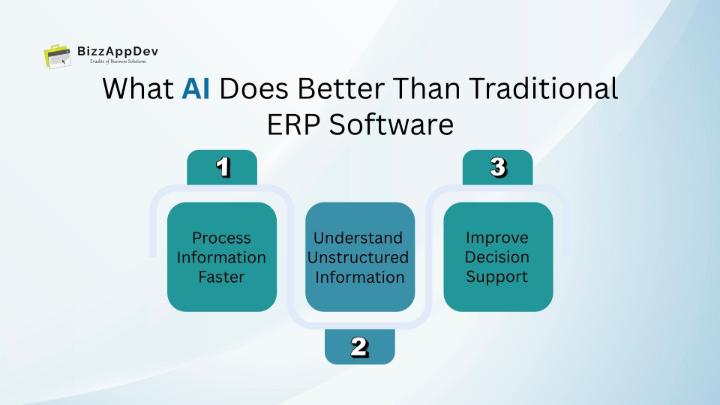
What AI Does Better Than Traditional ERP Software
While ERP systems excel at managing business processes, they were never designed to think, reason, or communicate like humans.
This is where AI creates value.
AI can help organizations:
Process Information Faster
Business teams spend significant time searching for information across multiple systems.
AI can analyze large amounts of data and surface relevant insights much faster than traditional reporting methods.
Understand Unstructured Information
Most business knowledge does not live inside an ERP system.
It exists in:
- Contracts
- Emails
- PDFs
- Policies
- Technical documents
- Customer communications
AI can understand and organize information that traditional ERP systems cannot easily process.
Improve Decision Support
AI can identify patterns, risks, and opportunities hidden within large datasets.
This helps decision-makers focus on actions rather than spending time gathering information.
These capabilities complement ERP systems rather than replace them.
The Biggest Limitation of AI Nobody Talks About
AI is powerful.
But it has a dependency that many businesses overlook.
AI requires reliable data.
Without structured business information, AI becomes significantly less useful.
For example, AI cannot independently:
- Maintain inventory accuracy
- Record financial transactions
- Enforce procurement rules
- Track operational activities
- Manage compliance requirements
- Control business workflows
AI can recommend actions.
It cannot become the operational system itself.
This distinction is one of the biggest reasons ERP software remains essential.
The Real Future: AI as an Intelligence Layer Above ERP
The biggest misconception in the AI versus ERP debate is the belief that one technology will replace the other.
What is happening is far more interesting.
AI is becoming an intelligence layer that sits above business systems.
Instead of replacing ERP platforms, AI connects with them.
It gathers information, provides context, supports decisions, and automates actions across multiple systems.
This approach allows organizations to keep the operational reliability of ERP while adding the flexibility and intelligence of modern AI.
The result is not AI-driven ERP.
The result is an AI-powered business ecosystem.
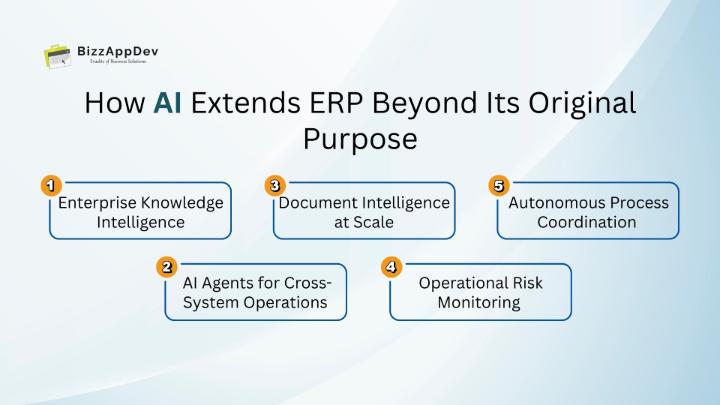
How AI Extends ERP Beyond Its Original Purpose
Traditional ERP systems were built to manage business transactions.
Modern AI integration expands what those systems can achieve.
By connecting AI models with ERP platforms and other business systems, organizations can unlock capabilities that were never part of traditional ERP software.
Enterprise Knowledge Intelligence
One of the biggest challenges businesses face is information fragmentation.
Critical information often exists across multiple locations, including:
- ERP systems
- Shared drives
- Internal documentation
- Vendor contracts
- Compliance policies
- Customer communication platforms
AI can connect these information sources and provide context-aware answers that would otherwise require searching through multiple systems.
Instead of finding data, employees can focus on using it.
AI Agents for Cross-System Operations
Traditional automation typically follows predefined workflows.
AI agents can operate across multiple business systems and support more dynamic decision-making.
For example, an AI agent could:
- Analyze inventory shortages
- Review supplier performance
- Evaluate procurement policies
- Compare purchasing options
- Recommend the most effective course of action
This creates a level of operational intelligence that traditional ERP workflows were never designed to provide.
Document Intelligence at Scale
Every business generates large volumes of unstructured information.
Examples include:
- Contracts
- Quotations
- Compliance documents
- Technical specifications
- Customer requests
AI can extract, classify, and connect information from these documents with operational data.
This reduces manual effort while improving visibility and decision quality.
Operational Risk Monitoring
Most businesses discover operational problems after they occur.
AI creates an opportunity to identify issues earlier.
By analyzing data across systems, AI can help detect:
- Procurement risks
- Inventory anomalies
- Supplier dependencies
- Process bottlenecks
- Potential disruptions
This allows teams to respond proactively instead of reactively.
Autonomous Process Coordination
Modern organizations rely on multiple business systems.
ERP is only one part of the technology landscape.
AI can coordinate activities between:
- ERP platforms
- CRM systems
- Customer support tools
- Procurement platforms
- Internal knowledge bases
This reduces manual handoffs and helps create more connected business operations.
Why Data Quality Will Become a Competitive Advantage
As AI adoption grows, data quality will become more important than ever.
Organizations often focus on implementing AI while overlooking the condition of their business data.
Common problems include:
- Duplicate records
- Incomplete information
- Inconsistent processes
- Disconnected systems
- Outdated data
AI does not solve these issues.
It exposes them.
The businesses that gain the most value from AI will be those that invest in strong data governance and reliable operational systems.
In many cases, the success of an AI initiative depends more on data quality than on the AI model itself.
Will ERP Systems Still Exist 10 Years from Now?
Almost certainly.
However, they will not look the same as they do today.
Users will spend less time navigating dashboards and searching through reports.
Instead, AI will help people interact with business systems in a more natural and efficient way.
ERP platforms will continue to serve as the operational backbone of organizations.
AI will serve as the intelligence layer that helps businesses make better decisions, access information faster, and automate complex processes.
The role of ERP will not disappear.
It will evolve.
Final Verdict: Will AI Replace ERP Systems?
No, AI will not replace ERP systems.
What AI will replace is the way many people interact with business software.
ERP systems remain essential because they manage transactions, maintain operational control, and provide the structured data businesses depend on.
AI brings a different kind of value.
It helps organizations understand information, connect disconnected knowledge, automate complex workflows, and improve decision-making at scale.
The businesses that thrive in the coming years will not view AI and ERP as competing technologies.
They will use ERP as the operational foundation and AI as the intelligence layer that unlocks greater efficiency, visibility, and business value.
The future is not AI vs ERP.
The future is AI-powered enterprise operations built on a strong ERP foundation.
Looking to integrate AI into your ERP ecosystem?
Let's discuss what's possible.
FAQs
No. AI can analyze information and automate tasks, but it cannot replace the structured processes, transaction management, and operational controls that ERP software provides.
Businesses still need ERP systems because they act as the source of truth for financial, operational, and inventory data. AI depends on this structured data to deliver accurate insights and recommendations.
ERP systems manage business operations and store structured data, while AI helps interpret information, automate decisions, and improve productivity. They serve different purposes and work best together.
AI integration helps businesses connect ERP data with documents, emails, knowledge bases, and other systems to improve decision-making, automate workflows, and reduce manual effort across departments.
Yes. AI agents can coordinate information and actions across ERP platforms, CRM systems, support tools, documents, and knowledge repositories to streamline complex business processes.
The future of ERP systems with AI is more intelligent and connected. ERP remains the operational foundation, while AI becomes the intelligence layer that enhances automation, insights, and user interactions.