
Most businesses don't replace their ERP system because it's outdated, they replace it when it no longer supports growth. However, a full ERP replacement is expensive, time-consuming, and often disruptive to day-to-day operations. That's why many organizations are looking for a smarter alternative: integrating AI into the ERP system they already use.
Modern AI solutions can work alongside existing ERP platforms to automate repetitive tasks, improve forecasting, uncover business insights, and help teams make faster decisions. Whether you're using SAP, Oracle, Microsoft Dynamics 365, NetSuite, or another ERP platform, AI can extend its capabilities without requiring a complete system overhaul.
This guide explains how AI integration for existing ERP systems works, where it delivers the most value, and what businesses should consider before getting started. If you're evaluating ways to modernize your ERP while protecting your current investment, this article will help you make informed decisions.
Why Businesses Are Integrating AI Instead of Replacing Their ERP
For many organizations, the ERP system is the backbone of daily operations. It manages finance, inventory, procurement, manufacturing, customer data, and more. Replacing it isn't just a software upgrade, it's a major business transformation that can take months or even years.
Instead of starting over, many companies are choosing AI ERP integration to improve the systems they already rely on.
This approach offers several advantages:
- Lower implementation costs: Adding AI is often more affordable than replacing an entire ERP platform.
- Faster time to value: AI projects can begin with a single business process, delivering measurable results in weeks rather than months.
- Minimal disruption: Employees continue using familiar ERP workflows while AI enhances specific tasks behind the scenes.
- Better use of existing data: ERP systems already store years of valuable business information. AI uses this data to identify patterns, generate predictions, and recommend actions.
Key takeaway
Think of AI as an intelligent layer that sits on top of your ERP system, not as a replacement. It helps teams work more efficiently by turning existing business data into faster insights and smarter decisions.
Can AI Be Integrated with Existing ERP Systems?
Yes. In most cases, AI can be integrated with an existing ERP system without replacing the software.
Today's ERP platforms are designed to connect with external applications through APIs, integration platforms, and cloud services. This makes it possible to introduce AI capabilities while keeping your core ERP processes intact.
AI integration is possible across different ERP environments, including:
- Legacy on-premise ERP systems
- Modern cloud ERP platforms
- Hybrid ERP environments
- Industry-specific ERP solutions
The integration approach depends on factors such as your ERP architecture, data quality, security requirements, and business goals. For example, a manufacturer may prioritize AI-powered demand forecasting, while a finance team may focus on invoice automation and reporting.
Why this matters
Successful AI implementation for ERP isn't about adding AI everywhere. It's about identifying the right business problem and using AI where it creates measurable value.
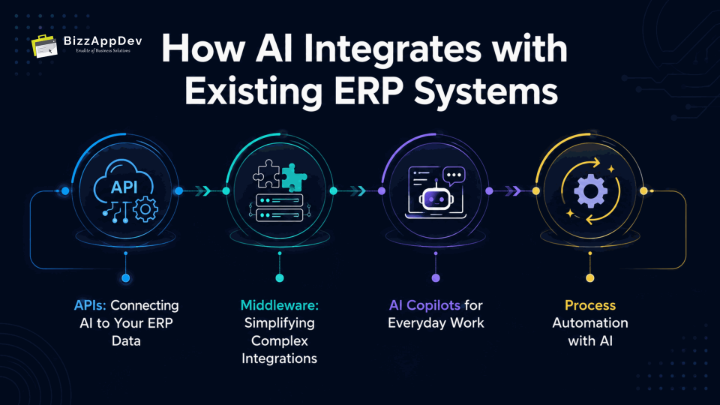
How AI Integrates with Existing ERP Systems
One of the biggest misconceptions about AI is that it requires replacing existing software. Most organizations integrate AI into their ERP using technologies that connect with existing workflows rather than rebuilding them.
Here are the most common integration methods.
APIs: Connecting AI to Your ERP Data
Application Programming Interfaces (APIs) allow different systems to exchange information securely. Most modern ERP platforms provide APIs that enable AI applications to access relevant business data without changing the ERP itself.
For example, AI can retrieve sales history from the ERP to generate more accurate demand forecasts or analyze procurement data to identify purchasing trends.
Because APIs use existing data, implementation is often faster and less disruptive than replacing core ERP functionality.
Middleware: Simplifying Complex Integrations
Not every ERP system connects directly to AI tools. Middleware acts as a bridge between applications, helping them exchange data even when they use different technologies.
This approach is especially useful for organizations running older or customized ERP systems. Instead of redesigning existing workflows, middleware allows businesses to integrate AI while maintaining system stability.
AI Copilots for Everyday Work
Many ERP vendors now offer AI copilots that help employees interact with business data more efficiently.
Rather than searching through multiple reports, users can ask questions in plain language, such as:
- "Which products are running low on stock?"
- "Show last month's procurement spending."
- "Which customers have overdue invoices?"
The AI interprets the request, retrieves information from the ERP, and presents it in a simple, easy-to-understand format. This improves productivity while reducing the time spent searching for information.
Process Automation with AI
Traditional ERP systems automate structured workflows, but they often require manual intervention when handling documents, emails, or exceptions.
AI enhances ERP process automation by handling tasks such as:
- Extracting information from invoices
- Classifying purchase requests
- Processing supplier documents
- Routing approvals based on business rules
This reduces repetitive work and allows employees to focus on higher-value activities instead of administrative tasks.
Key takeaway
The goal of AI for existing ERP systems isn't to replace established business processes. It's to make those processes faster, smarter, and more responsive by using the data your ERP already collects.
Where AI Delivers the Most Value in ERP
Not every ERP process needs AI. The greatest value comes from areas where teams spend significant time on manual work, repetitive decisions, or data analysis.
Here are some of the most practical applications.
Finance: Faster and More Accurate Operations
Finance teams handle large volumes of invoices, expense claims, and financial reports every day. While ERP systems manage these processes effectively, many tasks still require manual review.
AI can automatically extract invoice details, detect duplicate payments, flag unusual transactions, and generate financial summaries. It can also support predictive analytics in ERP by forecasting cash flow based on historical data and payment trends.
The result is faster financial operations, fewer errors, and better visibility into business performance.
Supply Chain: Smarter Inventory Planning
Inventory management is one of the strongest use cases for AI.
Instead of relying only on historical sales data, AI can combine information from customer demand, seasonal trends, supplier performance, and purchasing patterns to improve AI inventory forecasting.
For example, if demand for a product begins increasing earlier than expected, AI can recommend adjusting inventory levels before shortages occur.
This helps businesses reduce stockouts, avoid excess inventory, and improve customer satisfaction.
Procurement: Better Purchasing Decisions
Procurement teams often manage hundreds of suppliers, contracts, and purchase requests. While an ERP system records this information, AI helps businesses make better use of it.
For example, AI can analyze supplier performance, identify unusual spending patterns, recommend preferred vendors, and highlight contracts that require renewal. It can also review purchase requests and flag potential policy violations before approvals are completed.
This improves purchasing decisions, reduces procurement risks, and helps organizations control costs without adding extra manual work.
Manufacturing: Predict Issues Before They Disrupt Operations
Manufacturers rely on ERP systems to plan production, manage inventory, and schedule resources. AI adds another layer of intelligence by identifying patterns that people might miss.
By analyzing production data, machine performance, and maintenance records, AI can detect early signs of equipment failure and recommend preventive maintenance before breakdowns occur. It can also support production planning by identifying bottlenecks and suggesting schedule adjustments based on real-time demand.
The result is improved operational efficiency, reduced downtime, and more predictable production schedules.
Customer Service: Faster Responses with Better Insights
Customer service teams often need quick access to order history, invoices, delivery updates, and product information. Switching between multiple ERP screens can slow response times.
AI-powered assistants or ERP chatbots simplify this process. Instead of searching through reports, support teams can ask questions in plain language and receive relevant information instantly.
For example, a support representative can ask, "Has the customer's order shipped?" or "What is the current payment status?" and receive an immediate answer based on ERP data.
This allows teams to respond faster while improving the overall customer experience.
Executive Reporting: Turn Data into Actionable Insights
ERP systems generate large amounts of business data, but turning that data into meaningful insights often requires manual reporting.
AI can automate report generation, summarize performance trends, and highlight key business metrics in minutes instead of hours. It can also explain changes in revenue, expenses, or operational performance using natural language, making reports easier for business leaders to understand.
Instead of spending time building reports, executives can focus on making informed decisions backed by real-time insights.
Key takeaway: The best AI projects don't try to improve every ERP process at once. They focus on one high-impact business area, deliver measurable results, and then expand gradually.
Common Challenges and Best Practices
While AI integration for existing ERP systems offers significant benefits, success depends on proper planning. Most challenges aren't caused by AI itself, they're caused by poor preparation.
Challenge | Best Practice |
Inconsistent or incomplete ERP data | Clean and organize your data before implementation. AI performs best with reliable information. |
Trying to automate everything at once | Start with one business process that has a clear and measurable outcome. |
Integration complexity | Use APIs or middleware to connect AI with your ERP instead of modifying core functionality. |
Security and compliance concerns | Apply role-based access controls, encryption, and governance policies to protect sensitive business data. |
Low employee adoption | Involve users early, provide training, and demonstrate how AI simplifies their daily work rather than replacing their roles. |
A phased implementation approach reduces risk and helps teams build confidence before expanding AI across other departments.
Best Practices for Successful AI ERP Integration
Organizations that see the greatest return from AI usually follow a simple strategy: solve one business problem at a time.
Before starting your project, consider these best practices:
- Define a clear business objective instead of implementing AI for the sake of innovation.
- Prioritize high-impact workflows such as invoice processing, demand forecasting, or reporting automation.
- Ensure your ERP data is accurate, complete, and well-governed.
- Choose AI solutions that integrate easily with your existing ERP environment.
- Measure results using KPIs such as processing time, operational costs, forecasting accuracy, or employee productivity.
- Scale gradually after proving success in one department.
This approach delivers faster results while minimizing disruption to everyday business operations.
Conclusion
Integrating AI into your existing ERP system isn't about replacing technology that already works, it's about making it work smarter.
By combining AI with the data and processes already managed by your ERP, businesses can automate repetitive tasks, improve forecasting, enhance reporting, and support faster decision-making without the cost and disruption of a complete system replacement.
The most successful organizations don't begin with large-scale transformation projects. They start with one high-value use case, measure the results, and expand their AI initiatives as they gain confidence.
If your business is exploring ways to modernize its ERP environment, focus on practical outcomes rather than technology alone. A well-planned AI integration strategy can help you improve efficiency today while building a stronger foundation for future growth.
Ready to unlock more value from your ERP?
Discover how AI can enhance your existing system, without the cost of a complete replacement.
FAQs
Most modern ERP systems—and many legacy platforms—can support AI integration through APIs, middleware, or cloud-based integration services. The implementation method depends on your ERP architecture and business requirements.
No. In most cases, AI is designed to work alongside your existing ERP system. Businesses can add intelligent capabilities without replacing the software they already rely on.
Organizations typically see the greatest impact in finance, inventory management, procurement, customer service, reporting, and demand forecasting because these areas involve repetitive tasks and data-driven decisions.
The timeline depends on the complexity of the project. A focused pilot for a single workflow can often be implemented much faster than a full ERP modernization initiative.
Yes, when implemented correctly. Businesses should follow security best practices such as data encryption, role-based access, governance policies, and compliance requirements to protect sensitive information.