
Many businesses want to adopt AI but assume it means replacing their ERP system. Most organizations are taking a more practical route through AI ERP Integration.
Instead of investing in a new ERP, they are connecting AI tools and automation platforms to the systems they already use. This allows them to automate repetitive tasks, improve process accuracy, and gain deeper insights from existing business data.
The ERP remains the foundation for managing operations, while AI helps turn that data into faster actions and smarter workflows. As a result, businesses can modernize operations without disrupting the systems they depend on every day.
What Is AI ERP Integration?
AI ERP Integration is the process of connecting external AI technologies with an ERP system to automate workflows, analyze business data, and improve decision-making.
These integrations often involve:
- AI agents
- Machine learning models
- Intelligent document processing
- Predictive analytics platforms
- Conversational AI assistants
- Workflow automation systems
Rather than replacing ERP software, AI works alongside it. The ERP manages business data and operational processes, while AI helps automate repetitive tasks, identify patterns, and generate actionable recommendations.
ERP AI Integration: What Can AI Automate?
Business Process | AI Integration Outcome |
Invoice Processing | Automated data extraction and validation |
Procurement | Intelligent purchase request creation |
Customer Support | ERP-connected AI assistants |
Demand Forecasting | Predictive planning and recommendations |
Inventory Management | Smart replenishment suggestions |
Contract Management | Contract analysis and clause extraction |
Accounts Receivable | Automated payment follow-ups |
Supplier Management | Risk monitoring and supplier intelligence |
Project Management | Meeting-to-task automation |
Executive Reporting | Conversational AI copilots |
Not every ERP process is a good candidate for AI. The highest returns typically come from workflows that involve repetitive manual work, large volumes of business data, or decision-making that relies on historical patterns. That is why finance, procurement, inventory management, and customer support are often the first areas businesses choose to automate.
Why Businesses Are Investing in AI ERP Integration
ERP systems excel at organizing structured business information. However, they were not designed to interpret unstructured data, predict outcomes, or automate decision-making.
That is where AI creates value.
Organizations are investing in AI ERP Integration to:
- Reduce repetitive manual work
- Improve process accuracy
- Accelerate operational workflows
- Extract more value from ERP data
- Support data-driven decision-making
- Scale business operations efficiently
For most organizations, the challenge is not collecting data. It is turning ERP data into timely actions. AI helps bridge that gap by automating workflows and highlighting opportunities that might otherwise go unnoticed.
10 Business Processes AI Automates in ERP
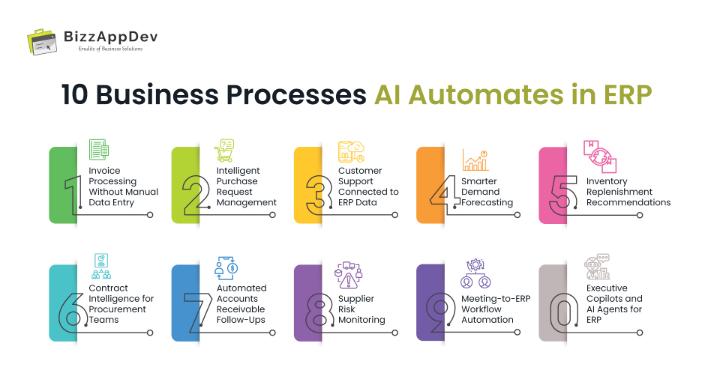
1. Invoice Processing Without Manual Data Entry
Finance teams often spend hours reviewing invoices and entering information into ERP systems. AI-powered document processing can automate this workflow by extracting invoice details, validating data, and creating transactions automatically.
Business value:
- Faster invoice processing
- Fewer manual errors
- Improved financial accuracy
- Reduced administrative workload
For organizations processing large invoice volumes, this can save significant time while strengthening financial controls.
2. Intelligent Purchase Request Management
Procurement requests frequently arrive through emails, forms, and collaboration platforms. AI can identify purchasing intent, extract key information, and create procurement requests directly within the ERP system.
Business value:
- Faster procurement cycles
- Better request consistency
- Improved visibility into purchasing activities
- Less manual administration
This allows procurement teams to focus on supplier relationships and strategic sourcing rather than repetitive administrative tasks.
3. Customer Support Connected to ERP Data
Support teams often need access to customer records, invoices, orders, and shipment details. AI assistants can retrieve this information directly from ERP systems and provide answers through a conversational interface.
Business value:
- Faster response times
- Improved customer experiences
- Reduced workload for support teams
- More consistent service delivery
Support teams spend less time searching across systems and more time resolving customer issues. That often translates into shorter response times and fewer internal escalations.
4. Smarter Demand Forecasting
Forecasting affects inventory planning, procurement, production schedules, and cash flow. By combining ERP data with machine learning ERP models, businesses can identify trends that traditional reporting often misses.
AI analyzes:
- Historical sales data
- Seasonal demand patterns
- Customer purchasing behavior
- Supplier lead times
Business value:
- More accurate forecasts
- Better inventory planning
- Reduced stock shortages
- Lower inventory carrying costs
Procurement and inventory teams gain earlier visibility into demand shifts, giving them more time to adjust purchasing plans before shortages or excess stock become a problem.
5. Inventory Replenishment Recommendations
Maintaining optimal inventory levels is a constant challenge. Too much inventory ties up capital, while too little inventory can lead to missed sales opportunities.
AI continuously evaluates inventory records, sales velocity, demand forecasts, and supplier performance to recommend replenishment actions.
Business value:
- Improved inventory planning
- Reduced capital tied up in slow-moving inventory
- Reduced stockouts
- More efficient procurement decisions
For example, a business using Odoo can connect external forecasting tools through APIs. This type of Odoo AI integration helps procurement teams receive intelligent inventory recommendations without changing existing ERP workflows.
6. Contract Intelligence for Procurement Teams
Vendor contracts often contain important information that is difficult to track manually. AI can review contracts and identify renewal dates, pricing terms, payment obligations, and compliance requirements.
Business value:
- Improved contract visibility
- Reduced compliance risks
- Better supplier governance
- Fewer missed deadlines
This gives procurement teams greater control over supplier relationships throughout the contract lifecycle.
7. Automated Accounts Receivable Follow-Ups
Late payments impact cash flow and often require considerable administrative effort. AI can monitor outstanding invoices within the ERP and automate payment reminders based on customer behavior.
Business value:
- Faster collections
- Improved cash flow
- Reduced manual effort
- More consistent communication
Finance teams can spend less time chasing payments and more time managing customer relationships.
8. Supplier Risk Monitoring
Supplier disruptions can affect inventory availability, production schedules, and customer commitments. AI can combine ERP supplier records with external risk indicators to identify potential concerns early.
Business value:
- Earlier risk detection
- Better supplier decisions
- Improved business continuity
- Reduced operational disruption
For businesses with long supplier lead times, early warnings can provide enough time to identify alternatives before production schedules are affected.
9. Meeting-to-ERP Workflow Automation
Important project decisions are often discussed during meetings but never properly documented. AI can automatically generate meeting summaries, identify action items, assign responsibilities, and update ERP project records.
Business value:
- Better accountability
- Improved project visibility
- Reduced administrative work
- Faster execution of action items
For example, after a project review meeting, AI can create tasks within the ERP, assign deadlines, and notify team members automatically. This helps ensure discussions translate into measurable progress.
10. Executive Copilots and AI Agents for ERP
Executives need quick access to business insights, not more dashboards.
By connecting AI agents for ERP environments directly to business data, leaders can ask questions in natural language and receive immediate answers.
Examples include:
- Which products generated the highest profit this quarter?
- What inventory is at risk of stockout?
- Which customers have overdue invoices?
- What regions are driving revenue growth?
Business value:
- Faster decision-making
- Better visibility across departments
- Reduced reliance on manual reporting
- More informed strategic planning
Instead of waiting for reports from multiple departments, executives can get immediate answers from ERP data and focus discussions on actions rather than information gathering.
Best Practices for Successful AI ERP Integration
Organizations that achieve the strongest results typically follow a focused approach.
A few best practices include:
- Start with a specific business challenge
- Prioritize high-impact workflows
- Improve ERP data quality before automation
- Measure outcomes and ROI consistently
- Choose scalable ERP automation tools
- Develop a phased AI ERP implementation strategy instead of attempting large-scale automation all at once
Organizations that start with a clearly measurable process—such as invoice processing or procurement approvals, typically find it easier to demonstrate ROI before expanding automation efforts.
Final Thoughts
AI is not replacing ERP systems. It is helping businesses get more value from them.
From invoice processing and demand forecasting to supplier management and executive reporting, AI ERP Integration allows organizations to automate time-consuming tasks, improve operational visibility, and make faster, more informed decisions.
The businesses seeing the strongest results are not overhauling their entire technology stack. They are identifying high-friction processes within their existing ERP environments and using AI to solve specific operational challenges.
As AI capabilities continue to evolve, organizations that combine reliable ERP data with intelligent automation will be better positioned to improve efficiency, adapt to change, and scale with confidence.
FAQs
No. ERP systems manage business processes and operational data, while AI helps automate tasks, analyze information, and improve decision-making.
AI ERP Integration is the process of connecting external AI technologies with ERP systems to automate workflows and generate business insights.
Finance, procurement, forecasting, inventory management, customer support, supplier management, project management, and reporting are among the most common use cases.
Costs vary depending on business requirements, ERP complexity, and integration goals. Many organizations begin with a single process before expanding to a broader AI ERP implementation roadmap.