
As ERP systems continue to evolve, understanding how AI LLM work with Odoo ERP has become increasingly important for organizations aiming to build smarter, more intuitive business platforms. The goal of AI in ERP is not to hand control over to machines, but to improve how users interact with systems, access information, and make decision, while maintaining strict control over business logic, data security, and compliance.
A governed, orchestration-based architecture makes this possible. Instead of allowing AI direct access to ERP data or workflows, intelligence is introduced through clearly defined layers. Each layer has a specific responsibility, ensuring that AI enhances Odoo’s usability and insight delivery without compromising its authority as the system of record.
How AI LLM Work with Odoo ERP Through Intent-Based Interaction
Traditional ERP systems rely on structured navigation, reports, and predefined workflows. While reliable, this approach can slow users who simply want quick answers or clarity.
When AI LLM Integration for Odoo ERP works, interaction shifts from action-based navigation to intent-based communication. Users no longer need to know where data lives or which menu to open. They express what they need in natural language, while the system handles interpretation and execution safely in the background.
This shift improves accessibility, reduces training effort, and makes ERP systems more approachable for both technical and non-technical users.
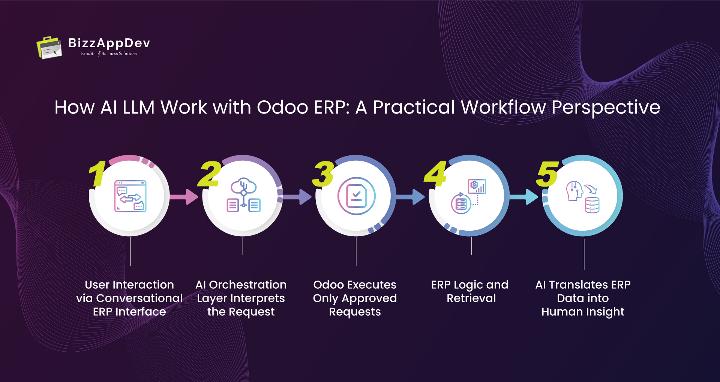
Step 1: User Interaction via Conversational ERP Interface
The workflow begins at the user interface.
Users interact with Odoo through a conversational layer such as a chat assistant, smart input field, or guided question panel embedded within the ERP.
Examples of user input include:
- “What are today’s sales figures?”
- “Which invoices are overdue?”
- “Is inventory running low this week?”
At this stage:
- The system captures intent, not system commands
- No workflows are executed
- No data is accessed
- The focus is purely on usability
This conversational ERP interface exists to simplify interaction and improve adoption, not to bypass ERP rules.
Step 2: AI Orchestration Layer Interprets the Request
Once captured, the request is passed to the AI orchestration layer, where the LLM operates.
A critical principle in how AI LLM work with Odoo ERP is separation of responsibility. The LLM does not connect to Odoo or the database. Instead, it functions as a reasoning engine.
At this stage, the LLM:
- Interprets the user’s intent
- Identifies required data types
- Breaks the request into logical steps
- Produces a structured execution plan
No data is read or written. No actions are taken. This design ensures AI intelligence supports understanding without gaining execution authority.
Understanding How AI LLM Work with Odoo ERP Using Governance Layers
Before any request reaches the ERP, it must pass through a Management and Control Plane (MCP).
This layer enforces security, compliance, and governance, ensuring AI does not become a shortcut around established ERP controls.
The MCP:
- Verifies user identity
- Enforces role-based access
- Applies organizational security policies
- Restricts data scope
- Blocks unauthorized operations
Only fully authorized and policy-compliant requests are allowed to proceed. Whether the request originates from a human user or AI interpretation, the same ERP rules apply.
Step 3: Odoo Executes Only Approved Requests
After validation, the MCP forwards the approved request to Odoo.
At this point:
- Odoo receives only clearly defined, authorized actions
- AI plays no role in execution
- Business logic remains unchanged
- Odoo retains full system authority
This preserves ERP sovereignty. AI improves how requests are formed and understood, but execution remains entirely within Odoo.
Step 4: ERP Logic and Data Retrieval
Odoo processes the request using its existing framework:
- Business rules
- Module-level constraints
- Workflow validations
Only after these checks does Odoo query the PostgreSQL database.
Key characteristics of this step include:
- Predictable performance
- Controlled write operations
- Accurate, factual data retrieval
- No AI interpretation at the data level
The database returns raw, verified data only.
Step 5: AI Translates ERP Data into Human Insight
The response follows the same governed path back to the orchestration layer.
Here, the LLM resumes its role, not as a decision-maker, but as an explainer.
The AI:
- Converts structured data into natural language
- Adds relevant business context
- Avoids assumptions or predictions
- Stays strictly within the provided data
For example:
“Today’s sales reached $128,450 across 342 completed orders.”
The result is clear, contextual, and grounded in trusted ERP data.
What This Model Enables for the Future of Odoo
This governed architecture defines the future of intelligent ERP.
As AI LLM work with Odoo ERP, conversational interfaces may become the primary way users interact with the system, reducing dependence on dashboards and static reports. ERP systems will feel less transactional and more advisory.
AI will also become more context-aware, connecting insights across sales, finance, inventory, and operations to surface trends or risks earlier. Teams will move from reactive reporting to proactive decision-making.
Rather than executing actions automatically, AI will recommend next steps, such as reviewing certain invoices or monitoring stock levels, while leaving final execution to users or approved workflows.
Over time, insights can be tailored by role, ensuring managers, analysts, and operational teams receive information aligned with their responsibilities and permissions.
Why This Governed Workflow Matters
This approach addresses the core challenge of AI-enabled ERP systems: gaining intelligence without losing control.
It ensures that:
- AI improves accessibility, not authority
- ERP rules and logic remain intact
- Security and compliance are preserved
- Users receive faster, safer insights
Instead of turning ERP into a black-box AI system, this model makes it more transparent, explainable, and trustworthy.
Final Thoughts
AI does not need to replace ERP systems to make them smarter. When designed correctly, AI listens, reasons, and explains, while execution remains firmly within Odoo.
By adopting an intent-driven, governed architecture, organizations can unlock the real value of AI LLM work with Odoo ERP: clearer insights, better decisions, and a more human ERP experience, without compromising trust, control, or reliability.
Build AI-Powered Odoo ERP Without Losing Control
Learn how a governed, orchestration-based LLM architecture delivers smarter insights, secure access, and explainable intelligence, while Odoo remains your system of record.