
AI is rapidly changing how businesses operate, but much of the conversation still focuses on chatbots, copilots, and generative AI tools. While these technologies are valuable, many organizations are now exploring a more practical application: AI Agents for ERP.
Unlike traditional automation tools that follow predefined rules, AI agents can understand context, access business data, and take actions across workflows. When connected to an ERP system, they can help automate repetitive processes, reduce operational bottlenecks, and support faster decision-making.
Rather than introducing another standalone tool, businesses are connecting AI agents to the workflows and data already managed inside their ERP systems. This allows teams to automate tasks, support operational decisions, and streamline processes without changing the way core business operations are managed.
Key Takeaways
- AI agents work alongside ERP systems rather than replacing them.
- They can automate repetitive processes across finance, procurement, inventory, and customer support.
- External AI agents connect to ERP data through APIs and integrations.
- Businesses typically achieve the best results by starting with a single high-impact workflow.
What Is an AI Agent?
An AI agent is software that can analyze information, make decisions based on predefined objectives, and perform tasks with minimal human intervention.
Unlike a traditional workflow automation tool that follows fixed instructions, an AI agent can evaluate context before acting.
For example:
- A rule-based workflow sends a reminder when an invoice becomes overdue.
- An AI agent can review payment history, prioritize high-risk accounts, draft personalized follow-up messages, and recommend the next action.
The goal is not simply automation. The goal is intelligent execution.
In a business environment, AI agents often work alongside existing systems such as ERP, CRM, accounting software, and collaboration platforms.
Within ERP-driven operations, AI agents use business data and workflow information to assist teams, automate routine activities, and support day-to-day decision-making.
AI Agents for ERP vs Traditional ERP Automation
Many businesses already use automation within their ERP workflows. However, traditional automation and AI agents solve different problems.
Traditional ERP Automation | AI Agents |
Follows fixed rules | Adapts to context |
Requires predefined workflows | Handles changing scenarios |
Executes tasks | Evaluates and recommends actions |
Works with structured inputs | Can process structured and unstructured data |
Reactive | More proactive |
The real value of AI agents is not that they automate more tasks. It is that they can handle workflows that require context, judgment, and adaptability.
Traditional automation remains effective for rule-based processes, while AI agents help businesses manage more dynamic workflows.
How AI Agents Integrate with ERP Systems
AI agents do not replace ERP systems.
Instead, they sit on top of existing ERP environments and interact with business data through integrations.
A typical workflow looks like this:
AI Agent → ERP Data → Analysis → Action
For example, an AI agent might:
- Retrieve inventory data from the ERP
- Analyze demand patterns
- Identify potential stock shortages
- Recommend replenishment actions
- Create a purchase request for approval
The ERP remains the source of truth, while the AI agent helps automate decision-making and execution.
Why Businesses Are Investing in AI Agents for ERP
Most organizations already have access to large amounts of ERP data.
The challenge is not collecting information. It is acting on it quickly enough.
This is where AI agents create value.
Businesses are exploring AI agents because they help turn ERP data into action faster:
- Reduce manual effort
- Improve workflow efficiency
- Accelerate operational decisions
- Surface hidden insights from ERP data
- Support teams without increasing headcount
- Improve consistency across business processes
As operational complexity increases, organizations are looking for ways to automate not just tasks, but also routine decisions.
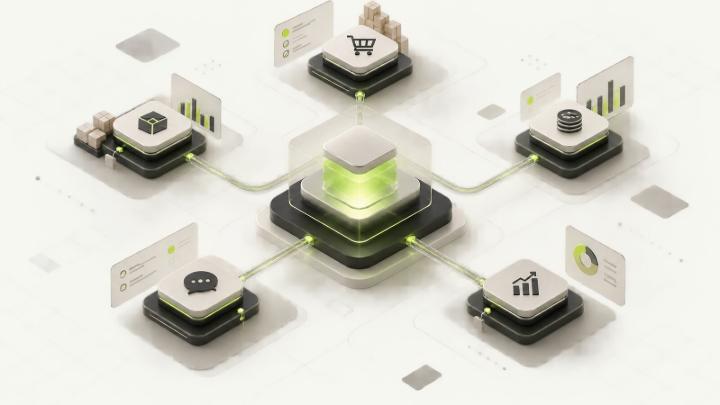
7 Real-World AI Agent Use Cases in ERP
1. Procurement Automation
Procurement teams often spend significant time reviewing inventory levels, supplier records, and purchasing requests.
An AI agent can continuously monitor ERP inventory data and identify when stock levels fall below predefined thresholds.
It can then:
- Recommend purchase quantities
- Compare approved suppliers
- Generate purchase requests
- Route requests through approval workflows
This reduces administrative effort while helping procurement teams respond faster to changing demand.
A distributor managing hundreds of SKUs can use an AI agent to identify products approaching reorder points and generate draft purchase requests before shortages occur.
2. Customer Support Assistance
Customer service teams frequently need access to order status, invoices, shipment details, and customer records.
An AI agent connected to ERP data can retrieve this information instantly and assist support teams with routine inquiries.
For example, when a customer asks about an order, the AI agent can:
- Access ERP order records
- Check shipment status
- Generate a response
- Escalate exceptions when necessary
Support teams spend less time searching for information and more time resolving customer issues.
3. Accounts Receivable Follow-Ups
Late payments are a common challenge for growing businesses.
Instead of manually reviewing outstanding invoices, AI agents can monitor receivables directly from ERP data.
They can:
- Identify overdue invoices
- Analyze payment behavior
- Prioritize collection efforts
- Generate personalized reminders
This helps finance teams improve cash flow while reducing repetitive administrative work.
A finance team can prioritize collection efforts based on customer payment history instead of reviewing every overdue invoice manually.
4. Inventory Management
Inventory management requires balancing customer demand, supplier lead times, and available stock.
AI agents can analyze ERP inventory records alongside forecasting models to identify potential risks before they become operational problems.
For example, an AI agent may:
- Detect unusual demand patterns
- Flag inventory shortages
- Recommend replenishment schedules
- Notify procurement teams proactively
This helps businesses maintain healthier inventory levels without relying solely on manual reviews.
5. Project Management Automation
Project-related information often becomes fragmented across meetings, emails, and ERP records.
AI agents can help bridge those gaps.
After a project meeting, an AI agent can:
- Generate summaries
- Identify action items
- Create tasks inside the ERP
- Assign responsibilities
- Track completion status
This reduces administrative overhead while improving project visibility.
6. Supplier Risk Monitoring
Supplier disruptions can affect production schedules, inventory availability, and customer commitments.
An AI agent can continuously monitor:
- Supplier performance records
- Delivery history
- Procurement data
- External risk signals
When potential issues are identified, the agent can notify procurement teams and recommend alternative suppliers or mitigation strategies.
This provides earlier visibility into supply chain risks.
7. Executive Reporting and Business Insights
Executives often rely on multiple reports before making operational decisions.
Business leaders no longer need to wait for multiple reports to understand what is happening across the organization.
AI agents can retrieve information directly from ERP systems and present it in a conversational format.
Business leaders can ask questions such as:
- Which products generated the highest profit this quarter?
- What inventory is at risk of stockout?
- Which customers have overdue invoices?
- What operational bottlenecks require attention?
Instead of waiting for reports, decision-makers receive immediate answers based on ERP data.
What Businesses Need Before Implementing AI Agents
Not every organization is ready for AI agents.
Successful implementation typically depends on three factors.
Reliable ERP Data
AI agents are only as effective as the information they can access.
Incomplete or inconsistent ERP records can limit their accuracy and effectiveness.
Integration Readiness
Businesses should ensure their ERP system can securely exchange data with other applications and services.
This is particularly important for organizations planning ERP AI integration projects.
Clearly Defined Processes
AI agents work best when they support well-understood workflows.
Organizations should identify repetitive, high-volume processes before introducing AI-driven automation.
Common Misconceptions About AI Agents
AI Agents Will Replace ERP Systems
No.
ERP systems remain essential for managing business data, transactions, and operational processes.
AI agents help teams act on ERP data faster by reducing the manual work required to review information, make routine decisions, and trigger actions.
AI Agents Are Just Chatbots
Not necessarily.
Chatbots primarily answer questions.
AI agents can analyze information, make recommendations, and trigger actions across business workflows.
AI Agents Work Without Human Oversight
In most business environments, human review remains important.
AI agents are designed to assist teams, not eliminate accountability.
Final Thoughts
AI agents are not replacing ERP systems. They are helping businesses get more value from them.
From procurement and inventory management to customer support and executive reporting, AI Agents for ERP can automate routine work, support faster decisions, and reduce operational bottlenecks.
The most successful implementations start with a specific business problem—whether that's managing inventory more effectively, improving collections, streamlining procurement, or giving leadership faster access to insights. The technology matters, but the real value comes from solving operational challenges that impact day-to-day performance.
As AI technology continues to evolve, businesses that combine reliable ERP data with intelligent automation will be better positioned to improve efficiency, adapt to change, and scale with confidence.
The best AI projects start with a single business challenge.
Identify one process that consumes time, creates delays, or depends on repetitive decisions, and start there.
FAQs
AI agents connect to ERP systems through APIs, middleware, or custom integrations. They access ERP data, analyze information, and perform actions such as creating records, generating recommendations, or triggering workflows based on predefined objectives.
The best starting points are processes that involve repetitive tasks, large volumes of data, or frequent decision-making. Common examples include procurement, inventory management, accounts receivable, customer support, and executive reporting.
Most modern ERP systems can support AI integrations through APIs, middleware, or custom development.
No. Workflow automation follows predefined rules, while AI agents can evaluate context and adapt their actions.
Finance, procurement, customer support, and inventory management are often strong starting points because they involve repetitive tasks and large volumes of ERP data.