
Businesses today generate massive volumes of operational data. However, many organizations still struggle to convert that data into clear, actionable decisions. This is where AI & LLM integration in Odoo ERP is transforming how modern enterprises operate.
By combining the flexibility of Odoo with advanced artificial intelligence technologies, including machine learning, predictive analytics, and large language models (LLMs), companies can automate workflows, analyze information in real time, and interact with their ERP system using natural language.
In 2026, AI-powered Odoo ERP systems are no longer experimental. They are becoming a strategic investment for organizations seeking intelligent automation, smarter forecasting, and scalable operational efficiency, often beginning with professional Odoo ERP implementation services to ensure a scalable foundation.
Industry research consistently shows that AI-driven automation reduces repetitive operational workload while improving decision speed and forecasting accuracy. This shift toward intelligent systems explains the rapid adoption of AI-enabled ERP platforms across industries.
This guide explores 10 practical ways AI & LLM integration in Odoo ERP is transforming businesses, along with implementation insights and real-world applications.
What Is AI & LLM Integration in Odoo ERP?
AI & LLM integration in Odoo ERP refers to embedding artificial intelligence and large language models into Odoo modules such as CRM, inventory, finance, and operations to automate workflows, generate predictive insights, and enable conversational data interaction.
Instead of relying solely on manual dashboards and static reports, intelligent Odoo ERP systems can:
- Understand natural language business queries
- Analyze large datasets instantly
- Automate repetitive tasks
- Generate executive-ready summaries
- Predict sales, inventory, and financial trends
In simple terms, AI adds an intelligence layer that transforms Odoo from a record-keeping tool into a smart, data-driven business platform, often supported by specialized AI integration services to align automation with business goals.
Key Capabilities Enabled by AI & LLM Integration in Odoo ERP
When businesses implement AI & LLM integration in Odoo ERP, they unlock advanced capabilities that enhance automation, analytics, and decision-making across departments.
Modern AI-driven ERP environments enable:
- Conversational ERP queries using LLMs
- Predictive analytics and forecasting
- Automated reporting with executive summaries
- Smart inventory optimization
- AI chatbots connected to live ERP data
- Intelligent sales and financial insights
These capabilities highlight how AI & LLM integration in Odoo ERP transforms traditional enterprise systems into intelligent, data-driven business platforms.
Why Businesses Are Investing in AI-Driven ERP Automation
Odoo already provides a modular system covering CRM, accounting, sales, HR, inventory, and operations. However, traditional ERP usage often involves:
- Manual reporting
- Repetitive data entry
- Reactive decision-making
- Time-consuming analysis
AI & LLM integration enhances ERP systems by introducing:
- Faster decision-making through predictive ERP analytics
- Automated workflow orchestration
- Intelligent data interpretation
- Improved user experience via conversational interfaces
Organizations implementing intelligent Odoo ERP platforms report improved operational efficiency, reduced human error, and better cross-departmental alignment, particularly when tailored through structured Odoo customization services.
How AI & LLM Integration Works Inside Odoo ERP
AI models and LLM-based systems connect to Odoo modules via APIs or custom integrations. Once connected, they:
- Analyze structured ERP datasets
- Detect operational patterns
- Identify inefficiencies
- Generate predictive forecasts
- Provide conversational responses to user queries
For example, instead of manually building a sales report, a manager can ask:
“Which products generated the highest margin this quarter?”
The system interprets the request, analyzes financial and sales data, and delivers a summarized insight instantly.
This shift from dashboard navigation to conversational ERP interaction is one of the most powerful transformations in 2026, often enabled through advanced Odoo development services for seamless integration.
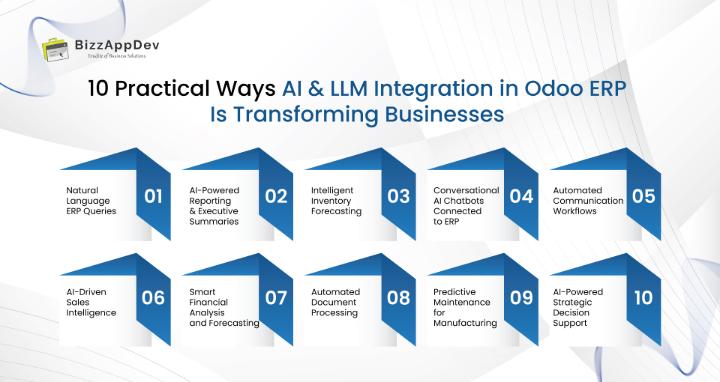
10 Practical Ways AI & LLM Integration in Odoo ERP Is Transforming Businesses
1. Natural Language ERP Queries
Large language model integration enables conversational access to business data.
Users can ask:
- “What were our top-performing products last month?”
- “Which customers have overdue payments?”
- “What items are below reorder level?”
The system retrieves structured insights instantly.
Impact:
- Faster access to critical data
- Reduced dependency on technical teams
- Increased executive productivity
2. AI-Powered Reporting and Executive Summaries
Instead of manually interpreting spreadsheets, AI-powered Odoo ERP systems:
- Summarize financial performance
- Detect revenue trends
- Highlight operational bottlenecks
- Generate plain-language executive summaries
This improves clarity and reduces decision-making delays.
3. Intelligent Inventory Forecasting
AI-driven ERP analytics analyze:
- Historical sales data
- Seasonal demand patterns
- Supplier lead times
- Customer purchasing behavior
Using predictive modeling, businesses can optimize procurement and reduce stock imbalances.
Results include:
- Lower stockouts
- Reduced excess inventory
- Optimized supply chain operations
4. Conversational AI Chatbots Connected to ERP
AI chatbots integrated with Odoo ERP provide real-time responses for:
- Order tracking
- Delivery timelines
- Product availability
- Invoice details
Because responses are pulled from live ERP data, accuracy remains high while reducing customer support workload.
5. Automated Communication Workflows
AI-powered ERP automation generates:
- Personalized email campaigns
- Lead follow-ups
- Payment reminders
- Service notifications
This ensures consistent communication while freeing up sales and support teams.
6. AI-Driven Sales Intelligence
By analyzing CRM data, AI can identify:
- High-value prospects
- Buying behavior patterns
- Upsell and cross-sell opportunities
- Churn risk indicators
Sales teams can prioritize intelligently, increasing conversion rates and revenue predictability.
7. Smart Financial Analysis and Forecasting
AI enhances financial management through:
- Automated expense categorization
- Cash flow forecasting
- Anomaly detection
- Real-time performance dashboards
This strengthens financial visibility and reduces manual accounting effort.
8. Automated Document Processing
AI-powered document intelligence extracts data from:
- Invoices
- Receipts
- Purchase orders
- Contracts
The system automatically updates ERP records, minimizing errors and accelerating data processing.
9. Predictive Maintenance for Manufacturing
Manufacturers using Odoo can leverage predictive models to analyze equipment usage and maintenance logs.
AI predicts when machines require servicing, enabling preventive action.
Benefits:
- Reduced downtime
- Fewer unexpected breakdowns
- Extended equipment lifespan
10. AI-Powered Strategic Decision Support
The most transformative advantage of AI & LLM integration is strategic intelligence.
By analyzing cross-functional ERP data, AI can recommend:
- Pricing adjustments
- Procurement timing strategies
- Sales planning optimization
- Inventory rebalancing
Odoo ERP evolves from a transaction system into an intelligent decision-support engine.
Practical Applications Across Industries
AI & LLM integration in Odoo ERP delivers measurable results across sectors:
Retail: Demand forecasting improves inventory turnover.
Manufacturing: Predictive maintenance reduces downtime.
E-commerce: Conversational AI enhances customer experience.
Service Businesses: CRM automation increases client retention.
Finance Teams: Automated reporting improves compliance and forecasting accuracy.
This demonstrates how intelligent ERP systems create operational resilience and data-driven growth.
How to Integrate AI & LLM with Odoo ERP
Successful integration typically follows five structured steps:
Step 1: Identify Automation Opportunities
Audit repetitive or data-heavy workflows.
Step 2: Prepare Structured ERP Data
Clean, organized data improves AI model accuracy.
Step 3: Integrate AI Models & LLM APIs
Connect AI systems to CRM, inventory, finance, and operations modules.
Step 4: Customize Intelligent Workflows
Align AI automation with specific business objectives.
Step 5: Train Teams and Monitor Performance
Ensure adoption while continuously optimizing performance.
Strategic implementation ensures long-term ROI and sustainable transformation.
Key Benefits of AI & LLM Integration in Odoo ERP
Organizations adopting intelligent ERP automation experience:
- Faster business insights
- Reduced operational workload
- Improved forecasting accuracy
- Smarter inventory planning
- Enhanced customer support
- Data-driven strategic decisions
These benefits explain why AI-powered Odoo ERP systems are becoming a competitive necessity in 2026.
Conclusion
Enterprise software is rapidly shifting toward intelligent automation, and AI & LLM integration in Odoo ERP is leading this transformation.
By combining Odoo’s modular flexibility with machine learning, predictive analytics, and conversational AI, businesses can unlock:
- Operational efficiency
- Smarter forecasting
- Real-time insights
- Scalable automation
In 2026 and beyond, organizations that embrace AI-driven ERP automation will gain a measurable competitive advantage through faster execution, deeper insights, and more informed decision-making.
Ready to transform your Odoo ERP with AI & LLM integration?
Connect with our experts to design smarter workflows and unlock real-time, data-driven decision intelligence for your business.
FAQs
AI & LLM integration in Odoo ERP involves embedding artificial intelligence and large language models into ERP modules like CRM, inventory, and finance. This enables automation, predictive analytics, and natural language queries, helping businesses make faster, data-driven decisions while reducing manual effort.
AI enhances decision-making by analyzing large datasets in real time, identifying trends, and generating actionable insights. It provides predictive forecasts, automated reports, and intelligent recommendations, allowing managers to respond proactively instead of relying on delayed, manual analysis.
Key benefits include improved operational efficiency, reduced manual workload, better forecasting accuracy, smarter inventory management, and enhanced customer experience. AI also enables automation and real-time insights, helping businesses scale faster and make more strategic decisions.
Yes, AI-powered Odoo ERP is scalable and suitable for small businesses. It helps automate repetitive tasks, improve customer engagement, and provide affordable insights without requiring large teams, making it a practical solution for growing companies.
Successful implementation involves identifying automation opportunities, preparing clean data, integrating AI tools via APIs, customizing workflows, and training teams. Partnering with experienced Odoo and AI integration experts like BizzAppDev Systems ensures smooth deployment and long-term performance optimization.